
Home Buying Mistakes to Avoid
Learn home buying mistakes to avoid, including budgeting, inspections, and mortgage tips to make your purchase smoother and cost-effective.
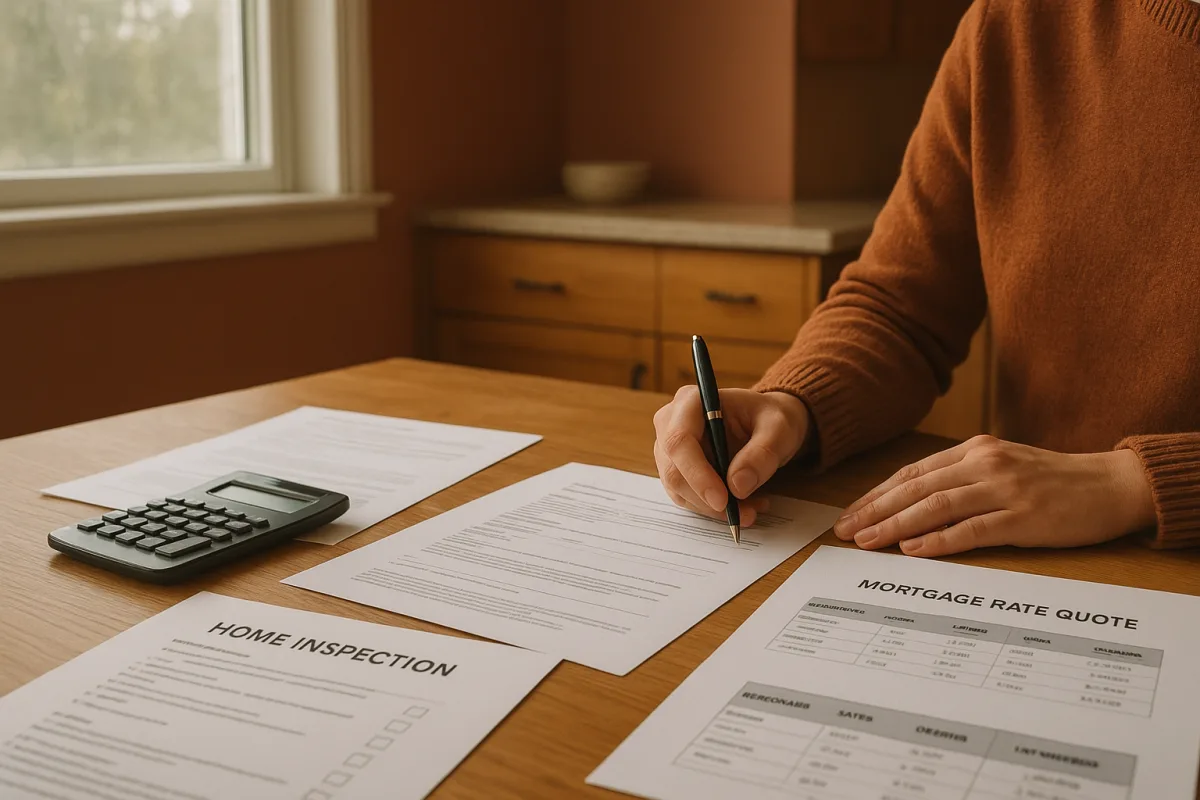
The home-buying number that matters: cash to close
One of the most expensive first-time buyer mistakes is not necessarily choosing the wrong house. It is using the down payment as the entire budget, then discovering that several other bills must be paid before the keys change hands.
“Cash to close” is the useful number because it combines the money needed to complete the purchase. It generally includes your down payment, closing costs, prepaid property taxes and homeowners insurance, plus any inspection costs paid earlier in the process. [9]
That number is different from the house price and different from the mortgage amount. A buyer can qualify for a loan with a low down payment, yet still need thousands of dollars beyond that down payment before closing.
The right cash-to-close target depends on the loan program, purchase price, local tax and insurance costs, seller concessions if any, and the condition of the property. It also depends on whether you qualify for assistance. There is no responsible single percentage for every buyer.
I am not a licensed real estate agent, lender, or financial adviser. This is an explanation of the mechanics buyers should understand before relying on a loan estimate, lender quote, or contract deadline.
Start with the down payment, but do not stop there
The down payment is the portion of the purchase price you pay directly rather than finance. On a $350,000 home, a 20% down payment would be $70,000, leaving a $280,000 mortgage before financed fees.
That is a large amount of money, but 20% is not a rule for every first-time buyer. Conventional loans can be available with 3% down, FHA loans commonly require 3.5% down, and eligible veterans can use VA financing with 0% down. [7]
Using the same $350,000 example, 3% down equals $10,500. A 3.5% FHA down payment equals $12,250. Those figures are materially lower than $70,000, which is why the “you must save 20%” rule can keep people from researching programs they may actually qualify for.
A smaller down payment does not mean the house costs less. It means more of the purchase price is financed, which generally produces a larger loan balance and monthly principal-and-interest payment. Conventional borrowers putting down less than 20% may also pay private mortgage insurance, commonly called PMI.
PMI is not a closing-cost substitute and should not be ignored when comparing loan offers. The actual cost varies by borrower and loan, so a buyer should look at the monthly payment and the loan estimate rather than assume a 3% down loan is automatically cheaper overall.
Then add closing costs, which are separate from the down payment
Closing costs are the fees and prepaid items required to originate the loan and transfer ownership. They typically run about 2% to 5% of the purchase price, although the precise amount depends heavily on the property, lender, state, and insurance and tax bills due at closing. [9]
On a $350,000 purchase, 2% is $7,000 and 5% is $17,500. That is the range a first-time buyer should put into an early estimate, not a promise of what any specific transaction will cost.
For a buyer using 3% down on that $350,000 home, the basic arithmetic looks like this:
- Down payment: $10,500
- Estimated closing costs: $7,000 to $17,500
- Estimated cash needed before inspection and moving expenses: $17,500 to $28,000
That example is intentionally simple. It does not include moving, immediate repairs, furniture, utility deposits, or a reserve for emergencies. It also does not assume any seller credit or down payment assistance.
Closing costs can include lender charges, title-related charges, escrow or settlement fees, and prepaid homeowners insurance and property taxes. [9] Some of these pay for services connected to the mortgage. Others fund bills that will come due soon after the buyer owns the home.
This distinction matters because a lender may advertise a low down payment, but the buyer still needs funds for the transaction itself. A pre-approval can establish a borrowing range, but it does not eliminate the need to read the estimated cash-to-close figure.
What “no-closing-cost” really means
Some lenders offer what is often called a no-closing-cost mortgage. That phrase can be misleading if it sounds like the costs disappeared. In many cases, the lender offsets upfront fees by charging a higher interest rate or incorporating costs into the loan structure. [9]
The comparison is therefore not simply “pay fees” versus “pay nothing.” It is often “pay more now” versus “pay a higher rate, or borrow more, over time.” Which option costs less depends on the actual rate increase, loan amount, and how long the borrower keeps that mortgage.
That is why the loan estimate matters more than the label. A buyer comparing offers should look at the interest rate, lender fees, credits, estimated cash to close, monthly payment, and the total amount financed.
At an average 30-year fixed rate of 6.71%, reported in September 2026, rate shopping is not a minor administrative task. [2] A difference of even a fraction of a percentage point can change the payment for years.
For illustration only, a $339,500 30-year fixed mortgage, representing a $350,000 purchase with 3% down, has principal and interest of roughly $2,190 per month at 6.71%. That estimate excludes PMI, property taxes, homeowners insurance, and any HOA dues.
The number is not a quote and should not be used to judge affordability. It shows why buyers should compare complete loan terms, not merely ask whether a lender can approve them.
Assistance can change the upfront equation
Down payment assistance is another reason not to assume that the cash-to-close number must come entirely from savings. Research cited in the brief identifies about 2,624 assistance programs nationwide, with an average benefit near $18,000. [21]
Those programs can take different forms, including grants, forgivable loans, deferred-payment loans, and second mortgages. Eligibility can depend on income, household size, location, occupation, credit, purchase price, or whether the buyer is a first-time buyer under the program’s definition.
North Carolina, for example, has been cited as offering a $15,000 forgivable loan program for qualifying buyers. [21] That does not mean every North Carolina buyer qualifies, or that an equally generous program is available in every county.
The practical mistake is not failing to use every program. Many programs will not fit a particular buyer. The mistake is assuming assistance does not exist before asking a lender, housing agency, or program administrator what is available locally.
Buyers should also ask whether assistance affects the timeline or adds documentation requirements. A program can improve the upfront math while making the financing process more detailed, which matters when a contract has strict financing and closing deadlines.
Inspections protect the budget after closing
Cash to close gets you ownership. It does not guarantee that the home will be inexpensive to own during the first year. That is where the inspection fits into the same financial system.
A standard home inspection commonly costs $300 to $600, with specialized checks such as radon, termite, sewer-scope, or mold inspections adding roughly $75 to $400 each. [14] The right add-ons depend on the property and region, not on a universal checklist.
Skipping an inspection can make an offer appear cleaner in a competitive market, but it shifts more uncertainty to the buyer. Redfin cites average first-year repair costs of about $14,000 for homebuyers, a reminder that a few hundred dollars spent investigating a property can be financially meaningful. [13]
An inspection is not a warranty and cannot identify every future repair. Its purpose is to provide information before a buyer’s contingencies expire, when the buyer may still be able to negotiate, request repairs, seek a credit, or walk away under the contract terms.
The financial question is not whether every inspected house will reveal a deal-breaking defect. It is whether you can afford to discover a roof, foundation, sewer, electrical, or moisture problem only after closing, when the repair bill is yours.
Timing keeps the numbers usable
A cash-to-close plan works best when started before house hunting. Buyers who start with listings rather than financing may become attached to a home before they know whether their income, debt, cash, and credit support the purchase.
The recommended timeline in the research brief starts with pre-approval, which can take 24 to 72 hours. The search and offer phase may take one to two months, followed by 30 to 45 days from contract to closing. [17]
That means a typical path from pre-approval to closing may run roughly three to six months. [18] The range is important because inspections, lender underwriting, appraisal, assistance-program paperwork, and title work do not move at exactly the same pace.
A major purchase before closing can disrupt this system. Taking on a car payment, opening new credit, or changing jobs can alter debt-to-income calculations or require additional lender review. The safer assumption is that financing remains subject to verification until closing is complete.
Local conditions change the answer
The same $350,000 illustration has different meaning in different markets. High-cost areas such as Miami and the San Francisco Bay Area present higher entry barriers, while markets including Jacksonville and Birmingham have been described as more favorable to first-time buyers. [1] [19]
Local conditions affect the available housing, insurance costs, taxes, inspection pricing, and the likelihood that buyers feel pressure to waive contingencies. They also affect whether a buyer can reasonably retain money after closing for repairs and routine ownership costs.
That is why avoiding home-buying mistakes is less about following a universal savings percentage than doing complete math before making an offer. Know the down payment, estimated closing costs, inspection budget, monthly payment components, and reserve you expect to have left afterward.
A low-down-payment loan, assistance program, or lender credit may be useful in the right circumstances. Whether it fits depends on your quoted rate, loan terms, local market, eligibility, property condition, and timeline.
Frequently Asked Questions
What are the most common home buying mistakes to avoid?
Common mistakes include not obtaining mortgage pre-approval before house hunting, skipping home inspections, underestimating total homeownership costs, not shopping around for mortgage rates, neglecting closing costs, and overextending financially. Buyers also often overlook researching neighborhoods, ignore real estate agent assistance, and fail to consider future resale value.
How can I budget correctly to avoid home buying mistakes?
Budgeting should start with the down payment but must include closing costs, prepaid taxes and insurance, and inspection fees. Closing costs typically range from 2% to 5% of the purchase price, so buyers should plan for these additional expenses beyond the down payment. It is important to consider the full "cash to close" amount rather than just the down payment.
Why is it important to consider closing costs when buying a home?
Closing costs cover fees for loan origination, title services, escrow, prepaid property taxes, and homeowners insurance, which can add 2% to 5% of the purchase price to your upfront expenses. Ignoring these costs can lead to underestimating the total cash needed to complete the purchase, causing financial surprises at closing.
How do mortgage rates affect home buying mistakes?
Mortgage rates directly influence monthly payments and overall affordability. Since rates can vary, getting multiple mortgage quotes is essential to avoid overpaying. For example, the average 30-year fixed rate was 6.71% in September 2026, so even small differences in rates can significantly impact long-term costs.
What should first-time buyers know to avoid costly errors?
First-time buyers should know that a 20% down payment is not always required; loans with as little as 3% down or even 0% down for eligible veterans are available. They should always get pre-approved, budget for closing costs and inspections, and avoid skipping important steps like home inspections to prevent unexpected repair expenses averaging around $14,000 in the first year.
How we researched this
This article was assembled from 23 cited references.
Nothing here is based on hands-on testing. Where a figure or finding appears, it belongs to the source cited beside it, and the writing says so rather than implying otherwise. Every source is listed below so you can check it.
Sources
- South Florida's would-be young homebuyers are living with their parents
- Mortgage rates rise, bringing the average rate on a 30-year home loan to where it was 4 weeks ago
- 7 First-Time Home Buyer Mistakes to Avoid
- Mistakes to Avoid When Buying a House | Opendoor
- Mistakes First-Time Home Buyers Commonly Make
- 10 First-Time Homebuyer Mistakes To Avoid | Bankrate
- First-time home buyer mistakes to avoid | Rocket Mortgage
- 10 Costly First-Time Home Buyer Mistakes (and How to Avoid Them in 2026) - The Saward Team
- How Much Are Closing Costs?
- First-Time Homebuyer: All Costs Explained (2026) | HomeCostLab
- First Time Home Buyer Closing Costs Explained | Mortgage-World
- First-Time Home Buyer Guide 2026 | HomeAffordabilityCalc.info
- Home Inspection Cost: A Fee That Could Save You Thousands | Redfin
- How Much Does a Home Inspection Cost? Averages and Add-Ons - LegalClarity
- Home Inspection Costs — What Every Inspection Type Costs in 2026 — ProFindr
- How Much Does a Home Inspection Cost? (2026 Price Guide) | Learn | Dwely.ai
- The First-Time Homebuyer's Timeline — Corie Adams Lending Team
- 2026 First-Time Home Buyer Mistakes (And How to Avoid Them) - InterWest Mortgage
- Zillow’s Best Markets for First-Time Home Buyers in 2026 - Zillow Research
- 14 First-Time Homebuyer Mistakes to Avoid | Chase
- First-Time Home Buyer Programs & Down Payment Assistance (2026)
- Down Payment 2026: How Much You Actually Need for a Home | SwitchWize
- Don't Regret Buying a Home: An Expert Guide to Navigating Today's Tough Housing Market
Related Articles
Affordable Neighborhoods for First Time Home Buyers in 2026
Explore affordable neighborhoods for first time home buyers with insights on monthly costs, taxes, insurance, and financing in 2026.

How to Create a Home Buying Budget: Step-by-Step Guide
Learn how to create a home buying budget including down payment, closing costs, monthly expenses, and credit tips for a smooth purchase.
Best Time to Buy a House in 2026
Discover the best time to buy a house in 2026 with insights on seasonal trends, mortgage rates, and market conditions to help you plan your purchase.
Documents Needed to Buy a House: Complete Checklist
Learn the essential documents needed to buy a house, including financial, identification, and mortgage paperwork to ensure a smooth home purchase.