
Improve Curb Appeal on a Budget
Learn how to improve curb appeal on a budget with practical, affordable tips to boost your home's exterior before selling.
Start with the listing date, not the shopping list
Sellers often begin with the enjoyable projects, such as new planters or lighting. The first practical problem is timing. If spring is your intended selling season, Kiplinger recommends beginning curb-appeal work four to six weeks before listing. [10]
That window matters because small jobs accumulate. Mowing and edging can take 30 minutes to an hour, but planting beds may take several days depending on their size. A two-story exterior can require two to five hours to power wash. [3]
Early spring is often the strongest period for buyer attention, although the exact timing is local. Axios reported that San Diego’s market can favor mid-March preparation, while broader national spring timing may be later. [1]
Work backward from photography, showings and any contractor availability. The goal is not to finish every imaginable exterior upgrade. It is to make the home look maintained when buyers first see the listing photos and arrive at the sidewalk.
Before spending, walk from the street to the front door and write down only what a buyer can see. Include weeds in pavement cracks, stained concrete, chipped paint, clutter, faded numbers, dead plants and a neglected mailbox.
This is a selling-preparation guide, not financial, lending or real-estate advice. I am not a licensed agent, lender or advisor. The right scope depends on your market, property condition, available cash and timeline.
Clear the things that make the house look unfinished
The cheapest correction is often subtraction. The Dailey House identifies visible hoses, bikes and bags of mulch as distractions, while Inkl flags unmaintained walkways and driveways as curb-appeal problems that can make a home harder to sell. [13][14]
Remove tools, spare pots, lawn equipment and temporary storage before photographs and every showing. Coil hoses out of sight. Pull weeds from driveway and walkway joints. This work does not create a new feature, but it stops buyers from reading disorder as deferred maintenance.
Avoid replacing clutter with decoration. Inkl specifically cautions against excessive ornaments and bright planters that pull attention away from the house itself. [14] One restrained pair of containers at the entry is different from a porch crowded with seasonal objects.
Look at the driveway as a functional surface, not a renovation opportunity. Remove weeds and stains first. If cracks are present, this research supports cleaning and weed removal, not an unsupported claim that resurfacing will necessarily pay back before a sale. [14]
Wash grime before deciding that anything needs replacement
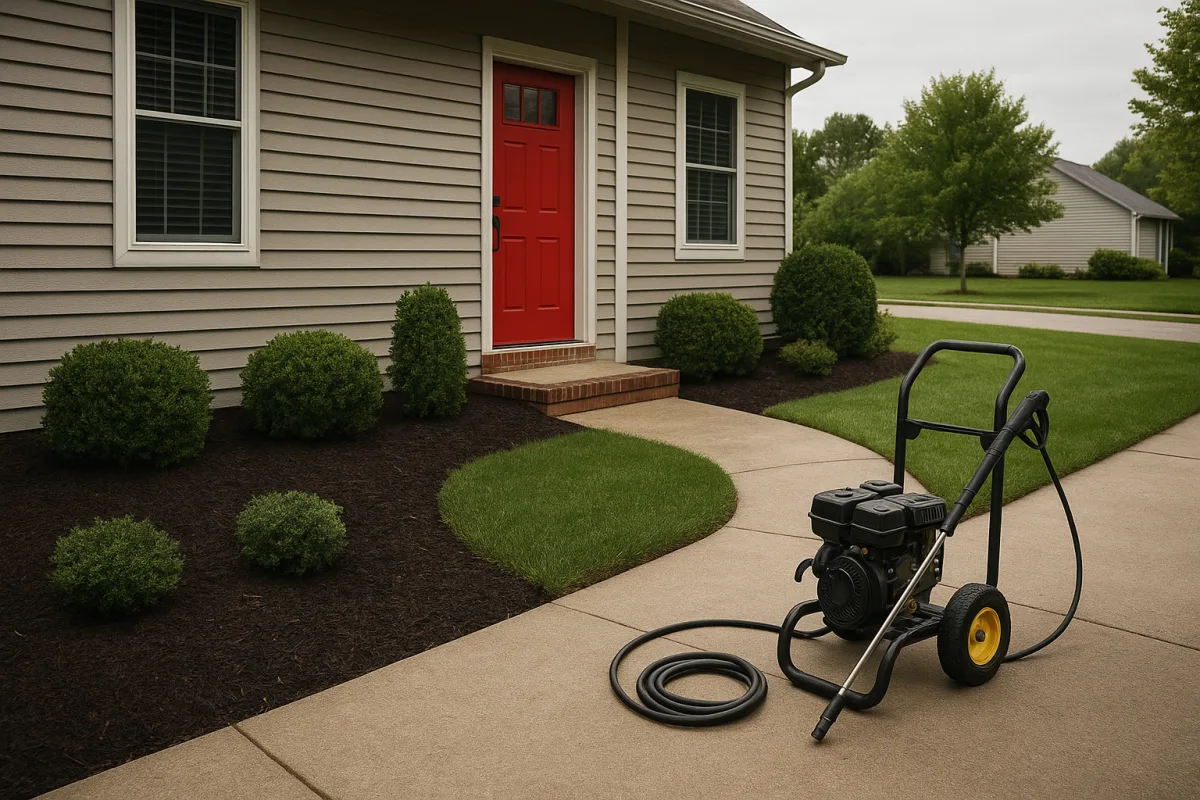
Dirt can make siding, concrete, steps and fencing look worn before they actually are. HouseLogic puts a DIY pressure-washer rental at roughly $40 to $100 a day, compared with about $100 to $300 for professional pressure washing. [3]
The decision is partly about time and comfort using the equipment. A two-car driveway commonly takes 30 minutes to two hours to wash, while a two-story house exterior can take two to five hours. [3]
Do not assume a rental is the complete cost. The research also gives a broader DIY pressure-washing range of $200 to $500, which may reflect supplies and project scale beyond a single daily rental. [5] Price the actual scope before committing.
Published ROI claims also vary. Curbgrade estimates a roughly 210% return for DIY pressure washing, while HomeEstimates lists pressure washing above 500% among spring improvements. [5][11] Those are estimates from different publishers, not a guaranteed addition to your contract price.
For a seller on a tight budget, washing is useful because it lets you judge the real condition afterward. You may find that the driveway, stoop or siding needs cleaning, not replacement. That is a material distinction in a pre-listing budget.
Fix the front door before replacing it
Once the entrance is clean, assess the door at close range. Chipped or faded paint is a visible problem, and The Dailey House estimates a repaint at about $35 to $50. Yardcast places materials for painting a front door around $30 to $60. [13][2]
Choose a color that works with the fixed elements you are keeping, including brick, siding, roof and stone. Yardcast identifies deep red, navy, sage green and black as options, while Homes and Gardens reports current interest in nature-linked shades such as sage, olive, terracotta and warm stone. [2]
The key is coordination, not trend-chasing. Homes and Gardens warns that stark white or mismatched exterior colors can work against the overall appearance. [12] If the home has an established neutral palette, a compatible darker door may be safer than a dramatic mismatch.
If paint cannot correct peeling, damage or a failing door, then compare refinishing with replacement. BlueprintKit puts refinishing at $150 to $400 and says it achieves much of the visual effect, while replacement ranges from $300 to $2,500. [6]
BlueprintKit reports front-door replacement ROI above 100%, but that figure should not be treated as money automatically recovered at closing. [6] A seller’s proceeds still depend on sale price, concessions, brokerage costs, taxes and the local market’s reaction.
For a limited budget, the decision tree is straightforward. Paint a serviceable door. Refinish one whose surface condition is the problem. Consider replacement only when the door’s condition is visibly beyond those fixes or conflicts with the property’s overall presentation.
Make the yard look maintained, not newly expensive
After cleaning the hard surfaces and entry, buyers will notice overgrown shrubs, bare beds and thin lawn edges. Opendoor specifically identifies overgrown landscaping and weeds as pre-sale fixes, and estimates fresh mulch at $3 to $5 per bag. [15]
Apply mulch in a two- to three-inch layer, the depth HouseLogic recommends. [3] This is a one-day project at a modest scale, but measure the beds before buying bags so your inexpensive refresh does not turn into repeated store runs.
Prune shrubs away from windows, paths and house numbers, then remove dead material before adding anything new. Mulch should frame the planting bed, not bury every problem. Fresh material cannot compensate for weeds, broken edging or plants that have outgrown the space.
Plant only where the bed looks genuinely sparse. For moderate U.S. climate zones 6 through 8, Bob Vila identifies hydrangeas, azaleas, Russian sage and lavender as curb-appeal choices. [7] Choose plants suited to the property’s actual climate and light exposure.
For colder zones 3 through 5, the research names Siberian iris, Karl Foerster feather reed grass, prairie dropseed and rugosa roses. For warm zones 9 through 11, options include lamb’s ears, olive trees, geraniums and salvias. [19]
If you want a lower-maintenance approach across regions, Homes and Gardens points to native perennials including black-eyed Susan, coneflower, verbena, blazing star and blue grama grass. [9] Native or climate-suited planting is less likely to look stressed during the listing period.
Know where the budget jumps. Return on Reno estimates a light professional landscaping refresh at $3,000 to $5,000, a standard package at $6,000 to $10,000, and a fuller landscape at $10,000 to $15,000. [4]
Those packages can be appropriate for a property with substantial exterior deficiencies, but they are not the default answer for every seller. Hardscaping, irrigation, retaining walls and paths can push the range to $15,000 to $25,000 or more. [4]
That is why mulch, pruning, edging and selective planting come first. They address what buyers see immediately without committing to improvements that may not fit your price point, neighborhood norms or time before listing.
Make the address and path easy to read
Now correct the details buyers use to find the home. HouseLogic recommends updating house numbers and the mailbox as quick, low-cost curb-appeal changes. [3] These are especially practical when old numbers are faded, too small or obscured by planting.
Curbgrade estimates a combined new house numbers, mailbox and porch light project at $180 to $400, with an estimated 145% ROI. [5] That range is more useful as a budget allowance than as a prediction of resale proceeds.
Install numbers where they can be read from the street and in low light. Before buying a new mailbox, check local placement rules and whether the existing post, door and flag are still functional. Replace only the visibly tired component if that solves the problem.
Solar pathway lights are a lower-cost alternative to a wired lighting project. HouseLogic says solar path lights can cost under $100 and are easy to install. [3] Use them to clarify the walk, not to turn the front yard into a lighting display.
This distinction can save substantial money. Professionally priced path lights run about $100 to $250 per fixture, with project totals of $700 to $2,000, according to the 2026 lighting ranges in the research brief. Avoid assuming a few solar lights require that scope.
Livingetc cautions that bright spotlights can feel excessive and intrude on neighbors. [12] For a seller, subtle path lighting and a functioning porch light usually solve the practical question: can an evening visitor see the route and the entry?
Set a budget ceiling before upgrades turn into a remodel
A lean plan can combine a $30 to $60 door-paint materials budget, a $40 to $100 pressure-washer day rental, mulch at $3 to $5 per bag and solar lights under $100. [2][3][15]
That is fundamentally different from approving a full exterior paint job. Curbgrade estimates exterior painting at $4,500 to $9,000, with a roughly 78% ROI estimate. [5] It may be warranted for failing paint, but it is not a budget substitute for washing.
Similarly, do not replace a front door merely because replacements can start around $300. The cited replacement range reaches $2,500, and it does not necessarily include installation, hardware changes or related trim work. [6]
Keep a separate contingency for small discoveries, such as a broken address plaque, missing porch-light bulb or additional mulch. This is not the same as setting aside funds for major repairs. It prevents a modest plan from stalling over minor omissions.
Finally, take listing photographs only after the project is complete and maintain the result through showings. Mow, edge, sweep the entry, remove fresh weeds and keep the path clear. The inexpensive work pays off visually only while it stays tidy.
Frequently Asked Questions
How can I improve curb appeal on a tight budget?
Focus on small, cost-effective projects such as repainting the front door (materials cost about $30 to $60), refreshing landscaping with mulch, updating house numbers and mailbox, and pressure washing exterior surfaces using a DIY rental ($40 to $100 per day). Removing clutter and weeds from visible areas also makes a noticeable difference without major expense.
What are cost-effective ways to boost curb appeal before selling?
Start with cleaning and maintenance tasks like power washing siding and walkways, tidying planting beds, and repainting the front door. Adding a few climate-appropriate plants and fresh mulch can improve appearance without a large investment. Solar pathway lights under $100 can also enhance curb appeal affordably.
How much does it cost to improve curb appeal affordably?
Affordable curb appeal improvements can range from about $30 for front-door paint materials to $40–$100 per day for a pressure-washer rental. Small landscaping refreshes like adding mulch and pruning are low-cost and can be done in a day. Larger landscaping packages typically start around $3,000 but are not necessary for basic curb appeal boosts.
What DIY projects improve curb appeal without major renovations?
DIY projects include repainting the front door, pressure washing exterior surfaces, removing weeds and clutter, refreshing mulch in planting beds, and updating house numbers and mailbox. These tasks require minimal tools and materials and can be completed within a few days before listing.
When should I start improving curb appeal before listing my home?
Begin curb appeal improvements four to six weeks before listing the home, especially if selling in spring. This timeline allows for cleaning, landscaping refreshes, and small repairs to accumulate and be completed before photography and showings. Work backward from your listing and showing dates to schedule tasks efficiently.
How we researched this
This article was assembled from 19 cited references.
Nothing here is based on hands-on testing. Where a figure or finding appears, it belongs to the source cited beside it, and the writing says so rather than implying otherwise. Every source is listed below so you can check it.
Sources
- Why early spring is the best time to sell a home in San Diego
- Curb Appeal Ideas: 50 Easy Ways to Transform Your Home's Exterior (2026)
- 15 Curb Appeal Ideas That Make a Big Impact on a Small Budget -
- Curb-appeal landscaping Cost in 2026 — Plus Resale ROI | Return on Reno
- Curb appeal cost vs value — 2026
- Curb Appeal Improvements That Actually Add Value (With Costs) | BlueprintKit
- The Best Plants for Curb Appeal, According to Real Estate Pros
- 7 zero-maintenance plants that will make your front porch look amazing (and skyrocket your curb appeal)
- The Best Native Perennials to Stop Weeds - 5 Low-Maintenance Plants That Do the Hard Work for You
- The Best Week to Sell Your Home in 2026 Could Boost Your Price
- Curb Appeal ROI: Which Upgrades Pay Off in Your Neighborhood Type | HomeEstimates
- 10 Design Ideas That Will Improve Your Home's Curb Appeal - Because Setting the Right Tone for Your House Starts Outside
- The Biggest Curb Appeal Mistakes New Homeowners Make
- 6 Curb-Appeal Mistakes That Can Make a Home Harder to…
- What to Fix Before Selling a House (And What Not To) | Opendoor
- Curb Appeal on a Budget: 10 DIY Upgrades Under $1,000
- Here's How Curb Appeal Will Change in 2026
- 21 Curb Appeal Ideas That Actually Add Value (2026) | Remodel AI
- 8 low-maintenance Mediterranean plants that can cope with hot, sunny weather - they'll thrive and flower despite dry spells
Related Articles
Home Energy Efficiency Improvements: Cost-Effective Tips
Learn how to improve home energy efficiency with audits, air sealing, insulation, and smart upgrades that save money and reduce energy use.
Increase Home Value Before Selling
Learn how to increase home value before selling with smart repairs, exterior upgrades, and budgeting tips for the best return on investment.

Improve Credit Score for Mortgage: Steps to Boost Your Score
Learn how to improve credit score for mortgage approval with proven steps, timelines, and tips to lower your mortgage rate.
Home Repairs Before Selling: Prioritize and Budget Smartly
Learn how to prioritize and budget home repairs before selling to attract buyers and avoid costly concessions.