
How to Read a Property Deed and Understand Its Sections
Learn how to read a property deed, understand ownership, legal descriptions, and key sections to know what you truly own.
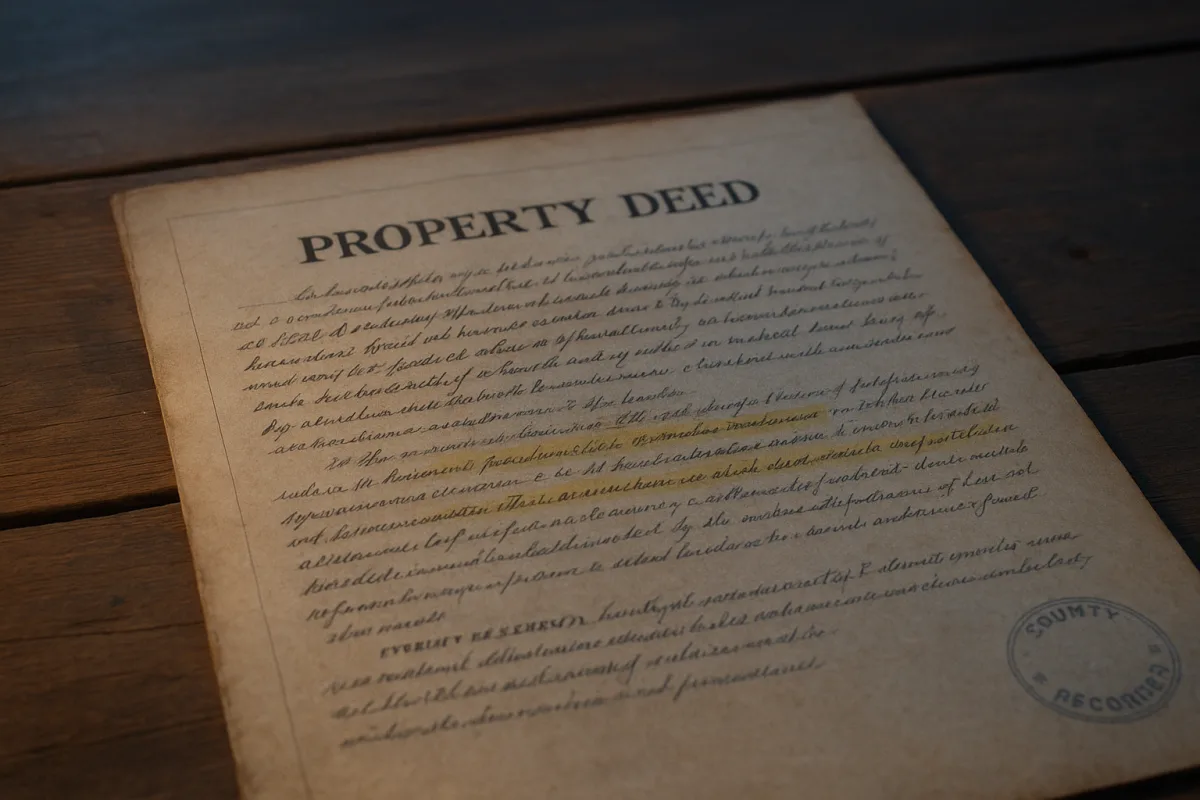
How to Read a Property Deed and Understand What You Own
Start by getting the right document
The deed is the document used to transfer an ownership interest in real property. It is not the same thing as a mortgage, promissory note, closing disclosure, title insurance policy or property-tax bill. [1]
If you recently bought a home, start with the signed copy in your closing package. Then compare it with the version recorded by the county recorder, register of deeds or equivalent local office.
The recorded copy matters because recording creates a public record of the transfer and affects priority between competing claims under state recording laws. Rules differ substantially between notice and race-notice jurisdictions, so do not assume another state’s procedure applies to yours. [1]
Search by your name, the prior owner’s name, property address or parcel number, depending on what your county’s system supports. Keep the instrument number, book and page number, or electronic recording reference with your title documents.
A delayed recording is not necessarily a problem. Nolo reports that deed recording may happen on the day of closing through electronic systems, while paper submissions and local backlogs can push processing out as far as 90 days. [6]
If the recorder cannot locate your deed after a reasonable processing period, contact the closing attorney, title company or settlement provider that handled the transaction. Ask what was submitted, when it was submitted and what recording reference they received.
Identify the people named in the deed
Near the opening of the document, find the grantor and grantee. The grantor is the person or entity transferring the interest, and the grantee is the person or entity receiving it. [1]
Check every name against the intended ownership arrangement. A missing spouse, an incorrect middle name, an omitted trust name or a mismatch between the buyer named in the contract and the grantee on the deed deserves prompt follow-up.
Do not rely on how the names are presented on a mortgage statement. A lender can be secured by the property, but the deed identifies the ownership interest conveyed. The research available here does not establish that mortgages or loan terms are normally set out in deeds.
You may also see a consideration statement, often describing an amount paid or reciting nominal consideration. This is a standard deed component, but it is not necessarily a complete accounting of your purchase price, seller concessions, escrow deposits or closing costs. [3]
That distinction matters when reviewing a closing file. Use the Closing Disclosure or settlement statement for loan charges, prepaid items, escrow funding and credits. Use the deed to understand the transfer and the interest conveyed.
Find the ownership, or vesting, language
The ownership form may appear after the grantee names or in a separate vesting clause. This is the part that answers a practical question: can one owner sell, leave or encumber an interest without the other owner?
Fee simple absolute generally means the broadest form of ownership, with rights that continue indefinitely. It does not mean the property is free of easements, taxes, zoning rules, mortgages or private restrictions. [4]
Tenancy in common means two or more people own undivided interests in the same property. Those shares can be unequal, and each owner can generally transfer their own share, with no automatic right of survivorship. [4]
For example, a deed might convey a home to one grantee as a 75 percent tenant in common and another as a 25 percent tenant in common. Both may use the whole property subject to the co-ownership arrangement, but their economic interests are not equal.
Joint tenancy typically involves equal shares and a right of survivorship. When one joint tenant dies, that person’s interest usually passes to the surviving joint tenant or tenants rather than through that owner’s will. [4]
Tenancy by the entirety is available to married couples in some states. It generally includes survivorship and can offer protections from creditors of only one spouse, but availability and effect depend on state law. [4]
Community-property rules apply in community-property states and can affect ownership of assets acquired during marriage. The deed wording is important, but it may not be the only document relevant to a married owner’s rights. [4]
If the deed says “joint tenants” when the owners intended unequal inheritances, or says “tenants in common” when they expected survivorship, this is not a cosmetic issue. Have a local real-estate attorney explain the recorded language before attempting a correction.
Read the granting clause before assuming what transferred
The granting clause is the operative language that says the grantor conveys an interest to the grantee. It may use terms such as “grant,” “convey,” “transfer” or “quitclaim,” depending on the deed type and state practice. [1]
Also locate the habendum clause, commonly introduced with language such as “to have and to hold.” It can define the estate being conveyed or state conditions and limitations that affect the grant. [3]
A warranty deed generally includes promises, often called covenants or warranties, concerning title. A quitclaim deed generally transfers whatever interest the grantor has, if any, without the same warranty promises. [1]
The deed label is useful, but the actual clauses control. Read the granting language, habendum and warranty provisions together, especially if the transaction involved family transfers, probate, divorce, a trust or a prior title issue.
Do not infer that a warranty deed guarantees a trouble-free property. It is a form of title covenant, not a home-condition report. It does not replace an inspection, survey, appraisal or review of the title insurance policy.
Move from the street address to the legal description
The address helps people find the home. The legal description identifies the land being conveyed. If an address appears in the deed, treat it as a convenience rather than the final word on the parcel’s boundaries. [3]
A metes-and-bounds description starts at a Point of Beginning and traces the parcel through distances and directional bearings until it returns to that point. It may use feet or older units such as rods. [5]
This format can look intimidating because every call matters. A line reading north 57 degrees east is materially different from south 57 degrees west, even though the characters are similar.
Lot-and-block descriptions identify a numbered lot and block on a recorded subdivision plat. They usually cite the plat book and page, cabinet and slide, or another recording reference needed to retrieve the map. [3]
The third common system is the Public Land Survey System, used mainly in western states. It identifies land through township, range, section and fractional-section descriptions, such as a quarter-section. [3]
Compare the legal description in your deed with the title commitment or title policy and, if you have one, the survey. Do not try to “correct” a suspected error by handwriting on your deed or relying on a real-estate listing.
Common description problems include transposed numbers, omitted lines, reversed bearings and compass-declination mistakes. These can become serious boundary disputes, and in some circumstances can undermine the effectiveness of the deed itself. [5]
If two documents describe the parcel differently, preserve copies of both and ask a title professional, surveyor or local real-estate attorney which document controls and whether a corrective deed or other recorded action is needed.
Look for rights other people may have in your land
After identifying what you received, look for what may limit it. Easements, restrictions and covenants may appear in the granting clause, habendum clause, separate provisions or references to other recorded instruments. [2]
An easement may give someone else a limited right to use part of the property, such as a right of way, utility access or drainage route. The deed may mention the easement directly or state that the transfer is subject to recorded easements. [2]
A restriction may limit how land can be used. Covenants, conditions and restrictions, often called CC&Rs, may be recorded separately and incorporated by reference rather than reproduced in full on the deed. [2]
When the deed says the property is conveyed “subject to” a recorded document, write down the cited recording number, book and page, or plat reference. Retrieve that document before assuming the restriction is minor or expired.
Massachusetts, for example, may use memoranda of encumbrances in Land Court practice. The broader lesson applies elsewhere: a short notation on the deed can point to a much longer record affecting your use of the property. [2]
This is also where a title insurance policy can help with navigation. The policy and its exceptions can identify recorded items, but do not treat a title-policy exception list as a substitute for reading the referenced documents.
Check execution, notarization and recording details
At the end of the deed, verify the grantor’s signature, the notarial acknowledgment and any witness signatures required where the property is located. Execution requirements vary by state, and some jurisdictions require more than notarization. [3]
Then locate the recorder’s stamp or electronic recording notation. It may show the recording date, instrument number, book and page, document number, barcode or clerk certification.
The date signed and date recorded may differ. That is normal, but the gap is worth understanding because recording establishes public notice and can matter if competing transfers or liens arise. [1]
Keep a digital copy of the recorded deed, but download it from the county source when possible. A scan supplied at closing can be useful, yet the public record is the version you should periodically verify.
Watch for current fraud and estate-planning changes
Some counties are adding tools intended to reduce deed fraud. Cuyahoga County, Ohio, began developing a Deed Lock program using two-factor authentication to help prevent forged property deeds. [8]
Availability is local, so check whether your own recorder offers deed alerts, recording notifications, identity verification or a document-locking program. Monitoring will not replace title protection or legal action, but it can shorten the time between an unauthorized filing and your discovery of it.
Transfer on Death Deeds, sometimes called beneficiary deeds, are another state-specific issue. As of October 1, 2026, Maryland joined Virginia and the District of Columbia in allowing these deeds, which can name a beneficiary outside probate. [7]
A Transfer on Death Deed is not simply a beneficiary line to add casually to an existing deed. Its validity, revocation rules, marital-property effect and creditor consequences are jurisdiction-specific, so get legal guidance before recording one.
FinCEN’s real-estate reporting rule, effective March 1, 2026, requires certain real-estate professionals to report covered non-financed residential transfers. It increases transaction transparency, but it does not change the basic clauses or legal description you will read in a deed. [9]
I am not a licensed real-estate agent, lender or legal adviser. A deed is a short document with outsized consequences, and the right interpretation depends on your state, ownership arrangement, title history and timeline.
Frequently Asked Questions
What information does a property deed contain?
A property deed typically includes the names of the parties involved (grantor and grantee), a granting clause, a legal description of the property, a consideration statement, ownership vesting language, any covenants or warranties, signatures, notarization, and recording information. The legal description is the controlling property identification, not the street address, and the deed may also reference easements, restrictions, or other recorded documents affecting the property.
How do I verify if my property deed is recorded?
You can verify if your deed is recorded by contacting your county recorder’s office, register of deeds, or equivalent local office. Many counties offer online public records searches by owner name, property address, or parcel number. Recording may occur electronically on the day of closing or take up to 90 days if paper processing or backlogs apply.
What does ownership vesting mean on a deed?
Ownership vesting language specifies the form of ownership conveyed, such as fee simple absolute, tenancy in common, joint tenancy, tenancy by the entirety, or community property. This language determines rights like transferability, survivorship, inheritance, and exposure to creditors, which are crucial for understanding how the property interest is held and can be managed.
How can I identify easements and restrictions on a deed?
Easements and restrictions may be found in specific language within the granting or habendum clauses, or through explicit easement or restriction clauses in the deed. The deed may also reference other separately recorded documents like covenants, conditions, and restrictions, which should be reviewed to understand any burdens on the property.
What is the difference between grantor and grantee in a deed?
The grantor is the person or entity transferring the ownership interest in the property, while the grantee is the person or entity receiving that interest. These roles are clearly identified near the beginning of the deed and are key to understanding who is conveying and who is acquiring the property rights.
How we researched this
This article was assembled from 9 cited references.
Nothing here is based on hands-on testing. Where a figure or finding appears, it belongs to the source cited beside it, and the writing says so rather than implying otherwise. Every source is listed below so you can check it.
Sources
- deed | Wex | US Law | LII / Legal Information Institute
- 19. Easements, Restrictions, Covenants and Other Rights Granted or Reserved in a Deed | Mass.gov
- What Does a Deed Look Like? Layout and Key Elements - LegalClarity
- Types of Homeownership - FindLaw
- Common Errors in Deed Descriptions
- Double Check That Your Home Deed Was Recorded -- Or Else!
- Transfer on Death Deeds Effective in VA, DC and MD (as of 10/1/2026) - Essential Legal Planning
- Cuyahoga County developing two-factor authentication system to prevent forged property deeds
- FinCEN’s 2026 Real Estate Reporting Rule: Does It Apply to Your Deed Transfer? - Deeds.com
Related Articles
How to Read a Real Estate Listing: A Buyer’s Guide
Learn how to read a real estate listing, interpret terms, prices, and abbreviations to make informed home buying decisions.

Real Estate Market Trends
Learn how to understand real estate market trends, including months of supply and mortgage rate impacts, to make smarter buying or selling decisions.

From W2 to Wealth: Building a Multi-Million Dollar Rental Portfolio
Learn how a former W2 employee built a multi-million dollar rental portfolio in under 2 years through house hacking and strategic investments in cash flow markets, offering valuable insights for aspiring real estate investors.

Mike and Lori's Ozarks Summer Home Hunt: Choosing Charm at Turkey Quarry
Follow Mike and Lori's journey on HGTV as they search for their dream summer home in the Ozarks, ultimately choosing Turkey Quarry for its charm and lakefront access. Experience the excitement of finding the perfect sanctuary by the water in this heartwarming episode.