
How to Read a Real Estate Listing: A Buyer’s Guide
Learn how to read a real estate listing, interpret terms, prices, and abbreviations to make informed home buying decisions.
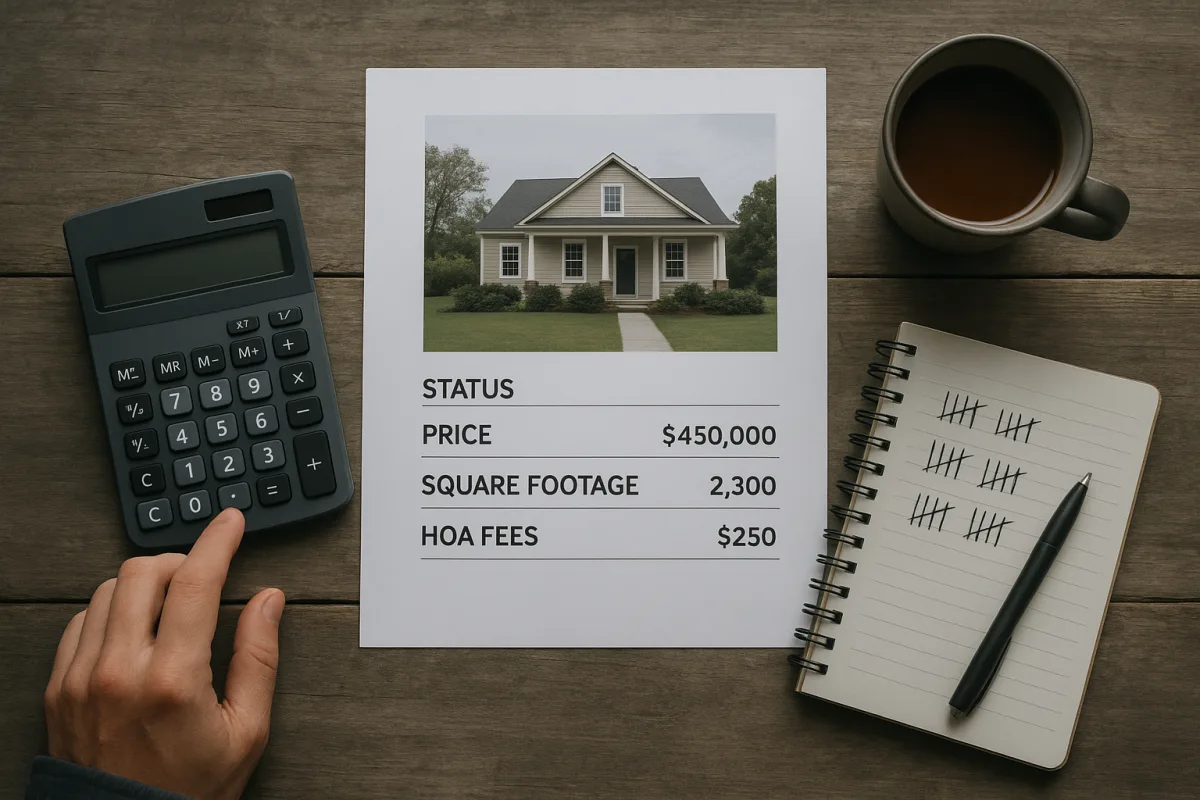
Start with the status, because it determines whether you can act
Before studying backsplash photos or calculating price per square foot, find the listing status. Common labels include active, contingent, pending, and sold. An active property is generally being marketed for offers. A contingent property has an accepted offer with conditions still outstanding, while pending usually means the deal is further along toward closing. [1]
That distinction matters because contingencies are the contractual checkpoints that can still change the result. A buyer may need financing approval, an acceptable inspection, or an appraisal that supports the agreed price. The listing alone will not tell you every term of an existing contract.
Also check the open-house date and time closely. Misreading an open-house schedule is a basic but common mistake, especially when a listing is updated, reposted, or shows several events. Save the listing, then confirm the time with the named brokerage before building your weekend around it. [1]
Look for DOM, meaning days on market, if the listing displays it. DOM tells you how long the property has been marketed, but it does not explain why. A long marketing period could reflect price, condition, buyer financing issues, a relisting, or something not visible online.
Read the basic facts as measurements, not marketing labels
The first block usually gives the address, property type, list price, bedrooms, bathrooms, interior square footage, lot size, and year built. These are useful fields, but each answers a different question. Do not let “3 BR, 2 BA” substitute for reading the actual room layout.
Home size is generally stated in square feet, or SF. The ANSI Z765-2021 standard provides a method for measuring a home’s square footage, but buyers should still ask what areas are included, especially for finished basements, garages, enclosed porches, and bonus rooms. [2]
Room dimensions make the square-footage number more real. A typical primary bedroom is about 14 by 16 feet, or 224 square feet, while a typical secondary bedroom is about 10 by 12 feet, or 120 square feet. [2]
That difference matters when a listing advertises four bedrooms. Four legal bedrooms can still mean one or two rooms are much smaller than the space your household needs. Check dimensions, window placement, closets, and door swings during a showing rather than relying on the bedroom count.
The same applies to common areas. Typical reference sizes include a 12-by-18-foot living room, roughly 216 square feet, and a kitchen around 225 square feet. A full bathroom may be around 40 square feet, while a half bath can be closer to 18 square feet. [2]
Ceiling height changes how those dimensions feel. Eight- to nine-foot ceilings are standard, while homes marketed as luxury properties often have ceilings of 10 feet or more. [2] If ceiling height matters to you, confirm it in person because listing photos can make rooms appear larger.
Lot size is usually shown in acres or square feet. One acre equals 43,560 square feet. [2] A 0.20-acre lot is therefore about 8,712 square feet, but that does not tell you how much usable yard exists after the house, driveway, easements, slopes, and setbacks.
Do not assume fences mark legal boundaries. If the lot shape, side yard, parking area, or neighboring encroachment matters to your plans, ask for available survey information and understand that a listing’s lot description is not a substitute for boundary verification.
Translate the shorthand carefully
Listings compress a lot of information into abbreviations. BR means bedroom, BA means bathroom, SF means square feet, AC means air conditioning, CAC commonly means central air conditioning, BSMT means basement, and FP or F/P means fireplace. [4]
You may also see Appl for appliances, Furn for furnace, HWT for hot-water tank, LR for living room, K for kitchen, RM for room, MBD for main bedroom, and MTG for mortgage. [4] These terms can help you scan quickly, but they do not establish condition or age.
Some abbreviations are ambiguous. “P” and “S” can have multiple meanings depending on the listing system or local practice. [4] When a shorthand term affects parking, sewer service, pool access, storage, or another material feature, ask the listing contact to spell it out.
CMA, another term buyers may encounter, means comparative market analysis. [1] It is a pricing tool based on comparable properties, not a guarantee that a lender’s appraisal will match the contract price or that a home will sell at its list price.
Put the list price beside the recurring costs
The asking price gets the biggest typeface, but it is only one line in the ownership math. Listings may also show price per square foot, homeowners association dues, and estimated property taxes. Read all three before deciding whether a payment might fit your budget. [3]
Price per square foot is most useful when comparing genuinely similar homes: similar location, age, condition, lot utility, and layout. It is less useful when one property has a renovated kitchen, a newer roof, a finished basement, or substantially different association obligations.
In a balanced market, offers often fall within roughly 3 to 5 percent of list price, though the range can be wider in especially fast or slow conditions. [3] That is a market observation, not a rule for any specific property, and it does not tell you what an appraisal will support.
HOA dues deserve the same attention as a higher purchase price because they recur. One Sun Belt example uses a $420,000 median-priced home with HOA fees of $300 to $800 per month. [3] That equals $3,600 to $9,600 per year before any future dues increases.
The same example places annual property taxes at roughly $4,200 to $6,300. [3] Taxes and association dues are not interchangeable, and neither is optional simply because the listing payment calculator emphasizes principal and interest.
Ask what the HOA fee covers, but do not assume every community provides the same services. The research supports wide variation in fee levels, not a standardized menu of inclusions. Review the association documents available during your transaction for the specific property.
Then separate purchase price from closing costs. Closing costs are commonly estimated at 2 to 5 percent of the loan amount. On a $350,000 home, the research brief gives a rough range of $7,000 to $17,500. [3] Your actual figure depends on the loan, location, title charges, prepaid items, and timing.
That is why a listing’s mortgage calculator is a starting estimate rather than a loan quote. I am not a licensed real estate agent, lender, attorney, or financial adviser. A lender can explain the rate, points, mortgage insurance, escrow deposits, and cash-to-close figures attached to your own application.
Read condition language as a list of follow-up questions
The feature section should identify major systems and included appliances. Look for roof material and age, HVAC type and service history, appliance list, foundation type, and statements such as “new,” “recently serviced,” “well-maintained,” or “as-is.” [1]
A phrase such as “10-year-old asphalt-shingle roof” gives you more to work with than “beautiful exterior.” Likewise, “central air recently serviced” is more useful than simply “CAC.” Neither statement, however, replaces a professional inspection or contractor evaluation. [1]
Appliance descriptions can clarify whether a refrigerator, dishwasher, washer, and dryer are present, and whether they are described as updated. [1] Presence is not the same as remaining useful life, warranty coverage, or repair-free operation.
Foundation language deserves the same discipline. A listing may identify a slab or crawl-space foundation and state that there are “no cracks.” [1] That is a seller-side description, not an engineering conclusion. Use the inspection period to evaluate visible conditions and any concerns raised by the inspector.
“As-is” is especially important wording. It signals that the seller may be unwilling to make repairs or offer credits, but the exact effect depends on the purchase agreement and local practice. Do not read it as proof that no defects exist, or that an inspection is unnecessary.
Skipping an inspection can expose buyers to repair costs estimated in the $5,000 to $30,000-plus range. [3] The appropriate inspection scope depends on the property and concerns identified, but the listing’s condition claims should help you form precise questions before making an offer.
Know the dates before you make an offer
A listing may include an offer deadline, especially where the seller expects multiple bids. Typical offer deadlines can be as short as 24 to 72 hours. [5] Put that deadline beside your pre-approval status, lender availability, and ability to review disclosures.
Pre-approval is different from casually estimating a payment online. Buyers who do not obtain mortgage pre-approval can lose time after finding a property, particularly when a seller expects proof that financing is plausible. [3] Ask your lender what documentation the pre-approval required and what remains to be verified.
If your offer is accepted, earnest money is commonly due within three to five days. Typical deposits are about 1 to 2 percent of the purchase price. [5] On a $350,000 offer, that is roughly $3,500 to $7,000, subject to the contract’s exact terms.
The inspection period commonly runs seven to 14 days after acceptance. [6] That is the window to schedule inspections, read reports, request repairs or credits if your contract permits them, and decide how inspection findings affect your next step.
A financed transaction commonly closes in 30 to 45 days, while a cash sale may close in seven to 14 days. [6] These are typical ranges, not promises. Financing, appraisal, title, repair negotiations, and contract deadlines can change the calendar.
Before closing, borrowers must receive a Closing Disclosure at least three business days before consummation. [7] Compare its cash-to-close amount, interest rate, loan costs, prepaid charges, escrow payments, and lender credits with the earlier Loan Estimate line by line.
Check local items the listing may not standardize
Climate-related features and local disclosure rules can matter greatly. Flood history, lead-paint disclosures, storm-resistant construction, heating efficiency, and similar issues may be handled differently by location. Current research did not identify detailed nationwide standards for how these items appear in 2026 listings.
That gap is a reason to ask local, property-specific questions rather than assuming silence means no issue exists. Ask the listing contact what disclosures are available, then review them against your own plans for insurance, repairs, commuting, schools, and neighborhood use.
Finally, use the named agent and brokerage as the route for factual listing questions: What conveys? What is the roof age? Are there HOA documents? Is there a survey? When are offers due? A clear written answer is more useful than trying to decode an omission from photos alone.
Frequently Asked Questions
What does the status of a real estate listing mean?
The status indicates where the property stands in the sales process. An active listing is open for offers, a contingent listing has an accepted offer with conditions still to be met, pending means the sale is nearing closing, and sold means the transaction is complete. Understanding status helps determine your ability to act and the timeline involved.
How do I interpret square footage and lot size in listings?
Square footage usually follows the ANSI Z765-2021 standard but may vary in what is included, such as finished basements or porches. Room dimensions give a clearer sense of space than bedroom counts alone. Lot size is shown in acres or square feet (1 acre = 43,560 sq ft), but usable yard space depends on factors like house footprint and easements, so verify boundaries with a survey if important.
What abbreviations are commonly used in real estate listings?
Common abbreviations include BR (bedroom), BA (bathroom), SF (square feet), AC (air conditioning), CAC (central air conditioning), BSMT (basement), FP or F/P (fireplace), Appl (appliances), Furn (furnace), HWT (hot-water tank), LR (living room), K (kitchen), MBD (main bedroom), and MTG (mortgage). Some abbreviations like “P” and “S” can have multiple meanings and should be clarified with the listing agent.
How should I consider HOA fees and taxes when reading listings?
HOA fees and property taxes can significantly affect monthly and annual housing costs beyond the listing price. For example, HOA dues can range from a few hundred to over eight hundred dollars monthly depending on the region, and property taxes vary widely. Compare these costs alongside price and condition to understand the total financial commitment.
What information is often missing from real estate listings?
Listings may omit details like roof or HVAC age, boundary surveys, and full disclosure information. Absence of such data is a prompt to ask targeted questions rather than assume favorable conditions. Always verify missing or unclear information through inspections, surveys, or professional advice.
How we researched this
This article was assembled from 7 cited references.
Nothing here is based on hands-on testing. Where a figure or finding appears, it belongs to the source cited beside it, and the writing says so rather than implying otherwise. Every source is listed below so you can check it.
Sources
- Real Estate Terminology & Definitions | Real Estate Dictionary
- How to Measure Your Home's Square Footage (Accurate Methods) | Opendoor
- Typical Real Estate Commission Cost 2026: Price Ranges & Hidden Fees | Sellable
- Real Estate Abbreviations - The Knowledge Library
- When Does a Real Estate Purchase Agreement Expire? - LegalClarity
- Home sale timeline from offer to closing: What to expect - Homes.com News
- Under Contract to Closing — Pennsylvania Timeline (2026) | Ariella + Lukasz Realty Group
Related Articles
How to Read a Property Deed and Understand Its Sections
Learn how to read a property deed, understand ownership, legal descriptions, and key sections to know what you truly own.

Real Estate Market Trends
Learn how to understand real estate market trends, including months of supply and mortgage rate impacts, to make smarter buying or selling decisions.

From W2 to Wealth: Building a Multi-Million Dollar Rental Portfolio
Learn how a former W2 employee built a multi-million dollar rental portfolio in under 2 years through house hacking and strategic investments in cash flow markets, offering valuable insights for aspiring real estate investors.

Mike and Lori's Ozarks Summer Home Hunt: Choosing Charm at Turkey Quarry
Follow Mike and Lori's journey on HGTV as they search for their dream summer home in the Ozarks, ultimately choosing Turkey Quarry for its charm and lakefront access. Experience the excitement of finding the perfect sanctuary by the water in this heartwarming episode.