
Real Estate Contingency: What It Means and How It Works
Learn what a real estate contingency is, common types, deadlines, and how it protects buyers in home purchase contracts.
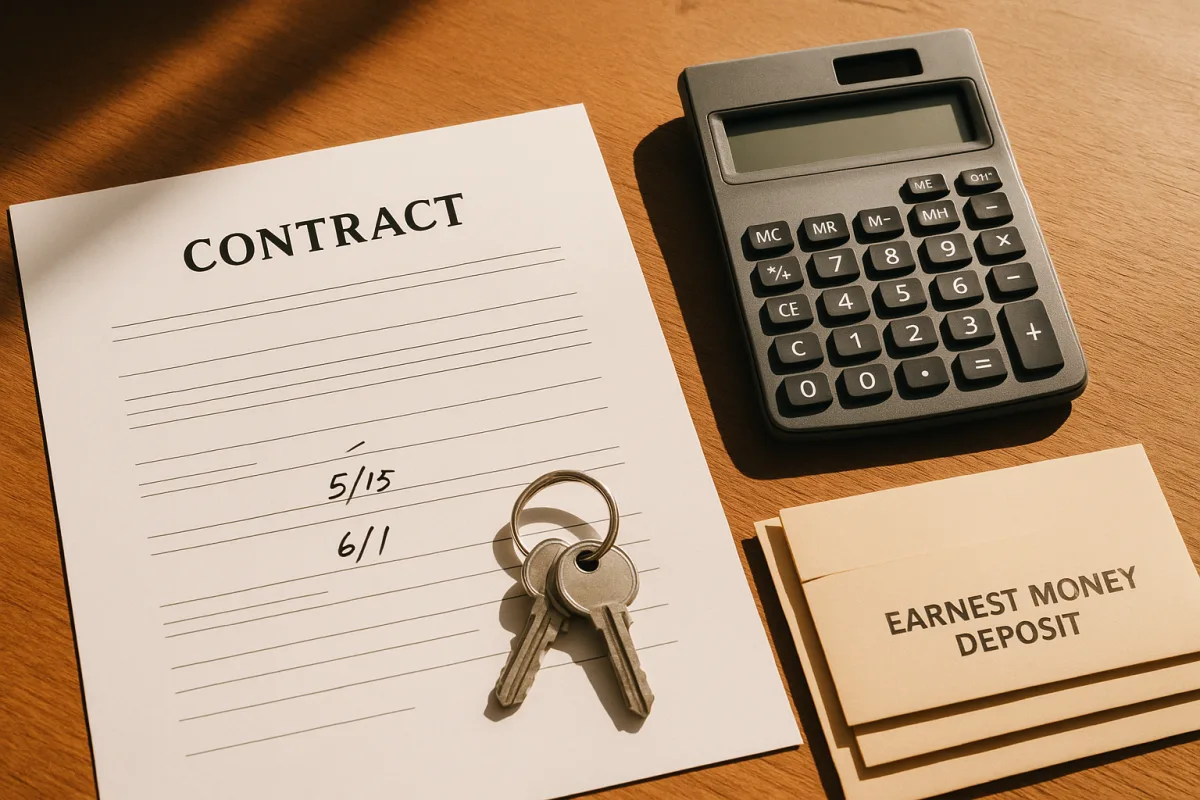
A contingency is a conditional promise to buy
A contingency in real estate is a condition written into a purchase contract. The buyer agrees to buy the home if specified events occur, such as obtaining financing, receiving an acceptable inspection result, or confirming that the title is clear. [1][2]
The practical point is not that the buyer can change their mind for any reason. The point is that the buyer has a defined contractual exit if a particular condition is not satisfied by a stated deadline.
Think of the contract as containing two promises at once. The buyer promises to purchase, while the seller promises to take the home off the market and work toward closing, subject to the listed conditions being resolved.
That distinction matters because a contingency is not merely a conversation starter. It allocates risk between buyer and seller before closing, including the risk that the house has expensive defects or the mortgage does not come through.
The money a contingency is designed to protect
The money at the center of most contingency disputes is earnest money, often called an earnest money deposit or EMD. It is money the buyer deposits after the contract is signed to demonstrate seriousness about completing the purchase.
LegalClarity reports that typical earnest money deposits in 2026 range from 1% to 3% of the purchase price. On a $400,000 home, that is $4,000 to $12,000. More competitive markets may see deposits of 5% to 10%. [1]
A buyer purchasing that same $400,000 home could therefore put up $20,000 to $40,000 in earnest money if a seller requires a 5% to 10% deposit. In lower-priced or rural markets, flat deposits of roughly $500 to $2,000 are also common. [1]
The deposit is usually held by an escrow holder or another designated party under the purchase agreement. It is not automatically the seller’s money the moment the buyer sends it, and it is not automatically refunded just because a buyer wants out.
Instead, the contract says when the deposit is refundable, when it can be released, and what each party must do to claim it. A properly used contingency generally allows the buyer to cancel and recover earnest money when the stated condition fails. [1][4]
Without that protection, a buyer who cannot close may face a claim that the seller is entitled to keep the deposit. Homes.com News and MyPurchaseOffer both identify waived contingencies and missed deadlines as common sources of financial loss and disputes. [11][12]
The mechanics: condition, deadline, decision
Every contingency has three moving parts: the condition, the deadline, and the required response. Buyers often understand the first part, such as “inspection,” but get into trouble on the second and third.
The condition is the event being tested. An inspection contingency tests the home’s condition. A financing contingency tests whether the buyer can obtain mortgage financing under the contract’s terms. An appraisal contingency addresses whether the property appraises at a level required for the financing arrangement.
The deadline is the period in which the buyer must investigate, negotiate, remove the contingency, request an extension, or cancel. LegalClarity notes that deadlines are negotiable, but missing one can cost a buyer the right to cancel or recover earnest money. [1]
The required response is the part that deserves a line-by-line read. A contract may require written notice, a particular contingency-removal form, delivery to a specified person, or action by a certain time of day.
This is why a buyer cannot safely treat a contingency period as informal extra time. If the inspection period ends Tuesday, arranging an inspection Tuesday may not preserve the right to cancel Wednesday.
The contract, local forms, and state law determine what notice is sufficient. I am not a licensed real estate agent, lender, attorney, or financial advisor, so I cannot interpret a particular contract. A local real estate attorney or qualified transaction professional can explain the deadline and notice rules that apply.
What an inspection contingency actually does
An inspection contingency gives the buyer time to inspect the property and decide whether its condition is acceptable under the contract. Common inspection periods run about 7 to 14 days. [1]
It does not mean the seller must repair every item the inspector finds. Nearly every home inspection will produce a list, and the contingency does not turn that list into an automatic seller-paid repair order.
Instead, the buyer commonly has several possible paths, depending on the contract. The buyer may accept the home as it is, request repairs or a credit, negotiate another solution, seek an extension, or cancel within the contingency period.
The seller can refuse requested repairs or credits. The key protection is typically that the buyer can decide not to proceed if the inspection outcome is unacceptable and can do so within the contractual process. [1][2]
Suppose an inspector finds a roof problem that the buyer estimates will cost $18,000 to address. The inspection contingency does not establish that $18,000 figure, require a price reduction, or force a repair. It gives the buyer leverage to negotiate and, if no agreement is reached, potentially cancel without sacrificing earnest money.
That is why an inspection contingency is best understood as an information-and-exit right. The inspection supplies information. The contingency determines whether the buyer can use that information to change course without losing the deposit.
Financing is not the same as preapproval
A financing contingency protects a buyer if they cannot secure the mortgage described in the purchase agreement within the specified period. These periods generally run 21 to 30 days, although the exact period is negotiable and location-dependent. [1][4]
Preapproval is helpful, but it is not the same as a final mortgage commitment. Loan approval can still depend on underwriting, income and asset documentation, credit changes, the appraisal, the property’s condition, and the lender’s review of the full file.
A financing contingency is therefore not an assurance that the loan will close. It is a risk-management provision for the period between offer acceptance and final financing approval.
New York financing contingencies are commonly about 30 days, according to the research brief’s state-specific examples. California’s customary inspection period can be 17 days. Those examples show why buyers should not assume that a deadline seen in an online article applies to their contract. [3][1]
A buyer should also read the financing language for the loan assumptions it contains. If the contract specifies a particular loan type, down payment, rate cap, or maximum payment, those details can determine whether a financing failure fits within the contingency.
Why appraisal contingencies matter when the value comes in low
An appraisal contingency addresses the gap between the agreed purchase price and the property value determined for lending purposes. It often runs 14 to 21 days and is frequently connected to the financing contingency. [1]
Here is the mechanical problem. A buyer can agree to pay $400,000, but if the appraisal comes in at $380,000, the lender may base its loan amount on $380,000 rather than $400,000.
Assume a buyer planned a 20% down payment and expected an $80,000 down payment on a $400,000 purchase. If the lender will lend 80% of the $380,000 appraised value, its loan would be $304,000.
The buyer would then need to bring $96,000 to reach the $400,000 price, rather than the originally expected $80,000. The appraisal gap costs that buyer an additional $16,000 in cash, unless the seller reduces the price or the parties reach another agreement.
That example assumes an 80% loan-to-value structure and a lender willing to lend 80% of the appraised value. Different loan programs, underwriting rules, down payments, and contract language can produce different numbers.
The appraisal contingency does not force a seller to lower the price to $380,000. It usually gives the buyer a contractual path to renegotiate or cancel if the appraisal does not meet the stated requirement.
Title and home-sale contingencies solve different risks
A title contingency gives the buyer time to verify that title can be transferred without unacceptable claims, liens, ownership disputes, or other defects. A typical title-review period is about 10 to 14 days. [1]
This is not the same as a home inspection. The inspector looks at the physical property. The title process examines the seller’s legal ability to transfer ownership and whether recorded claims may affect that ownership.
A home-sale contingency says the buyer’s purchase depends on selling their current home. These can run from 30 to more than 90 days because the buyer first needs to market, contract, and close on another property. [1]
Sellers may see that contingency as more burdensome because their own sale waits on a separate transaction outside their control. That does not make it unreasonable, but it does explain why it may be harder to negotiate in a competitive market.
A contingency does not automatically change closing costs
Contingencies and closing costs are separate parts of a transaction. A contingency may affect whether the deal reaches closing, but it does not by itself reduce lender fees, title charges, taxes, or other settlement costs.
State and local costs can vary substantially. The research brief cites Delaware transfer tax of 4.0%, New York mortgage recording tax ranging from 0.5% to 1.75%, and Florida documentary stamp tax of $0.70 per $100 of loan amount. [5][8][9]
RentOrOwn estimates buyer closing costs around 4.6% of the home price in Delaware and around 1.1% in Missouri. [10] Those figures are not contingency costs, but they show why a buyer should budget for closing separately from earnest money and any appraisal-gap cash.
Escrow fee responsibility also varies by state and county. California is one example where escrow fees may be split between buyer and seller, rather than assigned entirely to one side. [7]
The market changes the negotiating pressure, not the underlying risk
In spring and summer, when buyer competition is often stronger, sellers may be less willing to accept long or broad contingencies. In fall and winter, lower competition can give buyers more room to negotiate contingencies and repair requests. [13]
That pattern is not universal. The Pacific Northwest’s active period can run roughly February through July, while New York City has a more fall-focused market rhythm, according to the regional market observations in the research brief. [14]
The risk does not disappear because a market is competitive. Waiving an inspection contingency does not make a repair problem less expensive. Waiving a financing contingency does not make a lender more likely to approve the loan.
It simply shifts more of the financial consequence to the buyer. The right tradeoff depends on the buyer’s cash reserves, financing certainty, property condition, local contract practices, and timeline.
The most expensive error is often procedural
Buyers can lose protections without ever deciding to waive them. A missed inspection deadline, incomplete cancellation notice, or assumption that a verbal extension is enough can create a dispute over earnest money. [1][11]
Before signing, identify every contingency in the offer and write down four things: what condition it covers, the deadline, what notice is required, and what happens to earnest money if the condition fails.
Then compare those dates with the actual work required. If the inspection period is short, can an inspector visit quickly enough? If financing is tight, can the lender realistically complete underwriting before the contingency expires?
A contingency is valuable because it converts major unknowns into a defined process. Its protection depends less on the label, such as “inspection contingency,” than on the exact words, dates, and notice requirements in the signed contract.
Frequently Asked Questions
What is a real estate contingency and how does it work?
A real estate contingency is a condition in a purchase contract that allows the buyer to cancel the deal if certain events do not occur by a specified deadline. It provides a contractual exit for the buyer if conditions like financing approval or an acceptable home inspection are not met, generally allowing recovery of earnest money. The contingency sets clear obligations and deadlines for both buyer and seller before closing.
What are common types of contingencies in real estate contracts?
Common contingencies include inspection contingencies (typically 7–14 days), financing contingencies (usually 21–30 days), appraisal contingencies, title contingencies, and home sale contingencies. Each tests a specific condition such as the home’s condition, loan approval, property appraisal, clear title, or sale of the buyer’s current home.
How does an inspection contingency protect a home buyer?
An inspection contingency allows the buyer a set period, often 7 to 14 days, to inspect the property and negotiate repairs or cancel the contract if significant issues arise. This contingency helps the buyer avoid purchasing a home with costly defects by providing a contractual right to back out or request fixes within the deadline.
What happens if a buyer misses a contingency deadline?
Missing a contingency deadline can cause the buyer to lose the right to cancel the contract or recover earnest money. Deadlines are strict and typically require timely written notice or specific forms; failure to act by the deadline often means the buyer waives the contingency protections and risks forfeiting their deposit.
Can a buyer get their earnest money back if a contingency fails?
Yes, if a contingency condition is not met and the buyer properly cancels within the contract’s deadline and procedures, they generally can recover their earnest money deposit. However, if the buyer misses deadlines or waives contingencies, they risk losing the deposit to the seller.
How we researched this
This article was assembled from 14 cited references.
Nothing here is based on hands-on testing. Where a figure or finding appears, it belongs to the source cited beside it, and the writing says so rather than implying otherwise. Every source is listed below so you can check it.
Sources
- Real Estate Contingencies: Types, Deadlines, and Buyer Risks - LegalClarity
- Contingencies in Real Estate | Redfin
- Home Purchase Contingencies in California (2026)
- Why you need financing contingency & how it works | finder.com
- Closing Costs by State 2026: Seller & Buyer Fees, All 50
- Closing Costs by State & Fee Type (2026) — Complete Guide
- Escrow Fees Explained: What They Cost, Who Pays, and How They Vary by State (2026) | WhatIsEscrow.com
- Refinance Closing Costs by State: 2026 Guide | RefinanceUSA
- Closing Costs by State (2026) · Lotum AI
- Closing costs by state: a real 2026 range — RentOrOwn.info
- Can a buyer back out of a home purchase contract? - Homes.com News
- Real Estate Contingencies Explained: A Complete 2026 Guide for Buyers and Sellers | MyPurchaseOffer
- The Best Week to Sell Your Home in 2026 Could Boost Your Price
- Why the Pacific Northwest Real Estate Market Plays by Its Own Rules – Rockwell Institute Pacific Northwest Real Estate Market: 2026 Guide
Related Articles

Ben Mallah's Property Restoration Journey: Challenges and Triumphs
Ben Mallah faces challenges post-hurricane, restoring damaged pool with a professional team. Hotel renovations and real estate opportunities unfold amidst trials. Resilience and determination shine in property restoration journey.

Ben Mallah's Hotel Transformation: A Journey to Property Perfection
Join Ben Mallah as he leads a dynamic property rehab project, transforming a 90-room hotel with meticulous attention to detail and a vision for community support. Experience the challenges, camaraderie, and vision in this exciting journey towards property perfection.
How to Read a Real Estate Listing: A Buyer’s Guide
Learn how to read a real estate listing, interpret terms, prices, and abbreviations to make informed home buying decisions.

How to Choose a Real Estate Agent
Learn how to choose a real estate agent with expert tips on interviewing, verifying credentials, and comparing experience for buyers and sellers.