
Improve Credit Score for Mortgage: Steps to Boost Your Score
Learn how to improve credit score for mortgage approval with proven steps, timelines, and tips to lower your mortgage rate.
How to Improve Your Credit Score for a Better Mortgage Rate
Start with the number the lender is likely to price
A mortgage credit score is not simply a grade on a personal-finance app. Lenders use credit reports and scoring models to assess repayment history, current debt and recent borrowing before setting eligibility and pricing. [2][18]
The practical objective is not necessarily reaching a perfect score. It is getting into a better pricing band before the lender pulls credit, while avoiding actions that create a new problem on the report.
That distinction matters because mortgage pricing often changes in tiers. Borrowers at 760 and above generally receive the strongest pricing, while a 700 to 719 score can carry a higher loan-level price adjustment than a 760-plus score. [7][19]
A stronger score does not guarantee a particular rate. Your rate also depends on the lender, loan type, down payment, occupancy, debt-to-income ratio, points, lock period and market conditions when you lock.
For perspective, one 2026 mortgage-rate analysis estimates that improving a score by 50 points can lower a rate by roughly 0.5 percentage points. On a $350,000, 30-year loan, it estimates about $87 less per month and roughly $31,320 less paid over 30 years. [7]
Those are illustrations, not a quote or a promise. The right target depends on your present score, the rate sheet available to your lender, the size of your loan and how soon you need to make an offer.
First, give yourself a workable timeline
The first problem buyers hit is timing. A card payment made today may not change the balance a lender sees tomorrow, because issuers report on their own billing cycles and bureaus update reports after receiving that data.
Paying down debt or correcting an error often shows up in one to two months, according to LegalClarity and Experian reporting on score-update timing. Improvements of 25 points or more may take several months of consistently positive reporting. [11][12]
That makes a last-minute credit cleanup unreliable. If you expect to apply in eight weeks, focus on balances already reporting high, any past-due account, and factual report errors you can document immediately.
If you have six months, the same actions still matter, but you have more room for reported balances to fall and for an unbroken run of on-time payments to accumulate. Do not confuse time with inactivity, though.
Set a calendar reminder for each card’s statement closing date and each payment due date. The closing date is important because it commonly determines the balance that gets reported, even if you pay in full later.
Pull your reports before you pay the wrong debt
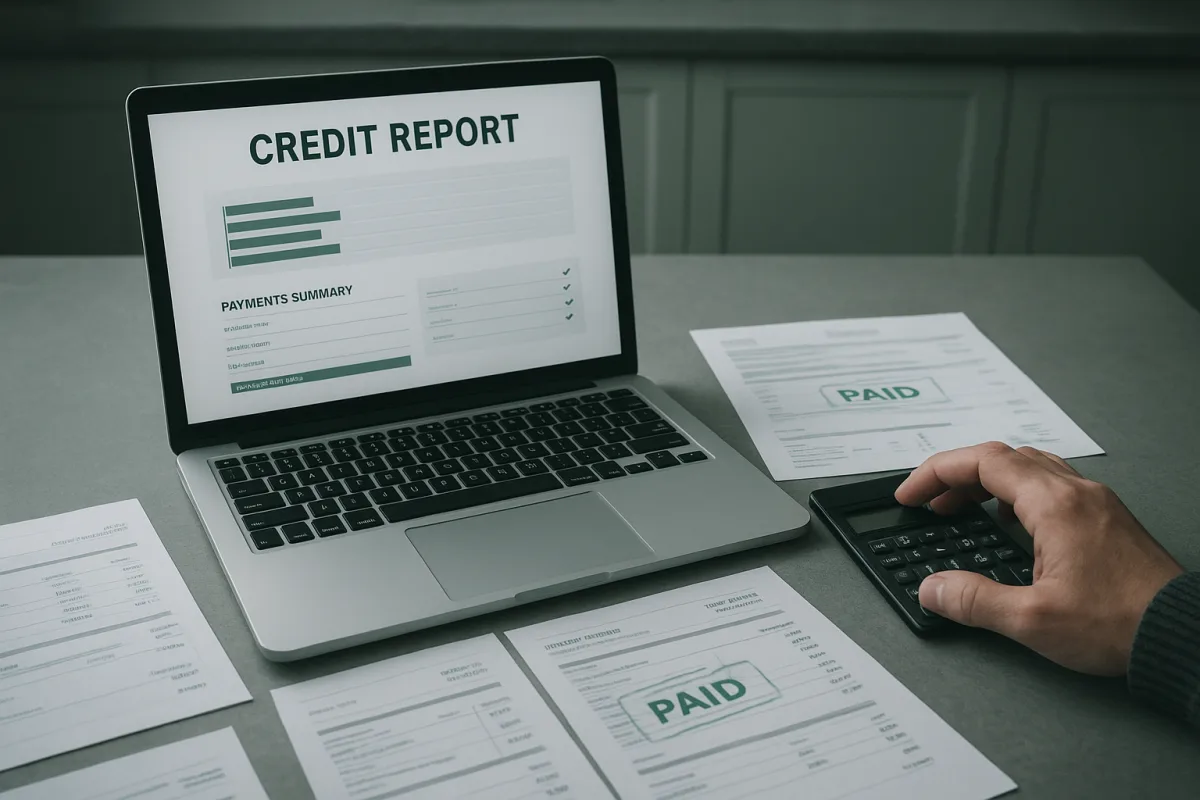
Review credit reports from all three bureaus before making a payoff plan. You are looking for accounts that are not yours, inaccurate late-payment entries, duplicate collections, wrong balances and accounts shown as open or delinquent when they are not.
This is not a cosmetic exercise. The Federal Trade Commission has found that one in five consumers had an error on at least one credit report, and correcting an error can improve the information used in scoring. [4]
Make a simple list with the creditor, account number, reported balance, credit limit, status and the bureau showing the item. Then compare each item against bank statements, payoff letters and correspondence you can retain.
Dispute an inaccurate item with the credit bureau and, where appropriate, the company supplying the information. Keep copies of the dispute, supporting records and outcome, since a lender may ask about recently changed information during underwriting.
Do not dispute accurate negative information simply because it is unfavorable. The research brief supports error correction, not a strategy of challenging legitimate debts or relying on credit-repair services to change mortgage scores.
Attack card utilization before paying low-rate installment debt
For many buyers, credit-card utilization is the fastest adjustable part of the score. Utilization compares reported revolving-card balances with available credit, both on individual cards and across all cards combined.
A useful working target is below 30% utilization, with under 10% generally the stronger target. Direct Lender cites Experian data indicating that moving utilization from 70% to under 10% can raise scores by 40 to 80 points within two billing cycles. [3]
The mechanics matter. A $3,000 balance on a card with a $5,000 limit is 60% utilization. Paying it down to $450 before the issuer reports reduces that card’s utilization to 9%.
Do not look only at your total credit-card debt. If one $1,000-limit card reports a $900 balance while other cards are unused, that heavily utilized card may still work against you despite a reasonable overall ratio.
Prioritize cards near their limits, then work toward keeping both individual cards and total utilization low. If cash flow allows, make a payment before the statement closes rather than waiting only for the due date.
Paying a card in full after its statement is issued avoids interest on many cards, but the earlier reported balance may already have appeared on your credit file. The score timing and the interest timing are related, but not identical.
Preserve the accounts that already help you
A common pre-mortgage mistake is closing an old card after paying it off. That may feel tidy, but it can shrink available credit and reduce the length of your credit history.
Credit-history length accounts for 15% of a FICO score, according to Kiplinger’s overview of score factors. Keeping an older account open can preserve history and available credit, assuming the account has no annual fee or other cost that changes the decision. [5]
You do not need to carry a balance to keep an account active. A small planned charge and an automatic full payment can be easier to manage than leaving a card unused until an issuer closes it.
Ask a card issuer about a credit-limit increase only if you can avoid raising spending. A larger limit with the same reported balance lowers utilization, which can support a score improvement. [6]
Before requesting an increase, ask whether the issuer will use a hard inquiry. The potential utilization benefit may not justify an avoidable inquiry if your mortgage application is close.
An authorized-user arrangement can also help in some circumstances. Direct Lender notes that being added to a card with a positive history can boost a score, but it is not a substitute for your own payment record. [3]
If considering that route, the primary cardholder’s history and current utilization matter. Being added to a card that carries a large balance or develops late payments can create the opposite result.
Make payment history boring from now through closing
Payment history is the largest named FICO factor, at 35% of the score. [5] Once you are preparing for mortgage preapproval, every account needs a payment system that does not rely on memory.
Set automatic payments for at least the required minimum on every open account, then separately schedule extra payments toward the cards you are paying down. Confirm that the linked checking account has enough cash before each draft.
A missed payment can hurt your score and leave a lender asking for explanations or updated documentation. Homebuyer and Stone Oak Mortgage both flag missed payments as a central error for prospective buyers. [15][16]
Continue this discipline after preapproval. A preapproval is not the finish line, and changes in debt, balances or payment status can affect the loan file before closing.
Avoid “helpful” new credit while your mortgage is pending
The next problem often arrives after a buyer has started house hunting. A furniture promotion, a new vehicle loan or a retail card may look separate from the mortgage, but it changes the credit picture.
Opening a new account can create a hard inquiry and reduce the average age of accounts. Both effects may lower scores, and the new required payment can also affect debt-to-income calculations. [13][20]
Hard inquiries are usually small and temporary. myFICO says an inquiry generally reduces a score by fewer than five points, but a cluster of new borrowing can send a different signal than one isolated inquiry. [20]
Do not close accounts, transfer large balances, co-sign a loan or finance appliances without first asking your mortgage contact how it could affect the file. This is especially important between application and closing.
That is not advice to avoid necessary financial decisions. It is a warning to understand the tradeoff before creating new debt while a lender is verifying assets, employment, liabilities and credit.
Shop mortgage lenders without treating every quote as a score penalty
When you are ready to compare mortgages, compare actual Loan Estimates rather than assuming the first lender has the best available rate. Rates vary by lender even for borrowers with similar credit profiles. [8]
Mortgage inquiries made within a concentrated shopping period are generally treated differently from scattered applications for unrelated credit. myFICO says multiple mortgage inquiries within 45 days count as one inquiry for scoring purposes. [20]
Keep the shopping organized. Obtain quotes within a short window, use the same loan assumptions for each lender, and compare rate, lender fees, points, monthly principal and interest, mortgage insurance, and cash to close.
Points deserve particular attention. A point generally means an upfront charge equal to 1% of the loan amount in exchange for a lower rate, but whether it pays off depends on the cost, rate reduction and how long you keep the loan.
Credit improvement and discount points solve different problems. A better score can improve the pricing you are offered before points, while points are an optional fee decision after the lender has priced the loan.
Know the approval thresholds, but focus on lender overlays
For FHA financing, the commonly cited baseline is a 580 credit score with 3.5% down. Scores from 500 through 579 can qualify with 10% down under FHA rules, though many lenders set higher internal minimums, often called overlays. [9][10]
That is why a score that appears eligible on paper may not receive the same treatment from every lender. Lenders also use different scoring models, including FICO versions and, for some conventional lending, VantageScore 4.0 availability beginning September 9, 2026. [18]
Ask each lender which scores and report versions it uses, whether it has overlays above program minimums, and whether a pending update could be reflected before application. Do not assume an app-displayed score matches the mortgage score.
I am not a licensed real estate agent, lender or financial adviser. A loan officer can explain that lender’s score model, overlays, pricing bands and documentation requirements, while a qualified credit professional can address disputed-report issues.
Frequently Asked Questions
How long does it take to improve credit score for a mortgage?
Visible credit score improvements from paying down revolving balances can appear within one to two months after card issuers report updated balances. Larger improvements of 25 points or more may take several months of consistent positive reporting. Timing depends on billing cycles and when credit bureaus update their reports.
What credit score improvements affect mortgage rates?
Improving your credit score by about 50 points may reduce your mortgage rate by roughly 0.5 percentage points. For example, on a $350,000 loan, this could lower your monthly payment by approximately $87. Mortgage pricing often changes in tiers, so moving into a higher score band can lead to better loan-level price adjustments.
How can I reduce credit card utilization to improve my mortgage credit score?
Focus on lowering your credit card balances to reduce utilization below 30%, ideally under 10%. Paying down high balances well before applying for a mortgage allows issuers to report lower balances, which can significantly boost your score within one to two billing cycles.
Should I avoid opening new credit accounts before applying for a mortgage?
Yes. Opening new credit accounts can cause hard inquiries and reduce the average age of your credit accounts, both of which may lower your credit score or complicate mortgage underwriting. It is recommended not to open store cards, auto loans, or other new accounts just before applying for a mortgage.
How do I dispute credit report errors before applying for a mortgage?
Obtain credit reports from all three major bureaus and carefully review them for inaccuracies such as accounts not yours, incorrect late payments, duplicate collections, or wrong balances. Document any errors and submit disputes with supporting evidence. Keep records of all communications and resolutions to provide to your lender.
How we researched this
This article was assembled from 21 cited references.
Nothing here is based on hands-on testing. Where a figure or finding appears, it belongs to the source cited beside it, and the writing says so rather than implying otherwise. Every source is listed below so you can check it.
Sources
- What 2026 could hold for the housing market
- What happens when a mortgage lender checks my credit? | Consumer Financial Protection Bureau
- How to Improve Your Credit Score Fast for a Mortgage in 2026 | Direct Lender
- Improve Credit Score for a Mortgage | First Colony Mortgage
- 5 Ways to Boost Your Credit Score
- How To Improve Your Credit Score To Buy a House (2026 Guide)
- How Your Credit Score Affects Your 2026 Mortgage Rate | MyMortgageOnline
- Mortgage Rates by Credit Score (2026) | ConsumerAffairs®
- FHA Loan Requirements for 2026 - NerdWallet
- What Credit Score Do You Need for an FHA Loan? (2026 Requirements) - SuperMoney
- When Does Your Credit Score Update After Paying Off Debt? - LegalClarity
- How Long After You Pay Off Debt Does Your Credit Improve?
- 5 Credit Mistakes to Avoid Before a Mortgage | Gator Agent | Gator Agent
- How could new credit score rules affect homebuyers? | Opendoor
- 7 Ways to Improve Your Credit Score Before Applying for a Mortgage (Including What's New in 2026) - Stone Oak Mortgage
- Fix Your Credit Score To Buy a Home in 6 Months | Homebuyer.com
- How to Improve Your Credit Score Before Buying a Home - SmallHomeBuyers
- What Credit Score Do Mortgage Lenders Use? 2026 Acceptance Tracker | Credit Technologies
- Mortgage Rate Spreads by Credit Score 2026: FICO & LLPA | Amortio
- How New Credit Impacts Your Credit Score | myFICO
- Do mortgage inquiries hurt your credit score?
Related Articles

Best Time to Buy a House in 2026
Discover the best time to buy a house in 2026 with insights on seasonal trends, mortgage rates, and market conditions to help you plan your purchase.
Home Buying Mistakes to Avoid
Learn home buying mistakes to avoid, including budgeting, inspections, and mortgage tips to make your purchase smoother and cost-effective.

Improve Curb Appeal on a Budget
Learn how to improve curb appeal on a budget with practical, affordable tips to boost your home's exterior before selling.

Documents Needed to Buy a House: Complete Checklist
Learn the essential documents needed to buy a house, including financial, identification, and mortgage paperwork to ensure a smooth home purchase.