
Buying a Home in a Flood Zone: What You Need to Know
Learn key steps for buying a home in a flood zone, including elevation, insurance, and mortgage impacts to make informed decisions.
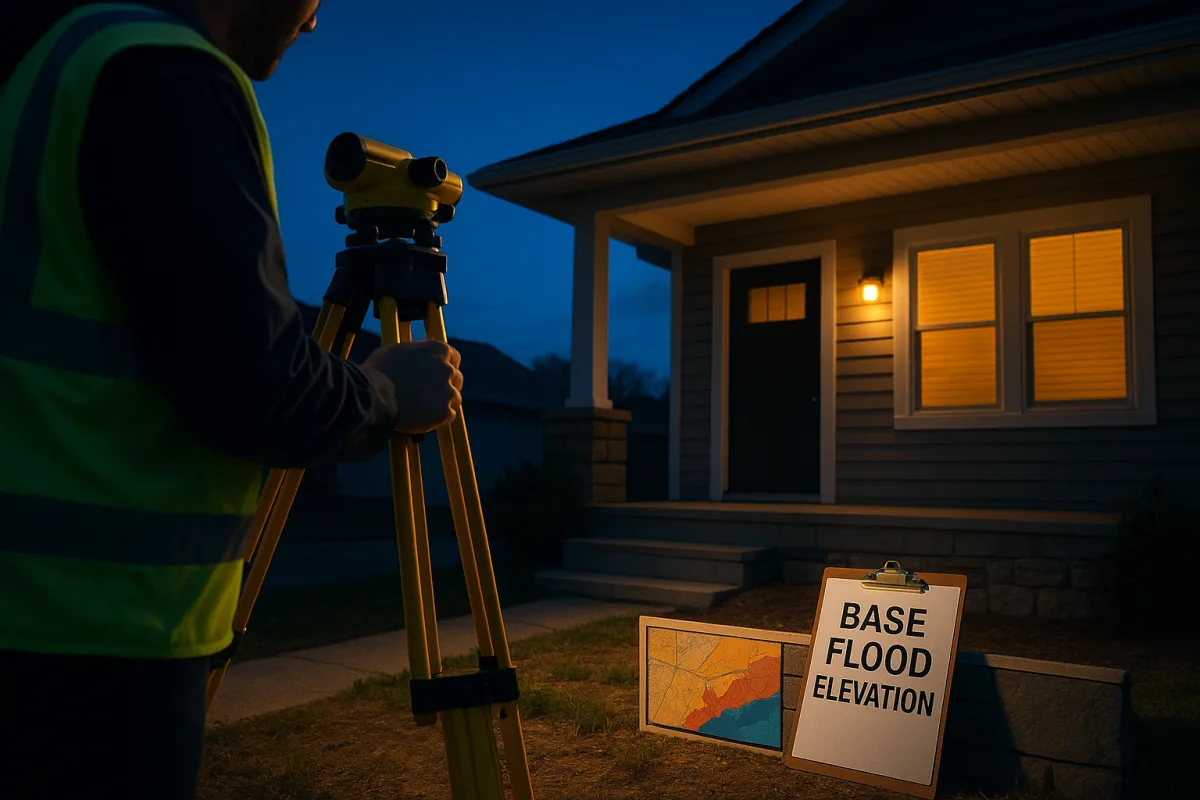
Flood-zone buying: understand the elevation number before you price the house
The flood-zone question is really an elevation question
A buyer who sees “AE” on a listing or lender notice often hears one message: flood insurance required. That is true for a federally backed mortgage in a Special Flood Hazard Area, but it is only the first mechanical consequence. [1] [5]
The more useful question is whether the building’s vulnerable parts sit above or below the Base Flood Elevation, usually called BFE. That comparison helps explain why two houses in the same mapped zone can carry very different flood-insurance costs and mitigation needs.
BFE is FEMA’s estimate of the water-surface elevation associated with the mapped base flood. High-risk Special Flood Hazard Areas generally have a 1% annual flood chance, and FEMA uses zones including A, AE and VE to identify them. [1]
Zone A is a high-risk designation where detailed elevation information may be limited. Zone AE is also high risk, but commonly has mapped BFEs. Zone VE identifies coastal high-hazard areas, where wave action adds another source of damage. [1]
That distinction matters because a house’s lot elevation is not the same as the elevation of its lowest floor, mechanical equipment, crawlspace or enclosed area below the living space. Insurance and damage exposure turn on the building details, not just the neighborhood label.
What an Elevation Certificate actually measures
An Elevation Certificate, or EC, is a standardized document prepared by a licensed professional or obtained through local floodplain records. It records building elevations against the applicable BFE, creating a site-specific picture that a broad FEMA map cannot provide by itself. [1]
For a buyer, the important entries are generally the BFE, the elevation of the lowest floor, and the location of utilities or equipment vulnerable to water. The document may also identify flood openings, such as engineered flood vents, in qualifying enclosed areas.
Think of the central calculation as elevation difference:
Lowest-floor elevation minus Base Flood Elevation equals the home’s elevation margin.
A positive result means the relevant floor is above BFE. A negative result means it is below. The certificate does not itself promise safety, eliminate the chance of flooding or set an insurance price, but it supplies information used in risk and rating decisions.
Suppose, purely as an illustration, a property’s BFE is 10 feet and the lowest floor is 8 feet. The elevation margin is negative 2 feet. A buyer should not translate that into a predetermined premium or a fixed repair bill.
Instead, that two-foot gap is a prompt to get an insurer’s quote, ask local floodplain staff how the structure was permitted, and price the realistic measures needed to reduce exposure. The answer depends on the house design, local rules, insurer and timing.
A house one foot above BFE is in a materially different position from one below it. Flood-mitigation guidance cited in the research brief estimates that elevating a home one foot above BFE can reduce flood damage by about 80%. [11]
That does not mean every house should be elevated, or that an elevation project will pay back dollar for dollar. It means elevation is the central physical variable when you are assessing a property’s flood vulnerability.
How that number becomes a monthly housing cost
Flood insurance is not a closing-cost line item in the way a lender fee or title charge is. It is an ongoing ownership cost. If your mortgage is federally backed and the home is in an SFHA, the lender must require flood coverage. [5]
The lender may collect the premium through escrow, alongside property taxes and homeowners insurance. In that setup, the annual premium is divided into monthly deposits, then the servicer pays the insurer when the bill comes due.
For example, an annual premium of $1,200 adds about $100 per month to the escrow portion of a mortgage payment. That is not a universal quote, just the math a buyer should run using the actual premium for the house.
Recent national figures show why using a generic online estimate is risky. Median National Flood Insurance Program premiums as of June 1, 2026 were reported at $847 overall, $1,008 in Zone AE and $1,317 in Zone VE. [9]
Those medians are reference points, not price caps. The Associated Press reported that premiums had risen roughly 90% over five years, reaching an average around $1,100 annually nationwide by late 2026. [2]
FEMA’s Risk Rating 2.0 uses more individualized pricing, so location, flood type, distance to water, rebuilding cost and building characteristics can matter alongside the mapped zone. The same zone code therefore cannot tell a buyer what they will pay. [2] [8]
Ask for a quote before removing a financing or inspection contingency, and ask whether the quoted policy assumes the current building configuration. If the seller has a policy, its premium is useful history, but it is not necessarily your future premium.
Also ask the lender exactly how it will handle the policy at closing. The research brief found no current national evidence that flood-zone status itself creates standard extra escrow or closing fees, so do not assume a particular surcharge without a written estimate.
Why a FEMA map is necessary, but not enough
FEMA’s map is the starting point because it determines whether a federal lending rule requires insurance. Zone X shaded indicates moderate risk, associated with a 0.2% annual flood chance, while unshaded Zone X is lower risk. [1]
But “not required” does not mean “no flood exposure.” About 25% of flood-insurance claims come from moderate- and low-risk areas, according to the National Flood Insurance Program’s consumer information. [13]
That is particularly important for a buyer comparing a house just inside an AE boundary with one just outside it. The insurance requirement may change at the line, while drainage patterns, intense rainfall and local infrastructure do not necessarily stop there.
Research published in Nature Communications in 2026 used deep learning to extend U.S. flood-hazard mapping and identified millions of properties exposed to previously unrecognized risk. That does not invalidate FEMA maps, but it is a reason not to treat them as a complete forecast. [6]
An American Economic Association study published in August 2026 similarly found that map updates removed some homes from high-risk areas while omitting roughly five million properties, with disproportionate effects in Black and Hispanic communities. [18]
For a buyer, this means adding local evidence to the map review: ask the seller about prior water entry, examine disclosures, speak with the community floodplain manager, and look at the drainage and grade during the inspection period.
Those steps do not produce certainty. They do help distinguish a technical map designation from the practical question: where will water go if a nearby creek rises, a storm drain backs up or a severe rainfall event overwhelms the area?
When a map change might be worth pursuing
Sometimes a home appears in a Special Flood Hazard Area even though the structure sits on naturally high ground or was built above the relevant flood elevation. In that case, a Letter of Map Amendment, or LOMA, may be the relevant process.
A LOMA is generally used to request removal from the mapped SFHA based on information such as surveyed elevation. FEMA says an application should be supported by the appropriate technical documentation, which is where an Elevation Certificate can become valuable. [4]
The research brief indicates that LOMA reviews commonly take four to six weeks and typically have no fee. [4] [9] That timeline is meaningful for a buyer because it may not fit a normal contract deadline unless the parties negotiate time.
A Letter of Map Revision, or LOMR, is a different and usually more involved route. It may be appropriate when a physical change, improved data or a broader mapping issue justifies revising the map rather than correcting one property’s apparent status. [4]
LOMR review can take up to 90 days, followed by a 90-day appeal period. Reported fees range from $6,750 to more than $9,000, so this is not a routine buyer due-diligence item for most transactions. [4] [9]
Even a successful map amendment should not be mistaken for proof that the house will never flood. It can remove a federal insurance requirement if the lender accepts it, but it does not change rainfall, runoff, coastal surge or a home’s physical vulnerabilities.
Price the mitigation that fits the water problem
The purpose of mitigation is not to buy every available product. It is to match the measure to the route water takes into or around the house. That is why the EC, site conditions and local expertise should come before a renovation budget.
Engineered flood vents, for example, allow water to move through qualifying enclosed areas and reduce damaging pressure on foundation walls. The research brief puts their typical cost at about $215 each, but the required number depends on the structure and applicable rules. [10]
A backwater valve targets sewer backup rather than river or coastal flooding. Reported costs are about $300 to $800. [11] A battery-backed sump pump, estimated at $500 to $1,200, helps with groundwater or interior drainage but needs power and maintenance planning. [11]
Interior drainage systems have a broader reported range of $3,000 to $12,000. [11] These measures may reduce certain water-entry risks, but none should be described as a substitute for elevation when the building’s lowest floor is materially below BFE.
Home elevation is the major intervention, with reported costs from $20,000 to $150,000 depending on complexity. [11] That range is large because foundation type, structure size, site access, utility relocation and local construction conditions can radically alter the work.
Flood barriers and shields may be useful in particular settings, but the research found no comprehensive U.S. average installed cost. Avoid inserting a guessed allowance into your offer analysis. Obtain a property-specific proposal if barriers are central to your plan.
Flood-resilient materials can also be expensive. A United Kingdom provider estimates £30,000 to £42,000 for a typical three-bedroom semi-detached-house refit in 2025-26 prices, but that is not a U.S. price benchmark or proof of effectiveness in every American home. [17]
Build the decision around documents, not reassurance
Request the current flood policy declarations page, any Elevation Certificate, prior flood-repair records, permits for elevation or foundation work, and the seller’s disclosures. Then obtain an insurance quote based on the home as it will exist when you own it.
Separately, ask the local floodplain manager whether there are local elevation, enclosure, rebuilding or substantial-improvement rules. A future project can trigger requirements that are not obvious from the purchase contract or a standard home inspection.
It is also worth recognizing how thin insurance coverage remains. The Government Accountability Office reported in October 2026 that 86% of high-risk properties lacked flood insurance, despite the federal requirement applying to many mortgaged homes in designated high-risk areas. [7]
That gap is not evidence that coverage is unnecessary. It shows that risk, affordability, mortgage type and awareness do not line up neatly. Your decision should rest on this property’s elevation, premium quote, financing terms and intended holding period.
I am not a licensed real-estate agent, lender, insurance producer or financial adviser. A lender, insurance professional, qualified surveyor and local floodplain manager can each answer different parts of this question, and the right answer depends on your rate, market and timeline.
Frequently Asked Questions
What should I know before buying a home in a flood zone?
Before buying, understand that flood zone labels like A, AE, or VE indicate high risk but do not tell the whole story. The key factor is the Base Flood Elevation (BFE) relative to the elevation of the home’s lowest floor and vulnerable equipment. This elevation difference influences flood insurance costs, mitigation needs, and resale risk. Also, if the mortgage is federally backed and the home is in a high-risk zone, flood insurance will be mandatory.
How does the Base Flood Elevation affect flood insurance costs?
The Base Flood Elevation (BFE) is FEMA’s estimate of the floodwater height during a base flood event. Homes with lowest floors below the BFE generally face higher flood insurance premiums and greater risk of damage. Elevating a home above the BFE can significantly reduce flood damage—by about 80% per foot—and lower insurance costs, but the exact premium depends on the building details and insurer.
What is an Elevation Certificate and why is it important?
An Elevation Certificate is a standardized document prepared by a licensed professional that records the elevation of a building’s lowest floor and other vulnerable features relative to the BFE. It provides site-specific information that FEMA flood maps alone cannot offer. This certificate is important because it helps insurers set premiums more accurately and informs buyers about flood risk and mitigation options.
Do I need flood insurance if my home is in a flood zone?
If your home is in a Special Flood Hazard Area (SFHA) such as zones A, AE, or VE and your mortgage is federally backed, flood insurance is required for the life of the loan. Outside these zones, flood insurance is optional but recommended, as about 25% of flood claims come from moderate- and low-risk areas. Despite requirements, many high-risk properties still lack insurance coverage.
How can flood zone status impact my mortgage and closing costs?
Flood insurance is not usually a closing cost but an ongoing expense that may be escrowed with your mortgage payment. For federally backed mortgages in high-risk zones, lenders must require flood insurance, which can add significantly to monthly housing costs. For example, an annual premium of $1,200 would increase monthly escrow payments by about $100.
How we researched this
This article was assembled from 18 cited references.
Nothing here is based on hands-on testing. Where a figure or finding appears, it belongs to the source cited beside it, and the writing says so rather than implying otherwise. Every source is listed below so you can check it.
Sources
- What is my Flood Zone | National Flood Insurance Program
- Millions who need flood insurance the most don't have it as flawed federal program raises prices
- 💰 Our flood risk
- Letters of Map Revision and Conditional Letters of Map Revision | FEMA.gov
- V-6 Flood Disaster Protection Act | FDIC.gov
- Deep learning completes US flood hazard maps revealing millions exposed to previously unrecognized risk | Nature Communications
- As Flood Risks Increase, Most Americans Still Don't Have Insurance for It (Interactive Map) | U.S. GAO
- How Much Does Flood Insurance Cost in 2026?
- Flood Insurance Cost by Flood Zone: Median NFIP Premiums (AE, X, VE) | floodriskhere.com
- Flood Vents Cost: Smart Vents, Wet Floodproofing & NFIP Rules | floodproofcost
- Flood Mitigation Strategies: Protecting Your Property | FloodRiskData
- Understanding Flood Areas - National Flood Insurance Exchange
- Flood Zone - National Flood Insurance
- Flood Insurance Myths: What You Need to Know | Allstate
- Flood Risk, Insurance Costs and Home Values in 2026
- New York City is at major risk of flooding that could leave 4.4 million people exposed to extreme damage, study finds
- Flood Defences for Homes: Doors, Barriers, Airbricks | Unda
- Flood Risk Mapping and the Distributional Impacts of Climate Information - American Economic Association
Related Articles

Documents Needed to Buy a House: Complete Checklist
Learn the essential documents needed to buy a house, including financial, identification, and mortgage paperwork to ensure a smooth home purchase.

Home Buying Mistakes to Avoid
Learn home buying mistakes to avoid, including budgeting, inspections, and mortgage tips to make your purchase smoother and cost-effective.
Risks of Buying a Foreclosure: What Buyers Need to Know
Learn the risks of buying a foreclosure, including repair costs, title issues, and hidden expenses to avoid costly mistakes.

How to Choose the Right Neighborhood for Home Buying
Learn how to choose the right neighborhood by evaluating taxes, schools, safety, commute, and future development before buying a home.