
How to Find a Home with Good Resale Value
Learn how to find a home with good resale value by evaluating location, schools, condition, and costs before buying.
Start with the resale question before you start touring
A home can be a place to live and a financial asset, but those are not identical tests. A smart resale search starts by asking who might plausibly want this home next, and what they can afford.
That means looking beyond current staging, paint colors and whether your furniture fits. The buyer pool at resale will care about the neighborhood, the home’s condition, local comparable sales and the payment required at then-current mortgage rates.
I am not a licensed real estate agent, lender, appraiser or financial advisor. This is a practical framework for reading the tradeoffs, not a recommendation to buy, sell or refinance.
First, set a purchase ceiling that includes more than the down payment. On a $400,000 purchase, typical closing costs of 2% to 5% work out to roughly $8,000 to $20,000. [9]
The line items matter because cash used to close is cash unavailable for repairs, upgrades or an appraisal gap. Reported cost components include loan origination charges of 0.5% to 1%, a $300 to $700 appraisal, title insurance of $500 to $1,500, and attorney or escrow charges of $500 to $1,500. [10][11]
Those expenses help complete the purchase, but they do not make the house worth more to a later buyer. Resale value is driven by demand, location, condition and comparable properties, not by how much you paid in lender or settlement fees. [9][10]
Solve the location problem before comparing kitchens
The highest-impact resale decision usually happens before the offer. You cannot renovate a weak commute, add a nearby supermarket, or create a useful transit connection through a weekend project.
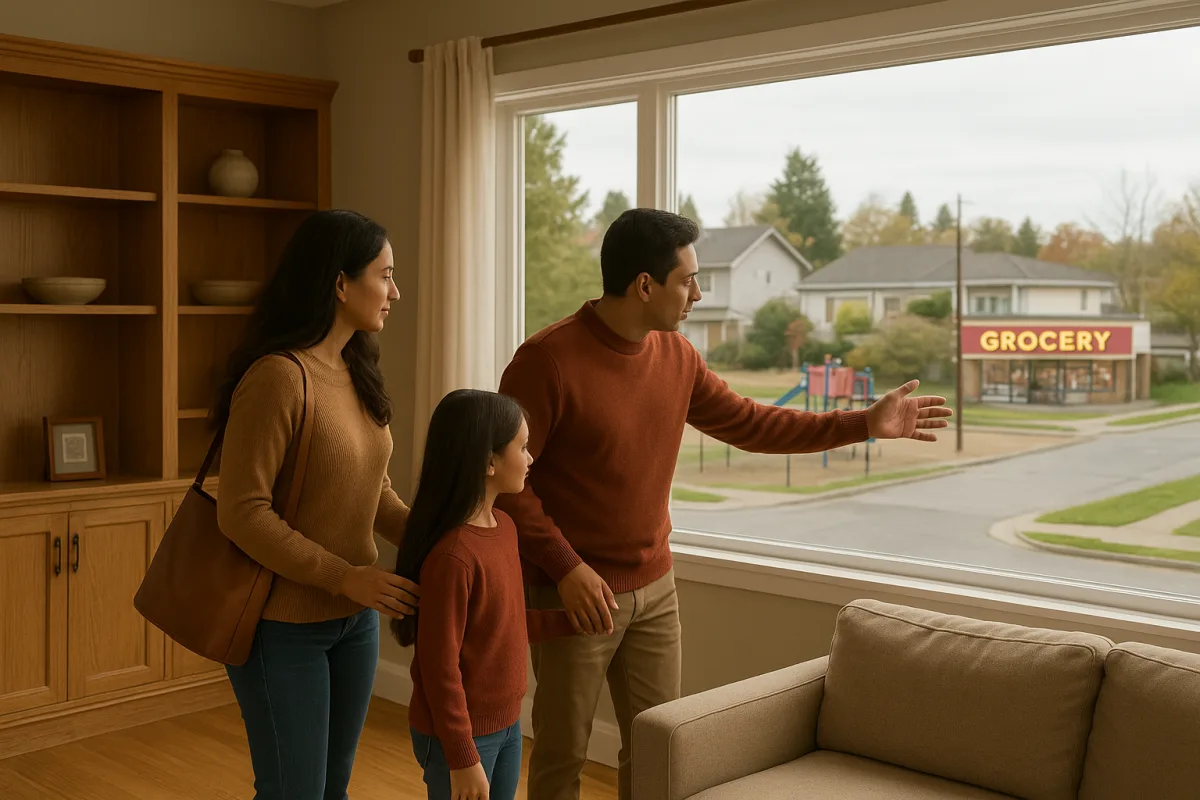
Build a location checklist for every listing. The research brief identifies five consistently supported features: grocery access, employment centers within about a 15-minute commute, walkability and safety, quality schools, and public transit availability. [1][16][17]
Do not reduce that checklist to a map pin. Drive the likely route during the hours you would actually use it, then repeat the trip from the house to groceries, parks, transit and major job centers.
The purpose is not to find a universally perfect neighborhood. It is to avoid paying a premium for a home whose everyday location disadvantages shrink the future buyer pool.
Walkability and safety deserve separate attention from proximity alone. Research on urban environments found that walkability and safety together contributed more than 20% of housing value, illustrating that buyers price the experience of a neighborhood, not merely its boundaries. [1]
A grocery store can also be more consequential than it sounds. Homeslyst identifies proximity to quality grocery stores and short access to employment centers among neighborhood amenities worth paying for, because both affect daily convenience for future purchasers. [16]
Public transit is especially worth checking where car ownership is optional or commuting costs are high. Opendoor’s location analysis includes transit access among the neighborhood features connected to property value, alongside school quality. [17]
When comparing two similar homes, write down what each offers within a realistic walking, driving or transit trip. “Close to downtown” is marketing language. “Twelve minutes to work at 8 a.m. and six minutes to groceries” is a testable advantage.
Price the school district premium instead of simply chasing it
School quality can support demand even for buyers without children, because many future buyers do care about attendance boundaries. But this is a feature with a purchase price attached, and that initial premium changes the investment math.
HonestCasa reports that homes in GreatSchools 8-to-10 districts command about a 28% premium over average 5-to-6 districts, using an example of $525,000 versus $410,000. [7]
Redfin’s national analysis puts the gap around 35%, with homes in highly rated school zones costing about $580,000 compared with $430,000 for the average U.S. home. [8]
The potential resale benefit is not limited to peak markets. HonestCasa reports that homes in top districts sold 22% faster during downturns, which may matter if your eventual sale coincides with a softer market. [7]
Still, do not call the entire school-zone premium “upside.” It is money you pay today. If a better district adds $115,000 to the price in the $525,000 versus $410,000 example, your loan amount, interest cost and property-tax exposure may all be higher.
Urban and suburban comparisons require extra care. Suburban district premiums can reach $100,000 to $200,000, while urban premiums may be higher because desirable school options are scarcer. [7][8]
Before offering, confirm the current attendance boundary directly with the district. A listing description is not a guarantee, and resale buyers may value a school assignment very differently if boundaries or school performance change.
Also calculate affordability at the higher price, rather than assuming the district protects every budget. Redfin found median-income households could spend 54.5% of income on housing in top districts, compared with 40.4% nationally. [8]
Do not use price per square foot as a resale forecast
Price per square foot is useful for organizing comparable listings, but it cannot tell you by itself which home will appreciate faster. It ignores lot utility, condition, layout, school assignment, transit access and the particular features buyers value locally.
The available data does not establish a direct nationwide correlation between a home’s price per square foot and future resale growth. National listing price per square foot fell from $233 in mid-2024 to $226 in September 2025, even as markets varied. [3]
New construction makes the limitation clearer. Average new single-family home size declined 11.6% from 2015 through 2025 while price per square foot rose 71.9%, showing how size, product mix and pricing can move independently. [4]
Use price per square foot as a warning flag, not a verdict. If one house is materially higher than nearby comparable homes, identify the specific reason: a larger usable lot, renovated systems, a better school zone or a location advantage.
If you cannot name the reason for the premium, assume the next buyer may struggle to name one too. The answer depends on the local market and the comparable sales available when you eventually list.
Protect the deal during inspection and appraisal
Once you find a location and price that work, the next resale risk is buying deferred maintenance that will reappear later as a lower appraisal or a buyer objection. Cosmetic flaws are often manageable. Systemic issues are different.
Inspection contingencies give a buyer a period to investigate the property and, depending on contract terms, negotiate repairs, credits or an exit. Read the deadline, the repair threshold and the method for delivering notices before signing.
Focus inspection attention on structure, roof condition, drainage, foundation signs and major systems. Spanr identifies structural and systemic problems as issues that can hurt an appraisal, which means they can affect both financing now and buyer confidence later. [13]
Visible maintenance also matters because it shapes offers before a buyer has read a report. AvailableMax identifies neglected maintenance needs as a reason homes receive lower offers or fail to sell efficiently. [15]
An appraisal gap is a separate calculation. Suppose you agree to pay $450,000 with a 20% down payment, but the appraisal comes in at $430,000 and the lender bases the loan on that lower value.
At 80% loan-to-value, 80% of $430,000 is a $344,000 loan. To close at $450,000, you would need to bring $106,000 before closing costs, rather than the $90,000 down payment you expected.
The extra $16,000 does not automatically become equity supported by comparable sales. It is cash bridging the difference between the contract price and the appraised value, and its wisdom depends on your reserves, timeline and local evidence.
An appraisal contingency can define what happens if value comes in low. That is contract-specific, so understand whether you can renegotiate, cancel, contribute more cash or proceed under a stated appraisal-gap commitment.
Escrow is also a purchase mechanic, not a resale feature. The escrow holder manages funds and documents under the contract, while a lender’s ongoing escrow account may collect monthly tax and insurance payments. Neither directly makes a neighborhood more desirable.
Spend improvement money where a future buyer can see it
The first year of ownership often reveals a temptation to remodel immediately. For resale purposes, start with defects, safety issues and visible deterioration before choosing highly personal design projects.
BuildCalc Pro estimates that replacing a garage door costs about $4,300 and adds $8,350 in value, a 194% return. That is an unusually strong estimate, but it remains a benchmark rather than a promise for every market. [5]
The same guide estimates manufactured stone veneer at $11,300 with $17,300 of value added, or a 153% return. Exterior improvements can help because they affect the first impression before a buyer reaches the kitchen. [5]
For a minor kitchen remodel, Renovation Defenders estimates $28,000 in cost and $31,640 in added value, a 113% return. The word “minor” matters: a functional update is not the same financial decision as a custom, high-end rebuild. [6]
A steel entry-door replacement is estimated at $2,200 in cost and $2,145 in added value, or 97.5% ROI. A deck addition costs about $15,000 but is estimated to return only $10,500 to $12,000, or 65% to 70%. [6]
These figures are estimates from renovation publishers, not guarantees and not evidence that every project produces a profit. Labor pricing, buyer preferences and neighborhood standards can change the result substantially.
Avoid upgrades that make the home an outlier for its block. WikEst warns that over-improving beyond neighborhood standards can reduce return on investment, while over-personalized spaces can narrow buyer appeal. [14]
That does not mean a home must look generic. It means expensive choices should be reversible when possible, especially if they replace broadly useful space with a niche feature that few future buyers will value.
Energy efficiency and modern amenities also deserve consideration when systems are near the end of their life. Kiplinger identifies the absence of energy efficiency and current amenities among features that can deter buyers. [12]
Keep records for the resale buyer you have not met
Save permits, warranties, invoices, inspection reports and records of major repairs. Those documents do not force a higher appraisal, but they can help a future buyer understand what was repaired and when.
Make a simple property file after closing. Include the original listing, disclosures, inspection findings, contractor scope of work, receipts and photographs taken before walls or finishes were closed up.
Finally, distinguish between a home that is expensive and one that is defensibly priced. The national market can move while individual neighborhoods move differently, so a good resale decision rests on local demand, condition and your timeline.
The right answer depends on your interest rate, cash reserves, market and intended holding period. A home with strong resale ingredients can still be a poor fit if the upfront premium leaves too little room for closing costs, repairs and ordinary ownership risk.
Frequently Asked Questions
What factors determine a home's resale value?
Resale value is primarily driven by demand, location, condition, and comparable properties. Key location features include proximity to quality grocery stores, employment centers within about a 15-minute commute, walkability, safety, quality schools, and public transit availability. The home's condition and how it compares to local norms also significantly impact value.
How can I evaluate a home's location for resale potential?
Evaluate location by checking daily-use features such as grocery access, commute times to employment centers, walkability, safety, school quality, and transit access. It helps to drive the likely routes during actual usage hours to assess convenience and neighborhood experience rather than relying solely on map proximity.
Why is school district important for resale value?
Homes in highly rated school districts cost about 35% more nationally, reflecting the premium buyers place on quality education. A top-rated school district is considered an expensive resale feature that can significantly increase a home's market value.
What closing costs affect home buying but not resale value?
Closing costs typically range from 2% to 5% of the purchase price and include loan origination fees, appraisal, title insurance, and attorney or escrow charges. These costs are necessary to complete the purchase but do not add to the property's resale value.
How do home condition and renovations impact resale value?
Prioritizing good condition over cosmetic customization is important. For example, a $4,300 garage-door replacement can add an estimated $8,350 in value. However, over-improving beyond local market norms can make it difficult to recover renovation expenses at resale.
How we researched this
This article was assembled from 17 cited references.
Nothing here is based on hands-on testing. Where a figure or finding appears, it belongs to the source cited beside it, and the writing says so rather than implying otherwise. Every source is listed below so you can check it.
Sources
- The economic value of neighborhoods: Predicting real estate prices from the urban environment
- U.S. Housing Market Report - Homes.com
- Price Per Square Foot in 2026: 12 Critical Factors That Actually Determine Home Value
- New Homes Shrank 11.6%, Price Per Sq Ft Up 71.9%
- Home Renovations With the Highest ROI — 2026 Cost vs. Value Guide | BuildCalc Pro
- Which Home Renovations Have the Highest ROI in 2026?
- School District Impact Home Values | HonestCasa | HonestCasa
- Homes in Highly Rated School Zones Cost 35% More Than the Average U.S. Home
- Closing Cost Calculator 2026 — Buyer & Seller Costs | CalcFi
- First-Time Home Buyer Guide 2026 | HomeAffordabilityCalc.info
- How Much Are Closing Costs in 2026? Average Fees | reAlpha Tech Corp. (AIRE)
- 5 Signs Home Buyers Have More Negotiating Power Right Now
- What Hurts a Home Appraisal 2026: 5 Factors That Kill Value | Home Guides | Spanr
- What Adds the Most Resale Value to a Home? 2026 Guide | WikEst's Resale Value? 2026 Guide | WikEst
- Why Your Home Isn’t Selling in 2026: 9 Real Reasons + Fixes
- 8 Neighborhood Amenities Worth Paying For - Homeslyst
- How important is location to property value? | Opendoor
Related Articles
How to Choose the Right Neighborhood for Home Buying
Learn how to choose the right neighborhood by evaluating taxes, schools, safety, commute, and future development before buying a home.

How to Find a Good Home Inspector: Tips and Licensing Info
Learn how to find a good home inspector by verifying licenses, comparing costs, and reviewing sample reports before hiring.
Best Renovations for Resale Value
Discover the best renovations for resale value with insights on ROI, recoupment, and which projects add the most value when selling your home.
Best Time to Buy a House in 2026
Discover the best time to buy a house in 2026 with insights on seasonal trends, mortgage rates, and market conditions to help you plan your purchase.