
How to Create a Home Buying Budget: Step-by-Step Guide
Learn how to create a home buying budget including down payment, closing costs, monthly expenses, and credit tips for a smooth purchase.
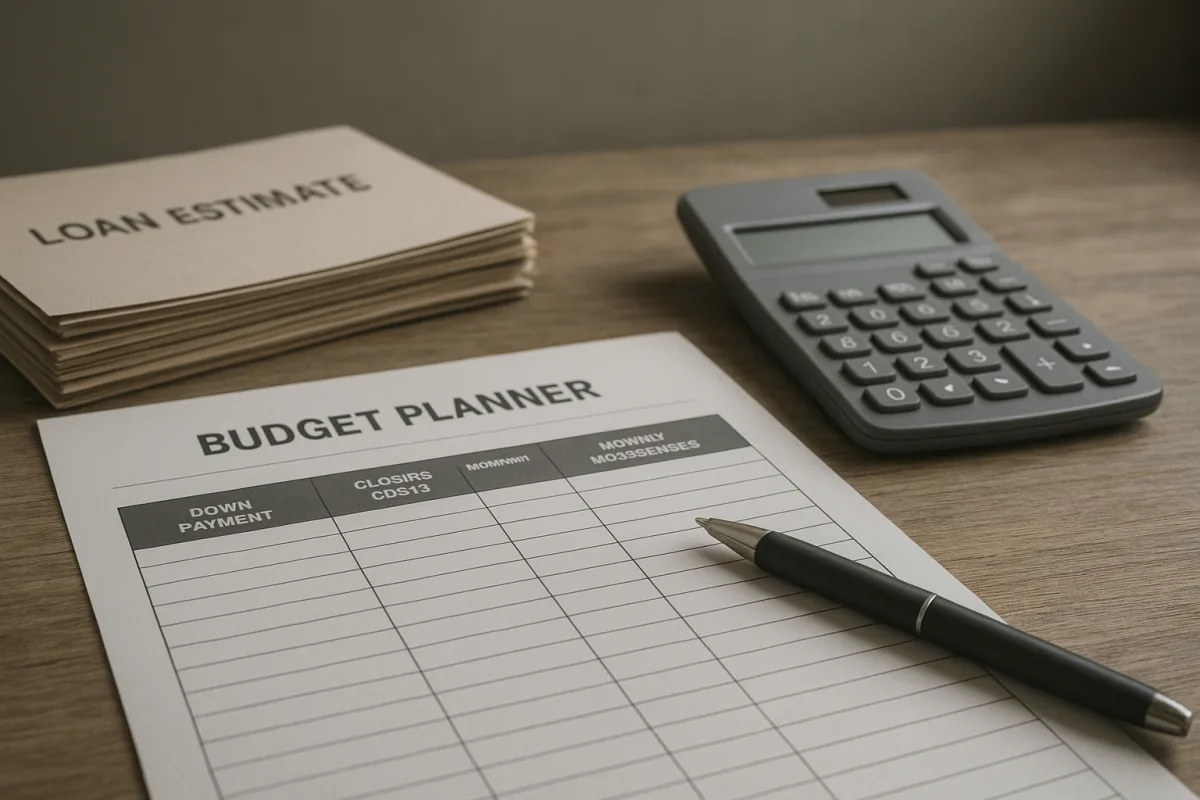
Start with a buying timeline, not a listing price
A home-buying budget works better as a sequence of deadlines. The first bill is not the mortgage payment. It is the work of turning current income, debt, savings and credit into a realistic range before a seller’s deadline forces rushed decisions.
The Consumer Financial Protection Bureau advises buyers to get their financial situation in order before entering the process, including reviewing spending, debts, savings and credit. [2] That is practical advice because lenders evaluate the application you submit, while you must live with the payment afterward.
A two-year runway is a useful planning model, not a requirement. Economic Mobility Project’s home-buying guidance proposes focusing on credit improvement and debt reduction during the first 12 months, while building the down payment over roughly six to 24 months. [16]
Use the same period to build an emergency fund. Down-payment money has a job at closing, but emergency savings has a different job after closing, when a repair, move or escrow shortage appears. Combining the two can leave a buyer cash-poor immediately after purchase.
In the final six months, shift from broad savings goals to transaction-specific estimates: pre-approval, likely closing costs, insurance quotes, taxes, inspections and moving. [16] This is when a vague goal such as “save 10%” needs to become a cash-to-close number.
Check credit before pricing the house
Credit affects both the likelihood of approval and the interest rate used in your monthly payment. Real Cost Report puts the average mortgage rate at 6.67% for borrowers with scores of 760 or above, versus 7.01% for a 700 score. [15]
That difference is measurable. On a hypothetical $340,000, 30-year fixed loan, principal and interest is roughly $2,190 monthly at 6.67% and about $2,260 at 7.01%, before taxes, insurance or mortgage insurance.
That example assumes the same loan size and a fixed rate, so it is not a rate quote. Still, it shows why improving credit before applying can matter more than shaving a small amount from a furniture budget.
Approval chances also fall sharply below a 620 score, according to Real Cost Report. [15] If a score is near that threshold, build time into the plan to correct report errors, reduce balances and avoid taking on new debt before mortgage applications.
Do not assume a pre-approval tells you what is comfortable. It generally signals what a lender may be willing to lend under its underwriting rules. Your own budget must account for costs that may not be fully reflected in a debt-to-income calculation.
Set the purchase-price range from cash and monthly limits
Start with two ceilings: available cash at closing and a sustainable monthly ownership payment. The lower result should drive the search range. This prevents a buyer from having enough income for a house but not enough cash to close, or vice versa.
Down payments are not uniform nationally. BestMoney reports first-quarter 2026 regional averages of 17.3% in the Northeast, 15.2% in the West, 13.6% in the Midwest and 11.1% in the South. [9]
Those are descriptions of regional behavior, not targets every buyer must meet. A lower down payment preserves cash but can trigger private mortgage insurance, while a larger down payment may reduce the loan amount and avoid PMI if it reaches 20%.
For budgeting, calculate several down-payment scenarios on the same price. On a $400,000 house, 20% is $80,000, 15% is $60,000, and 10% is $40,000. Then add the costs that do not disappear when the down payment changes.
If you put down less than 20%, mortgage insurance commonly costs 0.5% to 1.5% of the loan balance annually. [6] A $360,000 loan with a 1% annual PMI charge would add about $300 a month, though the actual premium depends on the loan and borrower.
Build the payment using the whole ownership bill
A listing’s mortgage calculator can understate the practical cost if it omits local taxes, insurance, HOA dues, maintenance or mortgage insurance. Create a monthly worksheet with a separate line for every recurring cost, even when an amount is initially an estimate.
Nationally, monthly costs combining mortgage, taxes, insurance and maintenance average roughly $3,369 to $3,703 for a $400,000 home, but state and local differences are substantial. [5] Use that only as a reminder of the categories, not a prediction for your household.
Property taxes and homeowners insurance deserve particular attention. In some places, tax and insurance costs can rival the mortgage payment, and those bills vary with local assessments, insurance markets and the specific property. [12]
Ask for the current annual property-tax bill and obtain homeowners insurance quotes while evaluating a property. Do not simply use a national average. A new policy, a reassessment or a different insurer can make the prior owner’s numbers an unreliable forecast.
Budget about $300 per month for utilities as a national starting point, then verify local electric, gas, water and trash costs where possible. [7] HOA dues are even less suitable for a national assumption, so obtain the current amount and review whether increases are permitted.
Maintenance should be a standing line item, not an occasional surprise. A common planning estimate is 1% to 2% of the home’s value annually. [3] On a $400,000 home, that is $4,000 to $8,000 a year, or roughly $333 to $667 monthly.
You will not necessarily spend that amount every year. The point is to fund the category before the roof leak, appliance failure or exterior repair turns into revolving credit-card debt. Older homes, deferred maintenance and climate exposure can make the needed reserve higher.
Price the cash needed before closing
Closing costs commonly run 2% to 5% of the purchase price, according to HomeCostLab. [3] On a $350,000 purchase, that is about $7,000 to $17,500, separate from the down payment and separate from money needed for moving or repairs.
There is no dependable single national closing-cost number. My Financial 101 cites a 2024 national average of $4,661 and suggests budgeting at least $6,000 in 2026, but state-level estimates range far beyond that figure. [4]
FreeFinCalc, for example, estimates average closing costs of $24,582 in New York, or 7.68% of the loan amount, versus $6,905 in Missouri, or 1.97%. It estimates $29,888 in Washington, DC, and $2,000 in South Dakota. [14]
These figures are estimates, not guaranteed borrower charges. They demonstrate why buyers should not use a national percentage as their final number. Local transfer taxes, title charges, lender fees, loan structure and negotiated seller credits all affect the result.
Request Loan Estimates from competing lenders and compare the fees line by line. LendingTree and Fair Price Check both emphasize that lender closing costs vary, so the interest rate alone does not tell you which offer requires less cash or costs less overall. [10] [13]
When comparing offers, separate charges into three groups: lender fees, third-party charges such as appraisal or title services, and prepaid items. A lender can offer a lower upfront fee while pairing it with a higher rate, so compare both the cash required and payment over your expected timeline.
Do not overlook escrow prepayments
An escrow account is not an abstract fee. It is an account the loan servicer uses to collect part of your expected property-tax and insurance bills with each mortgage payment, then pay those bills when due.
At closing, lenders often require two to six months of property taxes prepaid into escrow. [3] Homeowners insurance may also require an upfront premium, depending on the policy and closing arrangement. These amounts can make the cash-to-close figure materially higher than the down payment plus lender fees.
Put escrow prepayments in their own closing worksheet line. The exact requirement depends on the property-tax schedule, insurance premium, closing date and lender, and the research does not support a universal escrow-fee estimate. Ask for the preliminary Closing Disclosure figures as the transaction advances.
Escrow can also change after closing. If taxes or insurance rise, the servicer may increase the monthly escrow portion after its annual analysis. The size and timing of those increases are hard to generalize, so leave monthly slack rather than budgeting to the dollar.
Budget for the offer stage, including contingencies
Before making an offer, reserve money for inspection and appraisal costs, immediate repairs, moving and basic furnishings. These are part of becoming an owner, even though they may not appear in a lender’s advertised payment.
An inspection contingency gives a buyer a defined opportunity to investigate the property and, depending on the contract, negotiate, proceed or withdraw. Budgeting for the inspection helps preserve that decision point rather than treating it as an optional inconvenience.
An appraisal is different. It is primarily the lender’s valuation check for the loan, not a substitute for an inspection. If the appraisal comes in below the contract price, the financing is often based on the lower appraised value.
Consider a $400,000 contract with a 10% down payment. If the appraisal is $380,000 and the lender permits 90% financing of that value, the loan would be $342,000, leaving $58,000 of buyer cash needed for price and down payment rather than $40,000.
That $18,000 difference is the appraisal gap in cash terms under those assumptions. The actual result depends on your loan-to-value rules, appraisal contingency, renegotiation with the seller and whether you choose to bring additional funds. Do not promise gap coverage without identifying its source.
Choose timing based on your budget constraint
Market timing is a trade-off, not a universal strategy. Spring generally brings the most listings, but it also tends to bring the highest prices. More choices can help buyers with specific needs, while competition can put pressure on both price and contingencies.
Fall may offer price reductions of roughly 2% to 5%, according to RealCostIQ’s 2026 homebuyer guide. [6] On a $440,000 home, that works out to about $8,800 to $22,000, although local conditions can differ sharply.
Winter can bring lower prices but fewer listings. [6] A buyer whose main constraint is cash to close may value potential price flexibility, while a buyer needing a particular school area, layout or move date may value spring inventory more. The right answer depends on the local market and timeline.
Put the budget into a system you will update
Use a dedicated home-buying budget with separate categories for down payment, closing costs, escrow prepaids, inspection, appraisal, moving, repairs, furnishings and post-closing reserves. Do not let a large savings total hide the fact that several obligations will hit at different times.
TechRadar’s budgeting-software roundup includes YNAB, Quicken and Mint as tools for managing expenses. [8] The research brief does not provide current pricing for those services, so compare their present subscriptions and features directly before selecting one.
Whatever tool you use, update it after each material change: a new rate quote, insurance estimate, tax bill, HOA disclosure, inspection finding or lender Loan Estimate. A home budget is not a one-time affordability test. It is a living cash-flow plan.
I am not a licensed real estate agent, lender or financial advisor. This guide is a framework for asking better questions and checking the numbers attached to a purchase, not a recommendation to buy, sell or refinance.
Frequently Asked Questions
How do I create a realistic home buying budget?
Start by setting two limits: the cash you can afford to pay at closing and a sustainable monthly housing payment. Include all costs such as down payment, closing costs, prepaid taxes and insurance, inspection and appraisal fees, and ongoing expenses like mortgage insurance, property taxes, homeowners insurance, HOA dues, utilities, and maintenance. Use a timeline approach to prepare your finances over 12 to 24 months, focusing first on credit improvement and debt reduction, then on saving for the down payment and closing costs.
What expenses should I include in my home buying budget?
Your budget should cover the down payment, closing costs (typically 2–5% of the purchase price, varying by region and lender), prepaid property taxes and insurance for escrow, inspection and appraisal fees, and moving costs. After purchase, include monthly mortgage payments (principal, interest, mortgage insurance if applicable), property taxes, homeowners insurance, HOA fees, utilities, and maintenance costs averaging 1–2% of the home’s value annually.
How can I plan my budget before starting the home buying process?
The Consumer Financial Protection Bureau recommends getting your financial situation in order before house hunting, including reviewing your spending, debts, savings, and credit. A two-year runway is useful: spend the first year improving credit and reducing debt, while saving for a down payment over six to 24 months. Build an emergency fund alongside savings for closing costs, and in the final six months, focus on transaction-specific estimates like pre-approval, closing costs, and insurance quotes.
How much cash do I need to save before buying a home?
Cash-to-close includes the down payment plus closing costs, prepaid taxes and insurance, inspection and appraisal fees. Closing costs typically range from 2% to 5% of the purchase price but vary widely by state and lender. For example, on a $400,000 home, a 20% down payment is $80,000, plus closing costs that could be $8,000 to $20,000 or more depending on location. It’s important to also keep an emergency fund separate to cover unexpected expenses after closing.
How do credit scores affect my home buying budget?
Credit scores impact both your mortgage interest rate and your chances of approval. Borrowers with excellent credit (760+) may get rates around 6.67%, while those with a 700 score might see rates near 7.01%, which can increase monthly payments by about $70 on a $340,000 loan. Scores below 620 sharply reduce approval chances. Improving your credit before applying can lower your interest rate and monthly costs, making your home buying budget more manageable.
How we researched this
This article was assembled from 18 cited references.
Nothing here is based on hands-on testing. Where a figure or finding appears, it belongs to the source cited beside it, and the writing says so rather than implying otherwise. Every source is listed below so you can check it.
Sources
- Inflation, insurance, maintenance: Why owning a home in Illinois costs more in 2025
- Get your money situation in order | Consumer Financial Protection Bureau
- First-Time Homebuyer: All Costs Explained (2026) | HomeCostLab
- First-Time Homebuyer Closing Costs 2026 My Financial 101
- Think You Can Afford That House? Run These Numbers First
- First-Time Home Buyer Guide 2026: Every Step & Cost
- 15 First-Time Home Buyer Expenses to Save For in 2026: The Complete Financial Guide
- Best budgeting software of 2026
- How Much Do Homebuyers Put Down by Region?
- How Much Are Closing Costs? Average Costs and Fees in 2026 | LendingTree
- Best Homeowners Insurance - September 2026
- Where Taxes and Insurance Rival the Mortgage Payment
- Compare Mortgage Lender Closing Costs (2026)
- Average Closing Costs by State 2026 (All 50 States Ranked)
- Credit Score Impact on Mortgage Rates by Tier: How Much Each Tier Costs in 2026 - Real Cost Report
- Buying Your First Home: The Two-Year Runway | Empower — Economic Mobility Project
- The Home Buying Checklist: 12 Steps From Financial Prep to Move-In (2026) | Opendoor
- How to Master Cash Flow Planning for Buying a Home | Gerald
Related Articles
Home Buying Mistakes to Avoid
Learn home buying mistakes to avoid, including budgeting, inspections, and mortgage tips to make your purchase smoother and cost-effective.
Calculate Home Affordability: Full Cost Breakdown for Buyers
Learn how to calculate home affordability by including down payment, closing costs, inspections, PMI, and monthly expenses for a realistic budget.
Risks of Buying a Foreclosure: What Buyers Need to Know
Learn the risks of buying a foreclosure, including repair costs, title issues, and hidden expenses to avoid costly mistakes.
Documents Needed to Buy a House: Complete Checklist
Learn the essential documents needed to buy a house, including financial, identification, and mortgage paperwork to ensure a smooth home purchase.