
Affordable Neighborhoods for First Time Home Buyers in 2026
Explore affordable neighborhoods for first time home buyers with insights on monthly costs, taxes, insurance, and financing in 2026.
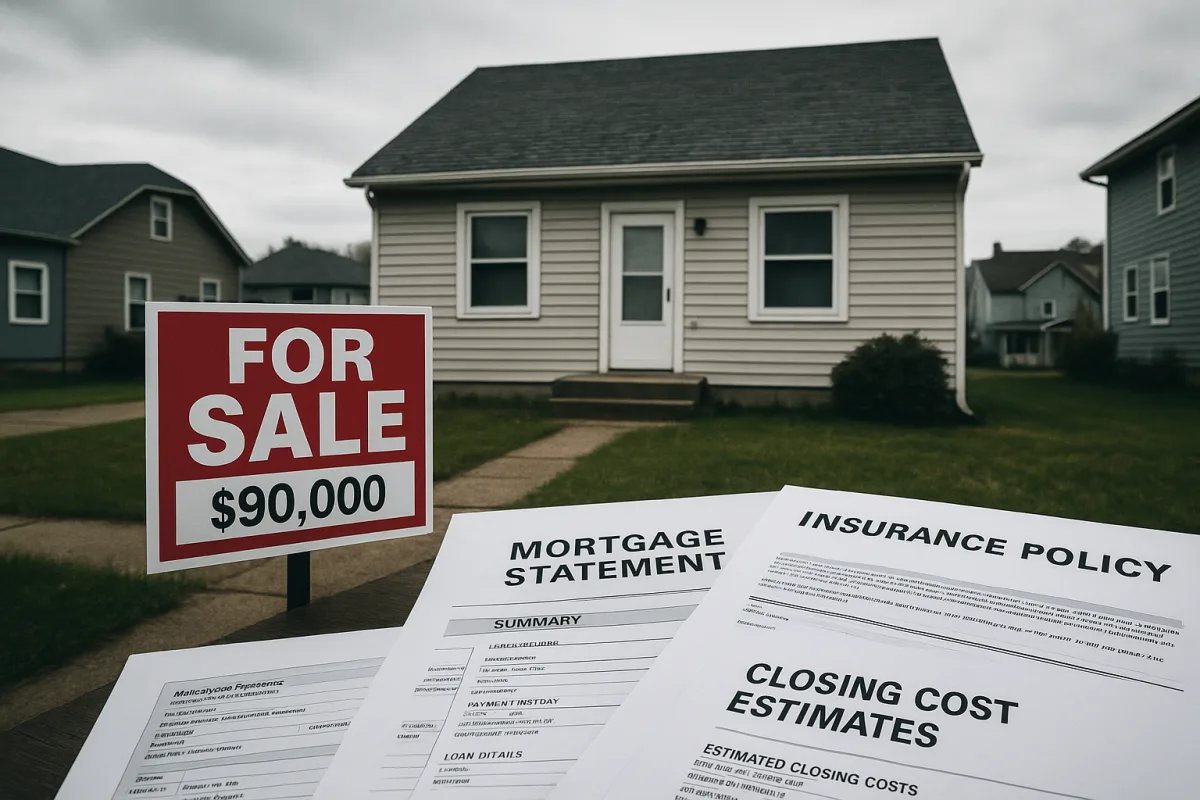
The number that makes a neighborhood affordable, or not
First-time buyers often start with a list of affordable neighborhoods, then sort listings by price. That is understandable, but the more useful number is the monthly ownership cost after financing, taxes, insurance, and any mortgage insurance.
The reports available for 2026 identify places including Jacksonville, Florida, Birmingham, Alabama, Peoria, Illinois, Altoona, Pennsylvania, and Ottumwa, Iowa as relatively affordable first-time-buyer markets. Their cited median home prices range from roughly $92,400 in Ottumwa to roughly $349,000 in Jacksonville. [2][3][4][5]
Those are city or metro-level affordability findings, not a verified national ranking of individual neighborhoods. The research does not provide a comprehensive 2026 neighborhood-by-neighborhood table, so a buyer should be cautious about treating a city median as the price of a particular block.
The useful exercise is to turn the listing price into a payment estimate. Mortgage professionals commonly call the result PITI, meaning principal, interest, property taxes, and homeowners insurance. If the loan requires mortgage insurance, that becomes another monthly line item.
That calculation is particularly important now because mortgage rates remain in the mid- to upper-6% range, while limited inventory has kept many markets competitive. [11] A lower purchase price still matters, but financing costs make the difference between a $100,000 home and a $350,000 home much larger than the sticker-price gap alone suggests.
Start with principal and interest
Principal and interest is the mortgage payment itself. Principal is the amount borrowed and gradually repaid. Interest is what the lender charges for lending that amount, and it makes up a larger share of the early payments on a standard fixed-rate mortgage.
Here is a simplified comparison using a 30-year fixed-rate loan at 6.75% and a 10% down payment. These are assumptions for illustration, not a rate quote, and they exclude taxes, insurance, mortgage insurance, association dues, maintenance, and closing costs.
On a $92,400 home, a 10% down payment is $9,240. The resulting loan amount is $83,160. At the assumed 6.75% rate, principal and interest would be about $539 per month.
On a $349,000 home, a 10% down payment is $34,900. The resulting loan amount is $314,100. At the same assumed rate and term, principal and interest would be about $2,037 per month.
That is a difference of roughly $1,498 each month before the other ownership costs are added. Ottumwa’s lower reported median price and Jacksonville’s higher reported median therefore do not merely imply different down payments. They produce fundamentally different monthly financing obligations. [2][3][4][5]
Rate matters as much as price. A buyer quoted 6.25% rather than 6.75%, or 7.25% rather than 6.75%, will get a different payment on the same house. The Loan Estimate is where to compare those actual lender-specific figures.
Taxes and insurance are not side costs
A common mistake is to compare only the mortgage payment shown by an online calculator. Property taxes and homeowners insurance can change the apparent affordability of a neighborhood, even when two homes have similar prices.
Property tax rates vary substantially by state. HomeCostLab puts the national average around 1.1% of home value, compared with 2.23% in New Jersey, 2.08% in Illinois, 0.86% in Florida, 0.71% in California, and 0.29% in Hawaii. [8]
A percentage is not a complete tax bill. Local assessments, exemptions, school districts, municipal levies, and reassessment practices all affect the actual amount. Still, the state-level figures show why two similarly priced homes can produce different monthly budgets.
For a rough illustration, Florida’s 0.86% rate applied to a $349,000 home equals about $3,001 annually, or about $250 monthly. That is only a broad estimate, not a Jacksonville tax quote, and a county tax bill may differ materially. [8]
Insurance introduces another variable. National homeowners insurance averages about $2,470 annually, or about $206 per month, but the state variation is substantial. Florida averages roughly $5,735 a year, while Nebraska averages roughly $6,425. [8]
That Florida average equals about $478 monthly. Add it to the earlier $2,037 principal-and-interest example and the running total becomes roughly $2,765 per month before mortgage insurance, maintenance, association dues, utilities, or flood insurance.
This is why Jacksonville’s median price should not be read as a complete affordability verdict. Florida’s lower property-tax rate may help compared with some states, but high insurance can absorb much of that benefit. [8]
The same principle applies in Illinois. Peoria may have lower home prices than many large metros, but Illinois’ cited 2.08% statewide property-tax rate means the tax line deserves close attention on each specific property. [8]
What escrow actually does
“Escrow” can mean two related but different systems. At closing, an escrow holder or settlement agent may hold funds and documents until the parties satisfy the contract and lender conditions. After closing, a mortgage escrow account may collect taxes and insurance monthly.
The monthly mortgage escrow account is not a savings account controlled freely by the homeowner. The loan servicer collects an estimated share of annual property taxes and insurance with each mortgage payment, then pays those bills when due.
Using the $349,000 Florida example, the rough tax estimate was $250 a month and the statewide insurance average was $478. A servicer could collect about $728 monthly for those two items, in addition to the $2,037 principal-and-interest payment.
In practice, the initial escrow deposit at closing can be larger than one month’s estimate. It may include several months of taxes or insurance, plus a permitted cushion. The exact amount depends on closing date, billing cycles, insurer timing, and the servicer’s analysis.
Escrow accounts are recalculated periodically. If taxes or insurance rise, the servicer may increase the future monthly payment and, in some cases, collect a shortage over time. A fixed-rate mortgage fixes the principal-and-interest payment, not necessarily the total payment.
The research brief does not provide reliable escrow-fee data for Jacksonville, Birmingham, Peoria, Altoona, or Ottumwa. Those charges vary locally, so they should be treated as transaction-specific figures to review on the Loan Estimate and Closing Disclosure.
Down payment is not the same as cash to close
First-time buyers often hear that the typical down payment is around 9% to 10%. That is useful context, but it does not mean a buyer needs only 10% of the home price in cash. [1]
Closing costs commonly run about 2% to 5% nationally. They can include lender charges, title services, government recording charges, prepaid insurance, initial escrow funding, and other transaction-specific items. [9]
On the $92,400 Ottumwa example, 10% down is $9,240. Adding closing costs of 2% to 5%, or roughly $1,848 to $4,620, produces an estimated cash-to-close range of about $11,088 to $13,860, before any seller credit or assistance.
On the $349,000 Jacksonville example, 10% down is $34,900. Estimated closing costs of 2% to 5% add about $6,980 to $17,450. That produces a broad estimated range of $41,880 to $52,350.
These examples are not quotes. They do show the mechanics: lower-price markets can reduce both the loan payment and the cash needed at closing, but location-specific taxes, insurance, repairs, and moving costs still belong in the calculation.
Low-down-payment programs change one line, not every line
Several programs can reduce the down-payment portion of the equation. FHA loans allow a 3.5% down payment for qualifying borrowers. Eligible veterans may use VA financing with no down payment, while eligible rural buyers may qualify for USDA financing with no down payment. [18]
Conventional programs including HomeReady and Home Possible may permit 3% down for eligible borrowers. State and local assistance can also provide grants or forgivable second loans, although eligibility, income limits, property requirements, repayment triggers, and funding availability vary. [18]
For example, the research identifies assistance programs of up to $17,500 through California’s CalHFA MyHome, up to $15,000 through Texas TSAHC My First Texas Home, up to $15,000 through New York SONYMA, and a $15,000 forgivable second mortgage program in North Carolina. [18]
A lower down payment increases the loan amount, which generally increases principal and interest. It can also mean mortgage insurance on many loan types. The program may solve an upfront-cash problem, but it does not make the home’s ongoing costs disappear.
Builder incentives deserve the same line-by-line treatment. A rate buydown, closing-cost credit, or free upgrade can reduce an upfront expense, but may be available only with a preferred lender, specific loan terms, or a price that reflects part of the incentive. [16]
Why the cheapest neighborhood is not automatically the lowest-cost choice
A neighborhood’s price point is only one part of ownership cost. Commute time, transportation spending, school needs, property condition, local development, and the likelihood of future repairs can materially change what a household pays and how the home fits its timeline. [15][16]
A house with a lower price can require a longer commute, higher fuel costs, a second vehicle, or near-term repairs. Conversely, a higher-priced home may have different tax exposure, insurance needs, or maintenance demands. The numbers are property-specific.
Before treating any market as “best,” compare the same set of figures for each candidate property: purchase price, down payment, interest rate, principal and interest, taxes, insurance, mortgage insurance, association dues, estimated repairs, and cash to close.
The right answer depends on the rate a borrower can actually obtain, the property’s tax and insurance history, local market conditions, and how long the owner expects to keep the home. I am not a licensed real estate agent, lender, or financial advisor, and this is not individualized buying, selling, or refinancing advice.
Frequently Asked Questions
What makes a neighborhood affordable for first time home buyers?
Affordability depends not just on home price but on the total monthly ownership cost after financing, taxes, insurance, and mortgage insurance if applicable. Neighborhood affordability also varies by local property tax rates, insurance costs, and other ownership expenses that influence the monthly payment beyond the sticker price.
How do monthly costs affect neighborhood affordability for first time buyers?
Monthly costs including principal, interest, property taxes, homeowners insurance, and mortgage insurance combine to form the total payment. Even homes with similar prices can have very different monthly costs due to variations in tax rates and insurance premiums, which can significantly impact affordability.
Which cities have affordable neighborhoods for first time home buyers in 2026?
Cities identified as relatively affordable for first-time buyers in 2026 include Jacksonville, Florida; Birmingham, Alabama; Peoria, Illinois; Altoona, Pennsylvania; and Ottumwa, Iowa. Median home prices in these cities range from about $92,400 in Ottumwa to $349,000 in Jacksonville.
How do property taxes and insurance impact affordability for first time buyers?
Property tax rates vary widely by state, affecting monthly costs; for example, Florida’s rate is about 0.86% of home value, while New Jersey’s is 2.23%. Homeowners insurance also varies, with Florida averaging about $5,735 annually, which can add hundreds of dollars per month to ownership costs, impacting overall affordability.
What should first time home buyers consider beyond home price when choosing a neighborhood?
Buyers should consider total monthly payments including taxes and insurance, closing costs, commute times, school quality, and future development plans. Focusing solely on home price can overlook these factors that affect long-term affordability and satisfaction.
How we researched this
This article was assembled from 18 cited references.
Nothing here is based on hands-on testing. Where a figure or finding appears, it belongs to the source cited beside it, and the writing says so rather than implying otherwise. Every source is listed below so you can check it.
Sources
- Cleveland home prices keep climbing
- 10 Best Metros for First-Time Home Buyers | Zillow
- Best Cities For First-Time Homebuyers in 2026
- Best Metros for First-Time Homebuyers 2026, Affordable New Construction Homes
- Best Cities for First-Time Homebuyers (2026) | Cost of Living Study
- First-Time Homebuyer Guide: Tampa 2026 | Insurance, DPA &…
- Austin First-Time Home Buyer Guide 2026 | Grewal RE Group
- First-Time Homebuyer: All Costs Explained (2026) | HomeCostLab
- US Closing Costs and Property Taxes: What Buyers Pay in 2026 · Habio
- Las Vegas Closing Costs 2026 Buyer and Seller Breakdown
- Buying a home in September 2026: pricing, leverage, timing - Homes.com News
- Housing Affordability Squeeze: A New Normal for Buyers | Morgan Stanley
- Britain's stagnant housing market: What can sellers do in a buyer's market?
- Articles
- First-Time Homebuyer Mistakes to Avoid in Dallas (2026 Guide for Smart Buyers) | Little Elm Buyers Agent
- Think You Can Afford That House? Run These Numbers First
- Best Cities for First-Time Homebuyers in 2026
- First-Time Home Buyer Programs 2026: Every Option That Saves
Related Articles
How to Choose the Right Neighborhood for Home Buying
Learn how to choose the right neighborhood by evaluating taxes, schools, safety, commute, and future development before buying a home.
Home Buying Mistakes to Avoid
Learn home buying mistakes to avoid, including budgeting, inspections, and mortgage tips to make your purchase smoother and cost-effective.
Benefits of Home Ownership: Equity, Costs, and Appreciation
Learn the benefits of home ownership including equity building, costs involved, and how appreciation impacts your investment over time.
Closing Costs: What They Are and How Much to Expect
Learn what closing costs are, typical fees included, and how much you can expect to pay when buying a home.