
How to Handle Multiple Offers on a House: A Seller’s Guide
Learn how to handle multiple offers on a house by comparing net proceeds, setting deadlines, and managing contingencies for the best sale outcome.
Start by deciding whether you actually have leverage
Multiple offers are useful only if they are real, complete and materially competitive. A showing schedule full of interest is not the same as three signed offers with lender information, earnest-money terms and a proposed closing date.
Market conditions should shape the process before you invite buyers to compete. Inman reported that 57% of homes in the Mid-Atlantic market it tracked received multiple offers, and 41.2% sold above list price. [9]
That does not describe every city. Axios reported more inventory and less urgency in the Twin Cities, while Redfin found that 44.7% of August 2026 home sales involved seller concessions. [8][9]
The practical implication is not to manufacture urgency where buyers have choices. Ask your listing professional to identify current local inventory, recent comparable sales, typical concessions and how often comparable homes are receiving multiple offers.
I am not a licensed real estate agent, lender, attorney or financial adviser. The right response to competing offers depends on your local market, property condition, timeline, tax situation and the actual financing terms in front of you.
Before offers arrive, reduce the reasons a buyer can reopen the deal
A seller seeking the highest net proceeds should focus on problems that can produce a later price cut. Inspection findings are one of the clearest examples because they can lead to repair requests, credits, renegotiation or termination.
Axios reported that inspection-related issues account for an estimated 25% to 30% of failed transactions in Portland. [1] That is a local finding, not a national failure rate, but it illustrates why pre-listing repairs and clear disclosures matter.
Review obvious deferred maintenance before the home goes live: leaks, aging systems, visible damage, safety items and prior repair documentation. You may decide not to repair everything, but an unknown issue discovered after acceptance weakens your bargaining position.
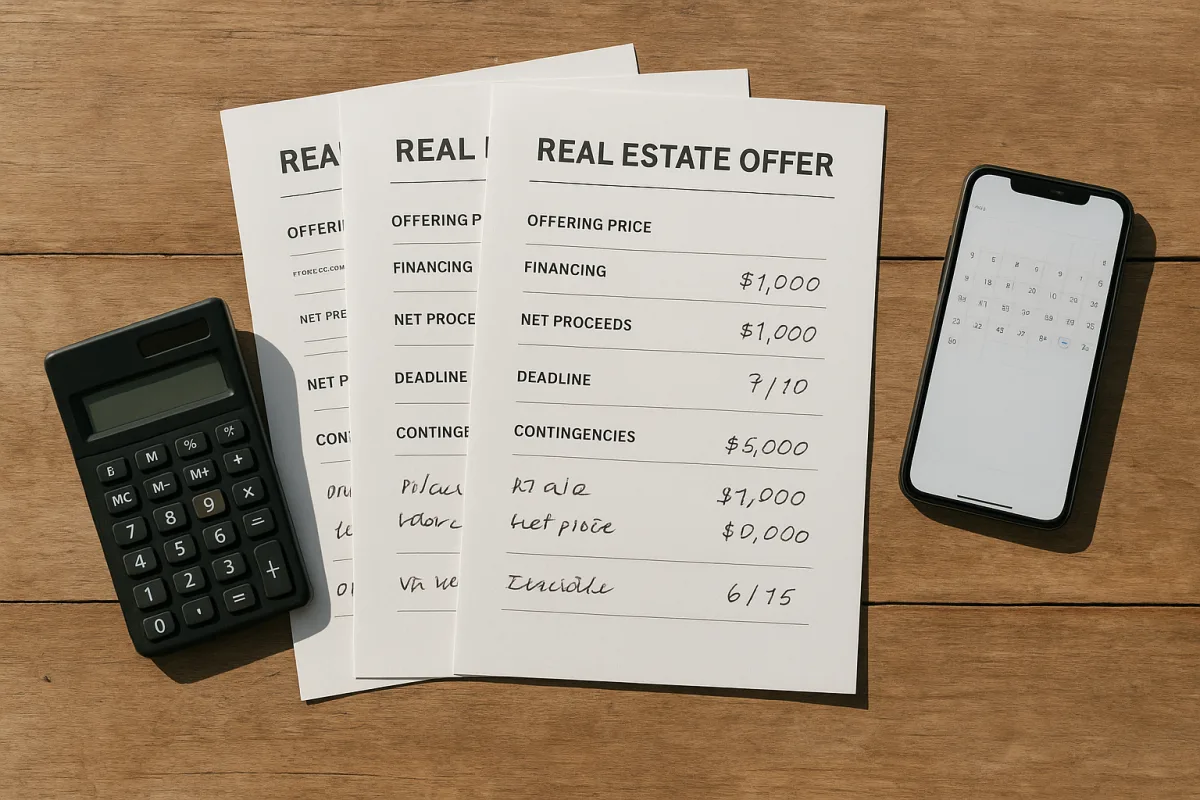
Set up a simple offer worksheet in advance. Include price, closing date, financing type, down payment, earnest money, inspection contingency, appraisal contingency, financing contingency, requested seller credits, personal-property requests and any sale-of-buyer’s-home contingency.
This is not busywork. EffectiveAgents warns that sellers who focus solely on the headline price can overlook weak financing, contingencies and terms that make an offer more likely to fail. [2]
Control the first decision window without rushing
When multiple offers arrive, do not accept the first acceptable offer simply because it is above list price. Premature acceptance is a recurring seller mistake identified in guidance on competing offers. [2][15]
Give buyers a clear written instruction: submit their best complete offer by a stated time, include preapproval or proof of funds, and specify whether escalation clauses will be considered. DocJacket identifies simultaneous counters and a highest-and-best deadline as ways to organize competition. [3]
A response period of one to five days is common, with 24 to 72 hours typical in competitive situations, according to Opendoor, LegalClarity and Redfin. [6][7] There is no universal legal response deadline, so follow the contract rules and local advice applicable to your sale.
Do not disclose more than you need to. You can tell buyers there are multiple offers and invite final terms without revealing another buyer’s price, financing details or concessions request. Poor handling of competing-offer information can create unnecessary disputes.
If one offer expires before your planned deadline, you have a timing problem, not necessarily a reason to accept it. Ask whether the buyer will extend the offer deadline, or decide whether its terms justify stopping the process.
Compare net proceeds, not the contract price
The offer price is the starting line. Your estimated proceeds depend on credits, repair commitments, closing costs assigned to the seller, prorated taxes or dues, payoff amounts and any other negotiated charges.
For a simplified example, assume Offer A is $500,000 with a $12,000 seller credit and $4,000 in promised repairs. Assume Offer B is $492,000 with no credit and no repair commitment. Before ordinary seller closing costs, Offer A leaves $484,000 and Offer B leaves $492,000.
That example does not establish typical credits or closing costs. It shows why a buyer’s “above asking” offer can be economically worse than a lower, cleaner proposal.
Redfin’s reporting on elevated concessions is particularly relevant here. When concessions are common, a seller cannot evaluate profit by comparing purchase prices alone. [8] Carolina Crafted Homes likewise flags seller-paid costs and concessions as items that can shrink actual proceeds. [16]
Build the worksheet so every offer is reduced to the same comparison point. List price, then subtract requested credits, repair obligations, seller-paid closing items and personal property with meaningful replacement value. Keep the normal transaction costs separate if they are expected across all offers.
A buyer asking for a credit may still be attractive if that credit solves a financing or affordability issue and the price accounts for it. The key is to treat the credit as part of the price negotiation, not as an afterthought.
Check whether the buyer can actually close
A financed buyer’s offer has two distinct questions: whether the buyer qualifies for the loan, and whether the home appraises at a value that supports the loan. These become more important when the offer is pushed upward by competition.
Compare the financing contingency length, loan type, down payment and documentation provided with the offer. EffectiveAgents identifies financing strength as a core part of choosing the strongest buyer, rather than simply choosing the largest number. [2]
Cash offers remove the mortgage approval and lender appraisal components, but still require verification of funds and can include inspection or other contingencies. Do not assume “cash” means unconditional or risk-free without reading the contract.
Earnest money is another risk signal. LegalClarity gives $10,000 as an example of a higher deposit that may indicate greater buyer seriousness. [7] The amount matters less in isolation than its relation to the purchase price, contingency terms and local contract rules.
A larger deposit does not automatically become yours if a buyer walks away. Whether earnest money is refundable depends on the contract, contingencies, deadlines and local law. Have your agent or attorney explain the actual deposit and default provisions before acceptance.
Price the appraisal risk in every high offer
An appraisal gap is not simply a buyer saying, “I will pay more.” It is the difference between the contract price and the appraised value, and a financed buyer needs cash, loan flexibility or a renegotiation plan to bridge it.
Assume a buyer agrees to pay $525,000, but the appraisal comes in at $500,000. The gap is $25,000. If the buyer has an appraisal contingency and no effective gap commitment, they may seek a price reduction, bring additional cash or terminate under the contract.
If the buyer promises a $15,000 appraisal-gap contribution, that does not necessarily guarantee a $525,000 closing price. In this example, the unresolved $10,000 still needs to be covered through more buyer cash, a revised loan structure, a lower price or another solution.
Homes.com and Home Stimulus both caution that escalation-driven prices can create financing and appraisal problems. [17] Ask for the exact appraisal-gap language, any cap on the buyer’s added cash, and whether the commitment survives a low appraisal.
A waived appraisal contingency can reduce one route to cancellation, but it does not prove that the buyer has the funds to close. Strong terms are specific: the amount of additional cash, the conditions attached and the consequences if the appraisal is low.
Read escalation clauses as three numbers and one proof requirement
An escalation clause usually has a base offer, an increment and a maximum cap. For example, a buyer might offer $490,000, agree to beat a bona fide competing offer by $2,000, and cap the price at $515,000.
That clause does not mean the buyer starts at $515,000. If the next strongest verified offer is $500,000, the escalated price would be $502,000 under those assumed terms, subject to the contract’s wording.
Home Stimulus advises sellers to require verification of the competing offer that triggered the escalation. [17] Without that requirement, an escalation clause can invite disputes over whether the seller used a real, valid and comparable offer to reach the higher price.
Check the fine print before using an escalation clause against another offer. Does the competing offer need to be financed or cash, free of unusual contingencies, signed and still open? Does the clause account for seller credits that change the real economic value?
Escalation clauses may be less useful in a market where buyers have leverage. Experian’s guidance, reflected in the research brief, notes that they can be less effective in buyer-friendly conditions and may introduce appraisal complications. [17]
Negotiate contingencies as risk and time, not slogans
Inspection, appraisal and financing contingencies each give the buyer a possible path to renegotiate or exit. MyHomeSale and My Home Advisor identify these as common contingencies sellers may negotiate, limit or seek to waive. [10][11]
The most profitable offer is not necessarily the one with no contingencies. A buyer who waives protections without adequate cash or financing capacity may still struggle to close, leaving you back on the market after valuable time has passed.
Instead, compare the scope and timing. A shorter inspection period means you learn sooner whether repair demands are likely. A clear appraisal-gap commitment tells you more than a broad statement that the buyer “will work through” a low appraisal.
Closing-date flexibility also has value. If one buyer can close on your preferred schedule or allow a post-closing possession arrangement where lawful and documented, that can outweigh a modest price difference for some sellers. [2][4]
Counteroffers should preserve the parts of an offer you like while repairing the expensive parts. You might counter a high-price offer by reducing a requested credit, shortening an inspection window, clarifying the appraisal gap or increasing earnest money, subject to local contract guidance.
Choose the offer you can explain on paper
After final offers are in, rank them using the same worksheet rather than intuition. First compare estimated net proceeds, then the likelihood of closing: financing documentation, appraisal exposure, contingencies, earnest money and timing.
There is no research-backed national number showing how much multiple offers, escalation clauses or tighter contingencies add to a seller’s profit. The available evidence supports a more limited claim: competition can improve terms, but outcomes vary by property condition and market. [9][17]
Document why the chosen offer won. A short record might note that it had the highest estimated net after credits, verified financing, a workable appraisal-gap commitment and a closing date that fit your move.
That discipline protects you from the most common error in a multiple-offer situation: treating the largest headline price as the best deal. The best offer is the one with the strongest expected net proceeds after the contract’s costs, conditions and closing risk are accounted for.
Frequently Asked Questions
How should sellers evaluate multiple offers on a house?
Sellers should compare complete signed offers rather than reacting to the first high number. It is important to rank offers by estimated net proceeds, financing strength, appraisal exposure, contingencies, earnest money, and closing fit. This approach helps avoid accepting a higher contract price that might yield less money or have a greater chance of collapse.
What factors matter besides price when handling multiple offers?
Besides price, sellers should consider financing strength, appraisal contingencies, inspection contingencies, earnest money deposits, requested seller credits, closing timelines, and any contingencies related to the buyer’s financing or sale of their current home. These factors affect the reliability and likelihood of the deal closing successfully.
How long should sellers wait for highest and best offers?
Sellers typically set a written deadline for “highest and best” offers, usually between 24 and 72 hours in competitive situations. This allows all buyers to submit their best terms and helps sellers compare offers fairly without rushing to accept the first high bid.
How can sellers reduce risks from inspection issues before listing?
Sellers should fix or disclose known inspection problems before listing when practical. Addressing obvious deferred maintenance like leaks, aging systems, visible damage, and safety issues can reduce the chance of repair requests, credits, renegotiation, or deal cancellations caused by inspection contingencies.
What is the best way to communicate with buyers during multiple offers?
The article does not provide specific guidance on communication methods with buyers during multiple offers. However, setting clear deadlines and using a structured offer worksheet to evaluate terms can help manage the process efficiently.
How we researched this
This article was assembled from 17 cited references.
Nothing here is based on hands-on testing. Where a figure or finding appears, it belongs to the source cited beside it, and the writing says so rather than implying otherwise. Every source is listed below so you can check it.
Sources
- Portland homebuyers get pickier
- Multiple Offers? How Sellers Pick the Strongest Buyer | EffectiveAgents®
- Multiple Offers on a House: How to Handle Them | DocJacket
- How to Win a Bidding War on a House - Homes.com
- 5 Signs Home Buyers Have More Negotiating Power Right Now
- How Long Does It Take to Sell a House? (2026 Data) | Opendoor
- How Long Does a Seller Have to Accept an Offer on a House? - LegalClarity
- Nearly Half of Homebuyers Get Concessions From Sellers as Most Markets Tip in Buyers’ Favor - Redfin Real Estate News
- Multiple Offers Remain Common In Mid-Atlantic Despite Market Cooling | Inman Real Estate News
- Contingencies Explained — MyHomeSale
- Home Buyer Contingencies 2026: A Negotiation Guide | My Home Advisor
- How to navigate and win a bidding war on a home
- Are Omaha Home Sellers Still Getting Multiple Offers?
- The Housing Market Is Splitting. Here Is Where Buyers Have Leverage.
- How to Navigate Multiple Offers When Selling in Newport Beach in 2026
- How to Handle Multiple Offers in Myrtle Beach 2026 — Hereda Team at Carolina Crafted Homes
- Escalation Clauses Explained for Sellers: Caps, Proof, Risk | Home Stimulus
Related Articles

How to Sell a House Fast: Proven Strategies for Quick Sales
Learn how to sell a house fast with pricing tips, pre-listing inspections, and marketing strategies to close quickly in any market.

Prepare for a Home Showing During Winter: Essential Tips
Learn how to prepare for a home showing during winter with tips on snow removal, thermostat settings, and managing wet boots for a safe, inviting visit.
Best Time to List Your Home: Seasonal and Regional Insights
Discover the best time to list your home, including seasonal trends and regional variations to maximize sale price and buyer interest.
Improve Curb Appeal on a Budget
Learn how to improve curb appeal on a budget with practical, affordable tips to boost your home's exterior before selling.