
Closing Costs: What They Are and How Much to Expect
Learn what closing costs are, typical fees included, and how much you can expect to pay when buying a home.
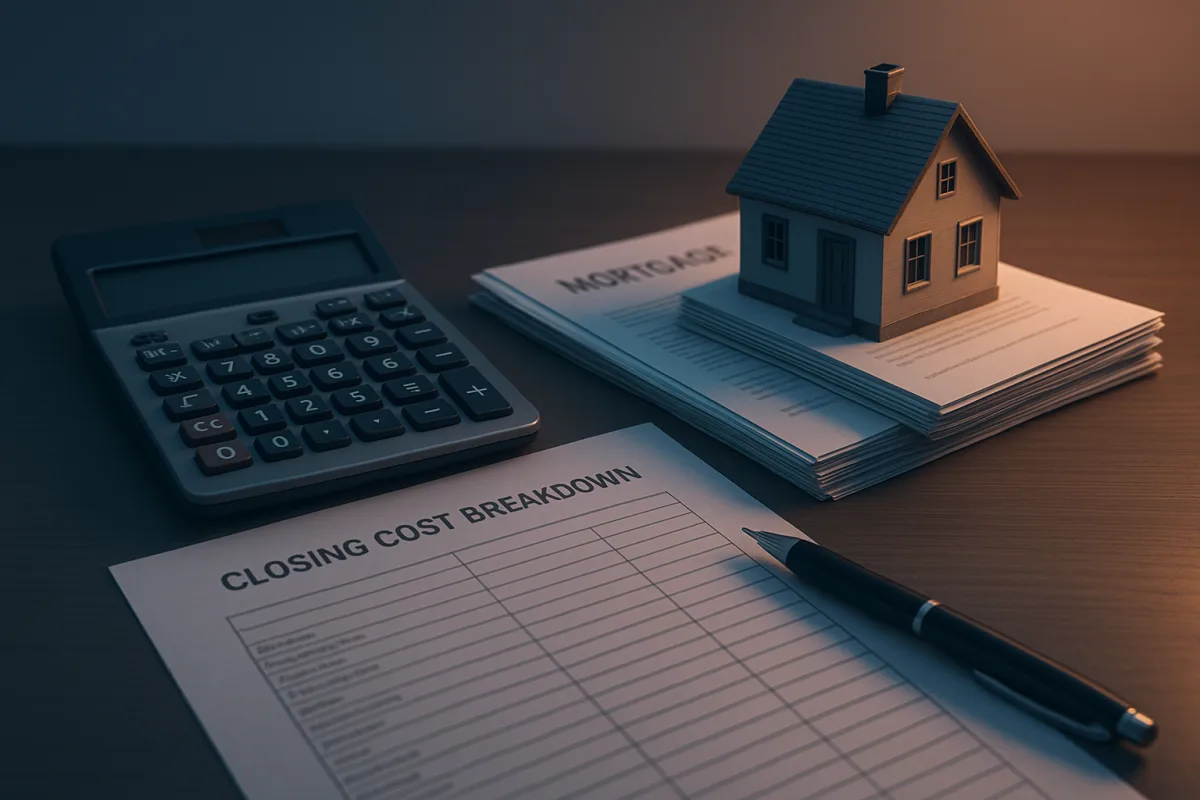
Closing costs are the transaction bill, not one fee
Closing costs are the collection of fees, taxes, insurance charges and prepaid expenses needed to transfer ownership and finalize a mortgage. They pay the lender, government recording office, title or escrow provider, appraiser, insurer and, in some states, a real-estate attorney.
For a buyer, the useful number is not simply “closing costs.” It is total cash needed before and at settlement. That figure combines costs paid during the contract period with the amount due when you sign final documents.
Most estimates put buyer closing costs at 2% to 5% of the home’s purchase price. On a $400,000 purchase, that is approximately $8,000 to $20,000, before considering the down payment itself. [2][3]
Some published guides use a wider 3% to 6% range. That does not necessarily mean the underlying bills differ as much as the headlines suggest, because some calculators divide costs by the purchase price while others divide by the loan amount. [4]
Why the percentage changes with the down payment
Assume a home costs $400,000 and you make a 10% down payment, or $40,000. Your mortgage would be $360,000. If eligible closing costs total $12,000, there are two accurate ways to describe that bill.
Measured against the purchase price, $12,000 is 3% of $400,000. Measured against the loan amount, it is about 3.33% of $360,000. A source using the second method will report the higher percentage, even though your dollar bill is identical.
This matters because buyers often see a national percentage and treat it as a quote. It is not. Use percentages for rough planning, but budget in dollars using your price, planned down payment, loan type and state.
A 20% down payment on that same $400,000 home produces a $320,000 loan. The same $12,000 of costs would then equal 3% of the price but 3.75% of the loan. Lower borrowing does not automatically lower every settlement charge.
The moving parts behind the bill
Mortgage-related fees are one major category. A lender may charge an origination fee, typically around 0.5% to 1% of the loan amount, plus underwriting fees commonly cited at $400 to $600 and a credit-report charge of roughly $30 to $50. [3][7]
On a $360,000 mortgage, a 1% origination charge alone would be $3,600. That is why the loan amount, not just the home price, matters when comparing mortgage costs between offers.
An appraisal is another early transaction cost. Buyers commonly see appraisal estimates of about $300 to $700, though the research range extends from $250 to $700 and can vary with property size and location. [3][6]
The appraisal supports the lender’s collateral decision. It is not a home inspection, and it does not tell you whether the roof, plumbing or electrical systems are in acceptable condition. An inspection is a separate pre-closing expense and should not be omitted from a cash budget.
Title work and settlement services are the next substantial category. A title company or attorney researches ownership and liens, handles documents and helps coordinate transfer of money and title. The exact process varies considerably by state.
An owner’s title insurance policy is commonly estimated at $500 to $1,500, while lender title coverage is often estimated at $300 to $900. [6][13] The lender policy protects the lender’s interest, while the owner policy is intended to protect the buyer’s ownership interest.
Attorney or escrow fees can add another $500 to $1,500 where those services are required or customary. [6][13] This is not a minor local difference: some states use attorneys heavily, while other markets typically close through title or escrow companies.
Government charges are usually smaller individually but still belong in the budget. Recording fees are commonly about $50 to $250, while transfer taxes can materially change the final number depending on the state and locality. [3][6]
That regional structure helps explain why national averages are only a starting point. The research identifies the District of Columbia at about 6.25%, or $29,888, New York at about 7.68%, or $24,582, and Delaware at about 6.71%, or $21,456. [8]
At the lower end, Missouri is cited at about 2.16%, or $6,905, while South Dakota is reported at under $2,000 in one comparison. [8][9] Those are state-level examples, not promises for a particular county, lender or property.
Prepaids are real cash, but they are not all fees
Buyers frequently underestimate prepaids because they sound less immediate than a lender charge. Prepaids can include homeowners insurance, property taxes and daily mortgage interest from the closing date until the end of that month. [2][7]
If your mortgage includes an escrow account, the lender may also collect an initial cushion for future property-tax and insurance payments. The money is generally held for those bills rather than paid as a service charge, but it still increases the cash required at closing.
This distinction is worth making when comparing lender estimates. Two loans can have similar lender fees but different prepaid and escrow requirements because of the closing date, insurance premium, tax calendar and local billing practices.
Closing near the end of a month can reduce the number of days of prepaid interest due at settlement. It does not eliminate the next month’s regular mortgage payment, and it may not reduce tax or insurance escrow deposits.
The right comparison is therefore not “which worksheet has the lowest fee total?” Compare the total cash required, the ongoing monthly payment, the interest rate, whether points are included and which costs are lender-controlled versus third-party or government charges.
Timing: what you pay before settlement and what waits
Earnest money is usually paid shortly after an offer is accepted, not on settlement day. It is commonly around 1% to 3% of the purchase price, although contract terms and local customs control the actual amount. [5][6]
On a $400,000 offer, a 1% earnest-money deposit would be $4,000. If the transaction closes as planned, that deposit is generally credited toward the buyer’s cash due, rather than added on top of the final bill.
Appraisal and inspection charges may also arrive before closing. A buyer who saves only for the settlement check can be short of cash during the contingency period, even if the eventual closing-cost estimate looked manageable.
Before settlement, the lender must provide the Closing Disclosure at least three business days in advance. [2][7] This form is where buyers should check the final loan terms, cash-to-close figure, credits, lender charges, title costs and prepaids against earlier estimates.
If the cash-to-close figure is higher than expected, identify why before settlement. It may reflect a legitimate insurance premium or tax escrow deposit, but it can also reveal changed lender charges, a missing credit or a fee you did not understand.
Credits can lower the buyer’s bill, but they do not erase it
Seller concessions are credits from the seller toward eligible buyer costs. They can reduce the money a buyer needs at settlement, but they are negotiated in the purchase contract and depend heavily on local market conditions. [6][7]
For conventional financing with less than 10% down, seller contributions are typically capped at 3% of the purchase price. FHA loans can permit seller concessions up to 6%, subject to the loan rules and the specific transaction. [5][7]
A 3% credit on a $400,000 purchase is $12,000. That might cover a large share of closing costs, but it does not necessarily cover a down payment, and it does not make every charge eligible under every mortgage program.
Buyers should also distinguish seller credits from lender credits. A lender credit may reduce upfront costs, but it can be paired with a higher interest rate. Whether that trade works depends on the rate offered, how long you expect to keep the loan and the actual credit amount.
The fees worth questioning
Not every charge is equally negotiable. Government recording charges and required taxes generally are not. But buyers can ask about loan origination fees, title-company pricing, attorney fees, administrative charges and, in some cases, prepaid arrangements. [6][13]
Courier and administrative fees are often estimated around $100 to $200, but they vary substantially by lender and location. [3] A small standalone fee may not determine your loan choice, yet it is reasonable to ask what service it covers.
Credit quality and property use also affect the deal offered. Conventional loans generally require credit scores of at least 620, while FHA financing can allow scores as low as 500 with a larger down payment. [5][7]
VA loans have no official minimum score, though lenders commonly prefer roughly 580 to 620, and USDA loans generally require scores of at least 640. [5] Higher credit scores can mean better rates and lower loan-related charges, but lender pricing is not uniform.
Second homes and investment properties commonly carry higher rates and fees than primary residences. [7][13] That makes a generic closing-cost percentage particularly unreliable when the home will not be your main residence.
I am not a licensed real-estate agent, lender or financial adviser. For a transaction-specific figure, ask your lender to explain each Loan Estimate and Closing Disclosure line, then confirm local title, attorney, tax and escrow practices with the professionals handling your closing.
Frequently Asked Questions
What are closing costs in a home purchase?
Closing costs are the collection of fees, taxes, insurance charges, and prepaid expenses required to transfer ownership and finalize a mortgage. They cover payments to the lender, government recording office, title or escrow provider, appraiser, insurer, and sometimes a real estate attorney.
How much are typical closing costs?
Closing costs typically range from 2% to 5% of the home’s purchase price. For example, on a $400,000 home, closing costs usually total about $8,000 to $20,000 before including the down payment.
What fees are included in closing costs?
Common fees include loan origination fees (around 0.5% to 1% of the loan amount), appraisal fees ($300 to $700), title insurance ($500 to $1,500 for owner’s policy and $300 to $900 for lender’s policy), attorney or escrow fees ($500 to $1,500 where required), underwriting fees ($400 to $600), credit report fees ($30 to $50), and recording fees ($50 to $250). Prepaid taxes, insurance, and interest are also part of closing costs.
How do closing costs vary by state?
Closing costs vary significantly by state due to differences in transfer taxes, title insurance regulations, attorney requirements, and recording fees. For instance, the District of Columbia averages about 6.25% of the home price in closing costs, while Missouri averages around 2.16%. Some states regulate title insurance fees, making costs more predictable.
Why do closing costs depend on loan amount?
Closing costs are sometimes expressed as a percentage of the loan amount rather than the purchase price, which changes the percentage figure. For example, a $12,000 closing cost is 3% of a $400,000 home price but 3.33% of a $360,000 loan. Since loan amount varies with down payment size, the percentage of closing costs relative to the loan can differ even if the dollar amount stays the same.
How we researched this
This article was assembled from 16 cited references.
Nothing here is based on hands-on testing. Where a figure or finding appears, it belongs to the source cited beside it, and the writing says so rather than implying otherwise. Every source is listed below so you can check it.
Sources
- Homebuyers are scoring deals - but prices remain high
- What Are Closing Costs and How Much Will You Pay? | Zillow
- Closing Cost Calculator 2026 — Buyer & Seller Costs | CalcFi
- How Much Are Closing Costs in 2026? Average Fees | reAlpha Tech Corp. (AIRE)
- First-Time Home Buyer Guide 2026 | HomeAffordabilityCalc.info
- House Closing Costs: How Much Buyers and Sellers Pay - LegalClarity
- What are closing costs on a house?
- Average Closing Costs by State 2026 (All 50 States Ranked)
- Closing Costs by State 2026: $2K (SD) to $17K (DC)
- How Much Does It Cost to Sell a House? Don't Overlook These Common Fees
- How Much Are Closing Costs for Sellers? | Redfin
- Buying Guide - propertyglob.com
- Closing Cost Breakdown for US Home Buyers 2026: What to Expect | WikEst
- First-Time Homebuyer Mistakes to Avoid in 2026 — A Florida Real Estate Guide
- 10 Costly First-Time Home Buyer Mistakes (and How to Avoid Them in 2026) - The Saward Team
- Closing Costs Explained for Homebuyers | Blog | Perry Homes
Related Articles
What to Expect During Closing Day: Key Steps Explained
Learn what to expect during closing day, including cash to close, final documents, and key steps to complete your home purchase.
Affordable Neighborhoods for First Time Home Buyers in 2026
Explore affordable neighborhoods for first time home buyers with insights on monthly costs, taxes, insurance, and financing in 2026.
Buying a Home with a Basement: What You Need to Know
Learn key tips for buying a home with a basement, including inspection, water issues, foundation concerns, and budgeting for repairs.
Risks of Buying a Foreclosure: What Buyers Need to Know
Learn the risks of buying a foreclosure, including repair costs, title issues, and hidden expenses to avoid costly mistakes.