
How to Vet a Real Estate Agent Before Hiring
Learn how to vet a real estate agent by verifying licenses, checking reviews, and asking key questions before hiring.
Start before you scroll through agent profiles
A trustworthy agent search starts with defining the representation you need. A buyer wants someone who can explain homes, offers, contingencies, inspections, appraisal issues, and the local contract process without treating every question as an interruption.
That sounds basic, but “real estate agent” is not a uniform service. Some agents primarily list homes. Others work regularly with buyers. Some cover a wide metro area, while others know one set of neighborhoods, building types, or school districts well. Redfin recommends asking about years active, transaction volume, whether the agent represents buyers or sellers more often, and their relevant ownership experience. [2]
Write down your likely search area, price range, property type, financing status, and timing before your first call. You are not asking an agent to predict the market. You are testing whether they can describe how the market mechanics affect your particular search.
For example, a buyer considering a condominium needs an agent who can discuss association documents, financing restrictions, special assessments, and resale comparables. A buyer looking at older detached homes needs someone who can explain inspection findings, repair negotiations, and the difference between a visible defect and a costly unknown.
Local knowledge matters because comparable sales are not just nearby addresses. A useful comparable should account for location, size, condition, lot, amenities, and recent market conditions. RealBetter identifies local market knowledge as a core sign that an agent is suited to the client’s needs. [3]
Build a candidate list that does not depend on one recommendation
A personal referral can be a productive starting point, but it is not due diligence. Your friend may have bought in a different neighborhood, used cash instead of a mortgage, or worked with the agent years ago.
Ask people you trust what the agent actually did. Better questions include: Did the agent return calls promptly? Did they explain the offer and inspection deadlines? Did they push you to waive protections? Did anything go wrong, and how did they handle it?
Then supplement referrals with agents who have recent transactions in your target area. Review platforms can help identify candidates, but iBuyer.com recommends looking across Google, Zillow, Realtor.com, and RateMyAgent rather than relying on a single set of reviews. [16]
Look for patterns, not just star averages. Several recent reviews that mention clear explanations, reliable follow-through, tough negotiations, or help resolving a transaction problem are more useful than generic praise. Likewise, repeated complaints about missed deadlines or pressure tactics deserve attention.
Do not automatically reject a newer agent. Instead, ask who will supervise the file, who covers showings or urgent offer deadlines, and whether a more experienced team member will participate in negotiations. The point is to understand the actual person and structure handling your purchase.
Check the license before you interview
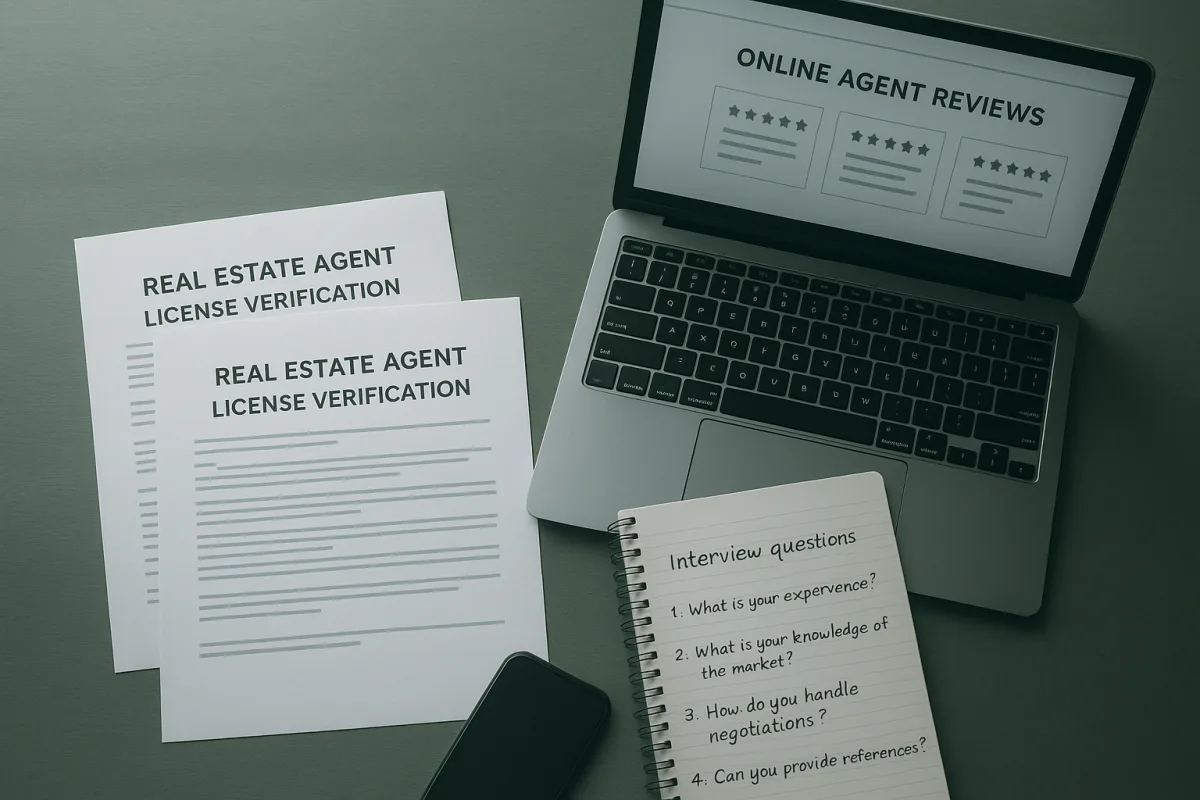
Before investing time in a lengthy interview, verify that each candidate holds an active state license and check for disciplinary history. Public databases make this a quick screen, often taking about two minutes. [15]
Licensing is necessary, but it is not a performance guarantee. Pre-licensing education requirements vary substantially by state. SmartAgentAlliance reports examples ranging from 40 hours in Michigan to 180 hours in Texas. [13] A license tells you an agent cleared the state’s entry requirements, not whether they know your neighborhood or communicate well.
Also be precise about labels. “REALTOR®” generally means the professional belongs to the National Association of Realtors, while “agent” or “broker” can refer to a state license status. Experian recommends verifying licensing and professional credentials rather than assuming a title proves expertise. [6]
Ask whether the agent has buyer-focused education or designations, such as Accredited Buyer’s Representative, often called ABR. A designation should not replace evidence of local work, but it gives you a specific credential to discuss. The National Association of Realtors includes professional certifications among the questions buyers should ask. [20]
Errors and omissions insurance is another item worth asking about, especially if you are comparing agents across state lines. Fifteen states require licensees to carry it, according to Veris Insurance. [14] It is not a substitute for careful representation, but the answer helps you understand the professional framework in your state.
Interview for the moments when the purchase gets expensive
The interview is not mainly about whether you get along. You need to know how the agent works when a listing gets multiple offers, an inspection reveals a concern, or an appraisal comes in below the contract price.
Start with experience: “How many buyers have you represented recently, and how many purchased in my target neighborhoods?” Realtor.com recommends asking directly about buyer specialization and recent comparable sales. [17] Ask for examples with enough detail to assess the answer, not confidential client information.
A useful follow-up is: “Show me how you would prepare a comparable-sales analysis for a home I am considering.” A strong answer should distinguish a seller’s list price from closed sales, explain adjustments, and flag where the available data is thin.
Next, ask about negotiation. Zillow identifies negotiation skill as a central quality of an effective agent. [5] Ask for two recent examples, including the original issue, the buyer’s objective, alternatives considered, and the final result.
Do not accept “I always get the best deal” as an answer. An agent cannot honestly promise an outcome when another buyer, seller, lender, appraiser, inspector, and contract deadline all influence the transaction. What they can explain is their process.
Ask how the agent approaches contingencies. Specifically, ask when they would recommend an inspection contingency, financing contingency, or appraisal contingency, and what could happen if you waive or shorten one. The right approach depends on your financing, cash reserves, property condition, and local competition.
An appraisal gap is a good test of whether an agent explains numbers plainly. If you agree to pay $550,000 but the appraisal is $530,000, there is a $20,000 gap between the contract price and appraised value. Whether that requires additional cash, a price reduction, revised financing, or a contingency-based exit depends on your loan terms and contract.
The agent is not your lender or legal adviser, so ask them to identify when the lender, inspector, attorney, or insurance professional needs to weigh in. Transparency about those boundaries is a positive sign, not a weakness. SoldNest identifies honesty about the property and transaction process as a key quality. [7]
Establish communication rules before an offer deadline tests them
Missed communication can become a money problem. An offer may need revision before a seller’s deadline. Inspection objections may have a contractual response date. A lender may need documents quickly to keep underwriting moving.
Ask each agent: “How will we communicate, who responds when you are unavailable, and what response time should I expect on weekdays and weekends?” FindLaw specifically recommends asking about availability, communication style, and response times. [18]
Get the answer in operational terms. “I am always available” is vague. “I respond to texts within two hours, my assistant handles scheduling, and my partner covers active offers when I am away” gives you something concrete to evaluate.
Also ask how many active clients the agent typically manages. A busy agent may have deep experience and solid support. But if showings are consistently delegated and the lead agent is unavailable for strategy calls, you should know that before you commit.
RBFCU identifies clear, prompt communication as a defining trait of a strong realty agent. [4] The practical question is whether the candidate’s system matches your needs, particularly if you work nontraditional hours or expect to compete for homes that move quickly.
Read the buyer agreement like a closing-cost estimate
Since the 2024 commission settlement, buyers are generally required to sign agreements with their agents before touring homes, making the agent’s compensation and scope of work more explicit. [1] That is reason to read the agreement slowly, not to treat it as routine paperwork.
Ask for the agreement in advance. Then identify the fee or commission, when it is earned, the length of the agreement, the covered geographic area, whether it is exclusive, and how either party can end it. Ramsey Solutions specifically recommends asking about commission, additional fees, exclusivity, and cancellation policies. [19]
Commission remains negotiable. Axios reported that average rates had not fallen significantly after the settlement, despite the greater emphasis on transparent agreements. [1] Opendoor estimates average total commission at about 5.70%, split roughly between a 2.88% listing-side share and a 2.82% buyer-side share. [8]
Those are averages, not a quote for your transaction. On a $500,000 purchase, 2.82% equals $14,100. That calculation does not establish who will pay it, whether a seller offers any amount toward it, or whether your agreement requires you to cover a shortfall. Those points belong in the written terms.
Do not choose solely on the lowest fee. Property Buyer Guide warns that fee-first selection can overlook service quality and professional capability. [21] Compare the total commitment: compensation, scope, availability, local experience, negotiation method, and exit terms.
Check references after the interview, not before
Once you have narrowed the list, ask each finalist for recent buyer references. Recent matters because market pace, team staffing, and an agent’s business model can change. FindLaw includes recent client references among its recommended interview questions. [18]
When you speak with a reference, ask what happened between offer acceptance and closing. That is where representation is most visible. Did the agent explain inspection options? Did they catch deadlines? Did they coordinate with the lender and title company? Did they pressure the buyer to accept a result?
Ask whether the agent’s early promises matched the service delivered. If a reference says the agent was excellent but cannot describe how, treat that as a warm endorsement, not conclusive evidence. You are looking for repeatable working habits.
Finally, compare your notes while the interviews are fresh. Give more weight to specific, verifiable answers than polished sales language. A trustworthy buyer’s agent should be able to explain their role, their compensation, their local evidence, and their process without making guarantees they cannot control.
Frequently Asked Questions
How do I verify a real estate agent's license and disciplinary history?
You can verify an agent’s active state license and check for any disciplinary history using public license databases. This process generally takes only a few minutes and helps ensure the agent is legally authorized to practice. However, licensing confirms entry requirements were met but does not guarantee performance or expertise.
What questions should I ask when interviewing a real estate agent?
Ask about their years of experience, transaction volume, whether they represent buyers or sellers more often, and their relevant personal property ownership. Also inquire about their local market knowledge, communication style, negotiation examples, and how they handle deadlines and contingencies specific to your property type and search area.
How can I check a real estate agent's recent transaction history?
Compare candidates by reviewing their recent local transactions, focusing on those in your target area and property type. This information can often be gathered during interviews or from online profiles, helping you assess their relevant experience and success in similar deals.
What should I look for in real estate agent reviews?
Look for patterns in reviews rather than just star ratings. Useful reviews mention clear explanations, reliable follow-through, strong negotiation skills, and how the agent helped resolve problems. Be cautious of repeated complaints about missed deadlines or pressure tactics.
How do I compare commission fees and contract terms with agents?
Treat the buyer-representation agreement as a cost document. Confirm the commission or fee amount, whether it is negotiable, the geographic area covered, contract duration, exclusivity, and cancellation options before signing. Remember that a lower fee does not necessarily mean lower overall costs, as agent skill can impact the transaction outcome more than small commission differences.
How we researched this
This article was assembled from 25 cited references.
Nothing here is based on hands-on testing. Where a figure or finding appears, it belongs to the source cited beside it, and the writing says so rather than implying otherwise. Every source is listed below so you can check it.
Sources
- Why broker fees have barely changed since the big settlement
- Top 10 Qualities of a Good Real Estate Agent | Redfin
- How to Choose a Real Estate Agent: 7 Signs You’ve Found the Right One
- 5 Traits to Look for in a Realty Agent| RBFCU - Credit Union
- What Makes a Good Real Estate Agent for Home Sellers | Zillow
- How to Choose a Real Estate Agent
- What Makes a Good Real Estate Agent: 10 Great Qualities
- Who Pays Realtor Fees? (After the 2024 NAR Settlement) | Opendoor
- Why a Landmark Real Estate Commission Settlement Hasn't Lowered Costs for Homebuyers
- How to Select a Real Estate Agent: A Buyer’s Guide - Inmobiliaria Costa Cambrils
- Common Red Flags to Watch Out for When Choosing a Real Estate Agent | NW Realty Group
- Red Flags When Comparing Real Estate Agents | Seeking Agents®
- Real Estate License Requirements by State (2026)
- Real Estate E&O Insurance Requirements by State (2026 Guide) | Veris Insurance
- How to Check a Realtor License: Status, Complaints, and ARELLO - FedLaws
- Real Estate Agent Reviews Guide 2026 | iBuyer.com
- 10 Questions Buyers Should Ask Real Estate Agents Before Hiring Them
- How To Choose Your Real Estate Agent - FindLaw
- Questions to Ask a Real Estate Agent Before Hiring - Ramsey
- Questions to Ask When Choosing a Real Estate Agent
- Mistakes to Avoid When Choosing a Buyers Agent | Property Buyer Guide
- 7 Common Mistakes Consumers Make When Choosing a Real Estate Agent - Laura Berger
- Common buyers agent selection mistakes Sydney buyers make
- Red Flags When Hiring a Real Estate Agent | IDEAL AGENT
- Real Estate Broker Advisory: Signed Listing Agreements REQUIRED By New Law
Related Articles

How to Choose a Real Estate Agent
Learn how to choose a real estate agent with expert tips on interviewing, verifying credentials, and comparing experience for buyers and sellers.
Choose the Right Real Estate Attorney for Your Home Purchase
Learn how to choose the right real estate attorney, including qualifications, fees, and key questions to ask before hiring for your home purchase.

Real Estate Success Secrets: Mastering the Market with Ricky Carruth
Discover Ricky Carruth's real estate success secrets from Golf Shores of Alabama. Learn to control your business, leverage unlimited competition, and dominate the market with weekly emails for lasting client connections. Optimize your real estate career with Carruth's expert advice.

Winter Home Selling Tips: How to Prepare and Price Your Home
Discover winter home selling tips including preparation, pricing, and maintenance to help you sell your home effectively during cold months.