
Inspection Contingency in Competitive Home Buying
Learn how inspection contingencies affect your offer and financial risk when buying a home in a competitive market.
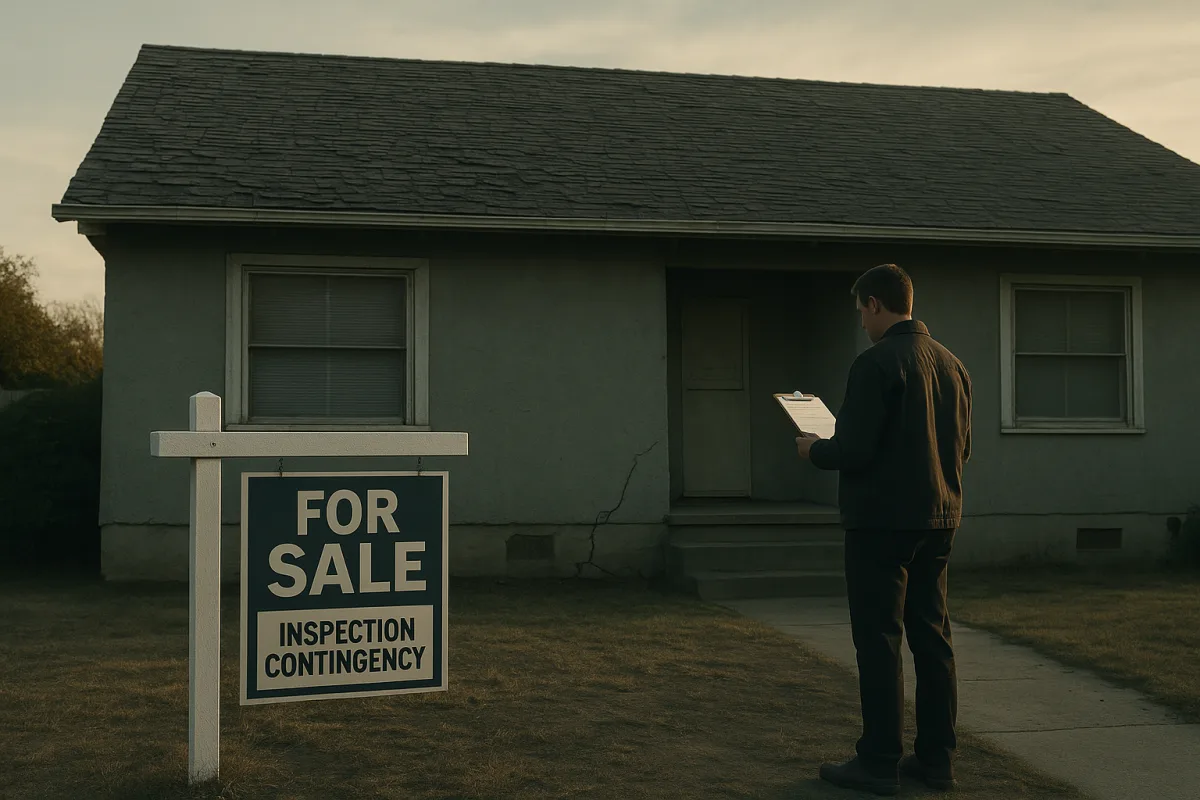
The competitive-market decision that deserves the most attention: your inspection contingency
In a bidding situation, buyers often hear a blunt instruction: waive contingencies. That can make an offer easier for a seller to accept, but it also changes who absorbs the financial risk if the house has expensive problems.
The inspection contingency is the clearest example. It is not a promise that a home is perfect, and it is not an insurance policy against every future repair. It is a contract right, exercised during a defined period.
That right generally lets the buyer investigate the home’s visible condition, then cancel, negotiate, or proceed under the rules in the purchase agreement. The mechanics vary by state and contract form, so the exact language matters more than the label.
I am not a licensed real estate agent, lender, inspector, or legal adviser. A buyer should read the actual contingency language with the professionals involved in the transaction, especially because a missed deadline can have costly consequences.
What an inspection contingency actually does
Once the seller accepts an offer, the contract starts a sequence of deadlines. The buyer deposits earnest money, arranges inspections, advances financing and appraisal work, and works toward closing. A financed closing commonly takes 30 to 45 days. [9]
The inspection contingency gives the buyer a window to order inspections and respond to what they find. Depending on the contract, the buyer may be allowed to request repairs, seek a credit, renegotiate the price, cancel, or accept the property as-is.
The seller does not have to agree to repair requests simply because an inspector identifies an issue. The contingency gives the buyer leverage because the buyer may have an agreed route to leave the deal before the deadline.
That distinction matters in a multiple-offer sale. A seller comparing offers may prefer an offer with fewer routes for the buyer to reopen negotiations. A short inspection period can therefore look stronger than a long, open-ended condition.
But “shorter” is not the same as “safer.” It means the buyer needs to line up an inspector quickly, be available to read the report, and decide whether the findings fit the budget before the contractual window closes.
The money at stake is usually earnest money
Earnest money is the deposit a buyer makes after the contract is accepted. It shows commitment and is generally held in escrow, rather than paid directly to the seller for immediate use.
Typical earnest-money deposits range from 1% to 3% of the purchase price. [3][4] On a hypothetical $500,000 home, that is $5,000 to $15,000 placed into escrow.
If the buyer cancels under a valid contingency and follows the required notice process, the contract may provide for the earnest money to be returned. If the buyer waives the contingency, misses the deadline, or defaults under the contract, recovering that money can be much harder.
That does not mean every inspection dispute ends with a lost deposit. Contract terms, state law, the reason for cancellation, and whether the parties agree on the release all matter. It does mean the deposit is real risk, not a symbolic gesture.
A buyer who raises earnest money to make an offer more attractive should look at the interaction between that larger deposit and the contingencies being removed. More earnest money plus fewer protections can create a substantially different financial exposure.
A numerical example, with assumptions stated
Assume a buyer offers $500,000, puts down 2% earnest money, and agrees to a seven-day inspection period. The earnest-money deposit is $10,000, held in escrow while the transaction moves forward.
During that seven-day period, an inspector identifies a material issue that changes the buyer’s expected ownership costs. If the buyer has retained an applicable inspection right and delivers notice on time, the buyer may be able to end the contract and seek return of the $10,000.
Now change one term: the buyer waived the inspection contingency to beat competing offers. The buyer can still inspect after acceptance if the contract permits access, but the discovery does not necessarily create a no-penalty path out of the deal.
The practical cost is not limited to the repair itself. The buyer may face a choice between proceeding with a house that now requires unplanned work, trying to negotiate without contractual leverage, or risking the earnest-money deposit by walking away.
This is why waiving inspection is different from merely accepting that an older home will need maintenance. The waiver shifts the risk of unknown visible-condition issues toward the buyer at the precise moment the buyer has committed money and time.
Inspection is not an appraisal, and neither is financing approval
Competitive-market advice often bundles inspection, appraisal, and financing contingencies together. They address separate risks, and treating them as interchangeable is a common source of confusion.
An inspection concerns condition. An inspector may identify visible concerns involving systems, structure, moisture, safety features, or deferred maintenance. Inspectors do not normally guarantee future performance or uncover every concealed defect.
An appraisal concerns value for the lender. The appraiser’s job is not to produce a repair list. The lender uses the appraisal to assess whether the property supports the proposed loan amount.
A financing contingency concerns the buyer’s ability to obtain the mortgage described in the contract. Mortgage pre-approval strengthens an offer because it shows a lender has reviewed initial financial information, but it is not the same as final loan approval. [3]
These distinctions matter at a 7.4% average 30-year fixed mortgage rate, reported in October 2026 by the Associated Press. [2] Higher rates reduce what a buyer can borrow at a given payment, and can make a surprise repair budget harder to absorb.
For illustration, a $400,000, 30-year fixed loan at 7.4% has principal-and-interest payments of roughly $2,770 per month. That calculation excludes taxes, homeowners insurance, mortgage insurance, HOA dues, maintenance and repairs.
The example is not a payment quote or affordability determination. It shows why an unexpected repair decision can be more consequential when the mortgage payment already consumes a larger portion of the buyer’s budget.
Why sellers care about the contingency
A seller does not only compare headline prices. They compare the probability that each contract closes, how long it may take, and how likely the buyer is to seek concessions after inspections or appraisal.
A cash offer may close in roughly seven to 14 days, compared with the typical 30- to 45-day schedule for financed purchases. [9] That speed can be appealing, but cash buyers still need to decide whether they want an inspection contingency.
For a financed buyer, pre-approval is one of the most useful ways to improve credibility without giving up the inspection right. It does not eliminate lending risk, but it signals that the buyer has begun the underwriting process. [3]
Buyers can also make their inspection terms clear rather than vague. A defined inspection period and a specific approach to repair negotiations may be easier for a seller to evaluate than an offer that leaves every issue open.
For example, a buyer might retain an inspection contingency while stating that they will not request cosmetic repairs. That does not guarantee acceptance, and the enforceability depends on the written terms, but it identifies the risk the buyer is actually trying to manage.
The market determines how much risk you may need to take
There is no national rule that buyers must offer above asking price or waive protections. The 2026 national median is two offers per home, while 16% of sellers receive four or more offers. [7][15]
Those figures describe a market with competition, not a uniform bidding war. San Francisco single-family homes have reportedly sold around 124.1% of list price, while some other markets have shown declining prices or more seller concessions. [8][10]
In Washington, D.C., higher mortgage rates have caused some buyers to pull back, according to Axios reporting. [1] San Diego has also seen price reductions, with prices down 1.1% since August 2025 and typical listing-price cuts of 6.5% from seasonal peaks. [10]
That means an inspection waiver may be a poor trade in a market where the seller already has fewer credible buyers. Conversely, in a property drawing several well-qualified offers, retaining broad contingencies may make an offer less competitive.
The right question is not, “What are buyers doing nationally?” It is, “What is this seller likely to value, and what financial risk can I actually carry if the house fails to meet expectations?”
The evidence does not support treating every tactic as essential
Escalation clauses, personal letters, and offers to pay a buyer’s agent commission are sometimes presented as standard ways to win. The available evidence does not establish a typical success rate for escalation clauses or quantify the value of personal letters. [3][4]
That does not mean those tactics never matter. It means they should not be treated as substitutes for understanding the contract. A buyer can win an offer and still inherit a costly problem if the terms remove too many protections.
Inspection waivers deserve particular caution because inspection issues contribute to a meaningful share of failed deals. The research brief estimates that roughly 25% to 30% of transactions fall through because of inspection issues. [11]
A buyer cannot eliminate property risk by being optimistic about repairs, relying on a listing description, or assuming a recently renovated home needs no scrutiny. Renovations can improve a home, but they do not make inspection terms irrelevant.
Treat the contingency as a priced decision
Before writing an offer, identify the maximum exposure created by the proposed terms. Start with earnest money, then add inspection fees, appraisal and lender costs already incurred, moving expenses, and the possibility of paying for issues after closing.
Closing costs themselves commonly run 2% to 5% of the purchase price. [3][4] On a $500,000 purchase, that is roughly $10,000 to $25,000, separate from the down payment and separate from future repairs.
That is why an offer price is not the complete number. A buyer offering $10,000 more while retaining a workable inspection contingency may be taking less total risk than a buyer who offers less but removes every exit route.
The strongest strategy is usually precise rather than aggressive for its own sake: obtain pre-approval, understand the local level of competition, know the deposit at risk, and decide in advance which property conditions would change the purchase decision.
Frequently Asked Questions
What is an inspection contingency in a competitive home buying market?
An inspection contingency is a contract right that allows the buyer a defined period to investigate the home’s visible condition after the seller accepts an offer. During this time, the buyer can request repairs, negotiate, cancel the contract, or accept the property as-is based on inspection findings. This contingency provides a way to back out or renegotiate before finalizing the purchase.
How does waiving an inspection contingency affect earnest money?
Waiving the inspection contingency removes a major exit right, meaning if the buyer discovers problems later and tries to cancel, they may forfeit their earnest money deposit. Earnest money, typically 1% to 3% of the purchase price, is held in escrow as a sign of commitment. Without the contingency, recovering this deposit becomes more difficult if the buyer defaults or misses deadlines.
Why is the inspection contingency important when buying a home competitively?
In competitive markets, buyers may shorten the inspection period or limit repair requests to make offers more attractive, but keeping the inspection contingency preserves a critical exit or renegotiation option. It protects buyers from unforeseen costly repairs by allowing them to cancel or renegotiate within the contract timeline. Removing it shifts financial risk to the buyer at a time when they have already committed earnest money.
What financial risks come with removing inspection contingencies?
Removing inspection contingencies exposes buyers to the risk of losing their earnest money deposit if they find problems but cannot cancel the contract without penalty. They may have to proceed with costly repairs or attempt renegotiations without contractual leverage. This can lead to unexpected expenses and a loss of the deposit, which is usually 1% to 3% of the purchase price.
How do inspection and appraisal contingencies differ in home buying?
Inspection and appraisal contingencies serve different purposes: an inspection contingency focuses on evaluating the visible condition of the home, while an appraisal contingency involves a lender’s estimate of the property’s value. One does not replace the other, as inspections assess condition and repairs, whereas appraisals assess market value for financing.
How we researched this
This article was assembled from 15 cited references.
Nothing here is based on hands-on testing. Where a figure or finding appears, it belongs to the source cited beside it, and the writing says so rather than implying otherwise. Every source is listed below so you can check it.
Sources
- D.C.-area homebuyers pull back as mortgage rates climb
- US home sales rose in September, but slowed from a year earlier as mortgage rates, prices rose
- How to Win a Home in a Competitive Market: 6 Offer Strategies
- How to Win a Bidding War on a House - NerdWallet
- The 15 Most Expensive Housing Markets in the US: Real Estate with the Highest Average Home Prices
- Redfin Reports Home Sellers Now Outnumber Buyers By 63%, the Biggest Gap in at Least 13 Years
- Engaged Home Shoppers Rose 20% This Spring, a Sign of Pent-Up Demand | Zillow Research
- Winning an offer in SF | SF Buyer's Guide · sfhomebuyers.ai
- How Long Does Escrow Last and What Affects It? - LegalClarity
- Home Price Trends by Region in 2026: A Market-by-Market Map | HomeCostLab
- First-time buyers: Avoid these 5 mistakes in a hot market | Opendoor
- Biggest Mistakes Home Buyers Make in San Francisco 2026
- Biggest Home Selling Mistakes in 2026 | Country Queen Real Estate
- How can home sellers navigate high mortgage rates?
- Homes Selling Over Asking Price: A 2026 Guide to US Market Trends - ok.com
Related Articles
Real Estate Contingency: What It Means and How It Works
Learn what a real estate contingency is, common types, deadlines, and how it protects buyers in home purchase contracts.

Best Time to Buy a House in 2026
Discover the best time to buy a house in 2026 with insights on seasonal trends, mortgage rates, and market conditions to help you plan your purchase.

Best Time to Buy a House in Spring: Insights for 2026 Buyers
Explore the best time to buy a house in spring 2026 with market trends, mortgage rates, inspections, and negotiation tips for buyers.

Buying a Home with a Basement: What You Need to Know
Learn key tips for buying a home with a basement, including inspection, water issues, foundation concerns, and budgeting for repairs.