
What to Do If Your Home Sale Falls Through
Learn what to do if your home sale falls through, including handling earnest money, understanding contingencies, and relisting strategies.
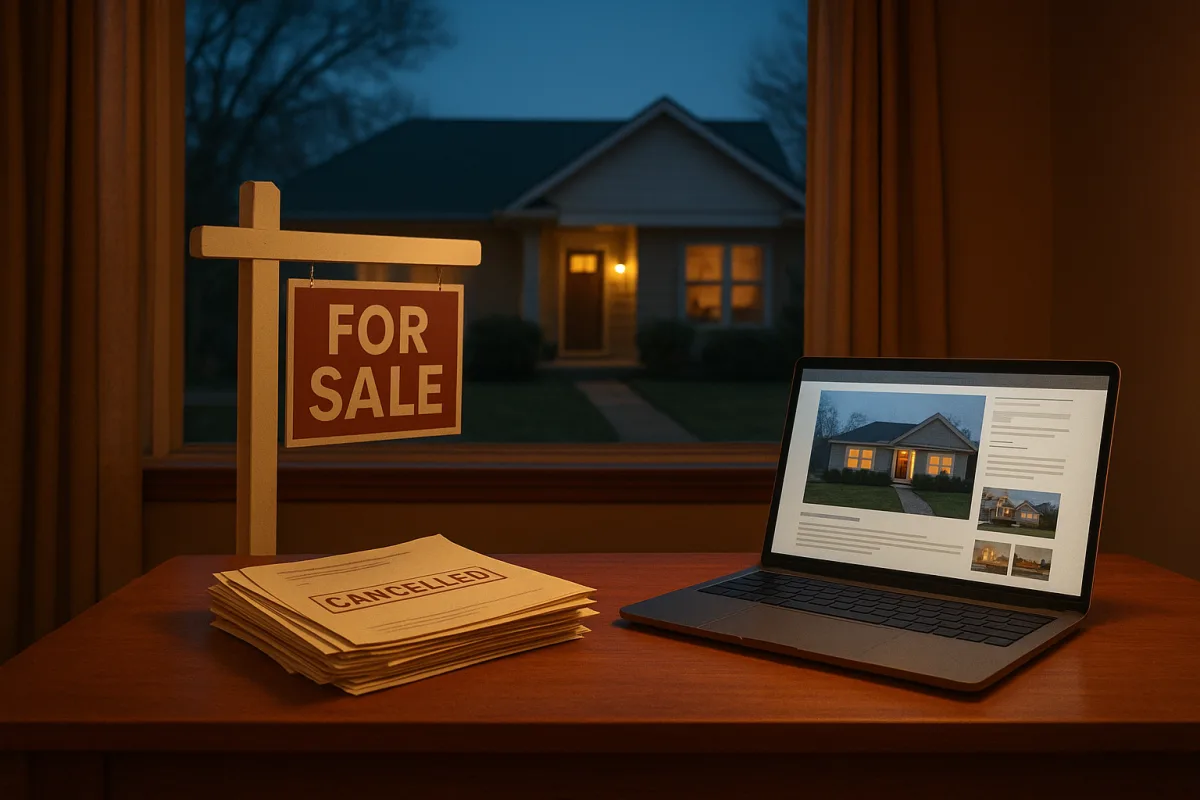
First, confirm that the deal is actually dead
A buyer’s worried phone call, a missed lender update, or a repair dispute is not necessarily a terminated contract. Start by asking for the written notice of termination and reading the purchase agreement’s contingency, notice, and cure provisions.
The practical question is simple: what deadline had passed when the buyer cancelled? Inspection, financing, appraisal, title, and sale-of-current-home contingencies may give a buyer a defined route out, but only if they acted according to the contract.
Homes.com identifies inspection defects, financing trouble, low appraisals, and title problems as frequent reasons pending sales fail. [7] Realtor.com similarly points to appraisal and inspection disputes as problems that can sometimes be saved through negotiation. [9]
Ask your agent or real-estate attorney for a dated timeline showing the offer acceptance date, contingency removal dates, notices received, inspection-objection deadlines, financing deadline, and scheduled closing. That timeline matters more than anyone’s verbal account of why the buyer walked.
Do not authorize a new listing as “active” until you know whether the prior contract has been released. Marketing a property while it remains under contract can create confusion, and potentially a second buyer you cannot yet sell to.
I am not a licensed real-estate agent, lender, or legal adviser. A local attorney or qualified agent can interpret the contract and state rules that apply to your particular transaction.
Find out why the buyer left, before deciding whether to save the deal
Request the buyer’s termination notice, inspection report, repair request, lender denial or financing update if available, appraisal, and title commitment. You may not receive every document, but the available paperwork should shape the next move.
A financing failure is different from a buyer asking for a $7,000 roof credit. If the buyer simply cannot qualify, offering a small concession may not solve the issue. If the lender needs a condition cleared, there may be a narrower fix.
Low appraisals require equally specific math. Suppose the contract price is $420,000 and the appraisal comes in at $400,000. The gap is $20,000, but it does not automatically mean you must cut the price by $20,000.
The buyer might bring additional cash, renegotiate the price, challenge the appraisal with better comparable sales, or leave under an appraisal contingency. Which option is realistic depends on the buyer’s cash, loan terms, contract language, and local market conditions. [9]
Before agreeing to reduce the price, ask whether the buyer is approved to cover any revised down payment and closing costs. A buyer who can bridge a $5,000 gap may not be able to bridge $20,000, especially after inspection repairs or lender-required reserves.
Inspection failures also need to be separated into categories. A buyer may be reacting to a newly discovered safety issue, a large deferred-maintenance expense, or a long report containing ordinary older-home observations that do not justify a major price change.
Kiplinger and HomeLight recommend addressing material inspection issues and reviewing the home’s presentation and pricing after a failed sale. [3][4] The useful response is not “fix everything.” It is to determine which findings would likely concern the next buyer too.
Handle earnest money and escrow without making assumptions
Earnest money is the buyer’s good-faith deposit, typically 1% to 3% of the purchase price. On a $400,000 sale, that suggests a common range of roughly $4,000 to $12,000, although the signed contract controls the actual amount. [10]
Whether you receive that money depends on why and when the buyer cancelled. Homebuyer.com and Nolo both note that buyers generally recover earnest money when they terminate within an applicable contingency period. [10][11]
If a buyer cancels after contingencies have expired and lacks a contractual basis, the seller may have a claim to the deposit. That is not the same as an automatic right to withdraw money from escrow.
The escrow holder usually needs signed instructions or another legally sufficient resolution before releasing disputed funds. Nolo notes that disputed earnest money can remain in escrow while the parties resolve the disagreement. [11]
State practice matters. A Tampa Bay guide notes that Florida generally requires a mutual written release before escrow funds are disbursed. [12] Do not treat that Florida example as a national rule, because escrow procedures and remedies vary by state and contract.
Ask the escrow or title company, in writing, what documents it needs to close its file and disburse funds. Ask your attorney whether signing a release waives any claim you may have, particularly if the buyer’s notice came after a contingency deadline.
Decide whether the original buyer is worth keeping
A failed deal does not always require a full restart. Realtor.com, Zillow as summarized in the research brief, and Kiplinger all frame the choice as a comparison between the failure cause, your time pressure, local demand, and the economic cost of relisting. [4][9]
Consider a repair credit when the inspection identifies a finite, documented problem and the buyer remains financially qualified. A credit can be cleaner than managing work while the buyer’s lender, appraiser, insurer, and closing date are all in motion.
Consider a price adjustment after a low appraisal when the comparable-sales evidence is weak or the buyer’s financing cannot support the original price. Relisting may expose the property to a second appraisal that lands in the same range.
Moving on may make more sense after a financing denial without a credible replacement loan, repeated missed deadlines, or an unresolved title issue. The goal is not to punish a buyer. It is to avoid losing more calendar time to a deal with no workable path.
Your market changes the calculation. In Tampa Bay, 18.1% of pending sales reportedly cancelled in February 2026, the highest rate among 47 metros tracked in that analysis. [12] In a market with elevated cancellations, the next buyer may scrutinize the listing history.
Las Vegas reporting identifies inspection and appraisal contingencies as common routes out of escrow. [14] If those were the reasons your deal failed, be prepared for the next buyer to ask similar questions unless you correct the underlying issue or disclose it clearly.
There is no reliable national figure for how often sellers successfully renegotiate with the original buyer. Treat any proposed rescue as a fresh underwriting decision: what must change, who pays, what deadlines apply, and can the buyer actually close afterward?
Calculate the cost of waiting before you choose a concession
A lower price or repair credit is visible. The cost of relisting is less visible because it arrives in pieces: another mortgage payment, property taxes, insurance, utilities, staging, repairs, and fresh marketing or photography.
Mortgage rates averaged 6.76% as of August 2026, according to Associated Press reporting. [1] That figure is market context, not your rate, but it helps explain why a buyer’s financing can weaken and why carrying an existing mortgage longer can matter.
Your personal carrying cost should use your own monthly numbers. Add principal and interest, taxes, insurance, HOA dues, utilities, and any required upkeep. Then multiply by the number of additional months you can realistically carry the home.
Also check whether you will face a prepayment penalty when the mortgage is eventually paid off. Opendoor notes that some mortgages impose penalties of 2% to 5% of the remaining balance for early payoff, though many loans do not. [8]
Do not confuse normal selling costs with costs caused by the failed contract. Mortgage24U places average closing costs at 2% to 5% of a $420,000 purchase price, or about $8,400 to $21,000, but seller and buyer charges differ substantially by location and agreement. [6]
RentOrOwn.info illustrates the location effect, reporting average closing-cost ranges of about 1.1% of sale price in Missouri and 4.6% in Delaware. [13] Use local estimates from your title company rather than applying either percentage to your own transaction.
If the inspection revealed a problem, obtain a written repair estimate before offering a credit or cutting the price. Typical home inspections cost about $400 to $700 in 2026, according to the research brief, but repairs identified by an inspection can range far beyond that. [6]
Repair the listing’s weak point before it returns to market
Once the contract is formally terminated, review the inspection report, appraisal, title issue, and buyer feedback with your agent. The objective is to separate a single buyer’s preference from a fact likely to affect every reasonable buyer.
For an inspection issue, choose among repair, price adjustment, credit, or disclosure. A pre-listing inspection can help identify defects before a new buyer spends weeks in escrow, and Homes.com and HomeLight recommend proactive inspection work and clear disclosures. [3][7]
If you make a repair, retain invoices, permits, warranties, and before-and-after documentation. If you do not make it, disclose accurately and price with that condition in mind. Concealing a prior issue does not make it less likely to arise again.
For an appraisal problem, ask your agent to review the original comparable sales against new listings, recent closings, square footage, condition, upgrades, and concessions. Do not simply relist at the old number because that was the signed contract price.
Kiplinger recommends comparing the listing price with current comparable sales after a deal fails. [4] A contract price shows what one buyer offered under specific terms, while an appraisal and closed comparable sales reflect a lender’s collateral analysis.
For a title issue, contact the title company or attorney immediately and ask what document, payoff, lien release, probate item, survey issue, or ownership correction is needed. Title defects can delay a replacement contract just as effectively as they delayed the first.
Relaunch quickly, but explain the history accurately
Redfin reported 45,000 homes relisted nationwide in January 2026, a record monthly count. [5] That does not establish a standard relisting timeline, and the research does not provide one, but it shows that sellers often return properties to market promptly.
Promptly should not mean prematurely. A relaunch before the release is signed, before a major repair is scoped, or before title is clear can recreate the same failure with a different buyer.
Update the listing photographs, condition notes, and disclosures if repairs or improvements have been made. HomeLight recommends improving presentation and communicating transparently with potential buyers after a failed transaction. [3]
Prepare a short, factual response for buyer agents who ask why the home returned to market. For example: financing did not obtain final approval, or the prior contract ended after inspection negotiations. Avoid unsupported claims about the former buyer.
If a buyer asks for the old inspection report or appraisal, ask your agent or attorney what may be shared under local rules and your prior agreement. You can describe completed repairs and provide your own documentation without speculating about confidential details.
Finally, reassess the agent relationship using specific questions. Did the pricing analysis reflect current comparable sales? Were deadlines tracked? Was the buyer’s financing strength evaluated? Were inspection objections handled with estimates rather than instinct? [3][4]
The right response depends on your mortgage payment, contract deadlines, local demand, repair facts, and timeline. A seller with strong demand and flexible housing may make a different choice from a seller facing a rate-lock, relocation date, or monthly carrying-cost squeeze.
Frequently Asked Questions
What are the first steps to take if my home sale falls through?
First, confirm that the deal is officially terminated by requesting the buyer’s written notice of termination and reviewing the purchase agreement’s contingency and notice provisions. Identify the reason for failure—such as financing, inspection, appraisal, or title issues—and gather all relevant documents like inspection reports or lender updates. Avoid relisting the home until the prior contract is formally released to prevent confusion or legal complications.
How do I handle earnest money when a home sale falls through?
Earnest money is typically 1% to 3% of the purchase price and serves as the buyer’s good-faith deposit. Whether the seller keeps this deposit depends on the timing and reason for cancellation: if the buyer cancels within a valid contingency period, they usually get the earnest money back. If the buyer terminates without a valid contingency, the seller may be entitled to keep the deposit, but disputes are often resolved through escrow and may require legal advice.
Can I relist my home immediately after a sale falls through?
You should wait to relist until the previous contract is formally released and the property is ready for marketing. Relisting promptly after resolving the issues that caused the sale to fail is common practice; for example, January 2026 saw a record 45,000 homes relisted nationwide. Correcting the original problems—such as pricing or inspection concerns—before relisting can improve chances of a successful sale.
What legal considerations should I know if my home sale falls through?
Legal considerations include understanding the contract’s contingency deadlines and termination clauses, as these determine whether the buyer’s cancellation is valid. Handling earnest money and escrow properly often requires compliance with local laws, which vary by state. Consulting a qualified real estate attorney or agent is important to interpret your contract and state-specific rules, especially before relisting or negotiating with a new buyer.
How do I decide whether to renegotiate or relist after a failed home sale?
Deciding between renegotiation and relisting depends on the reason the sale fell through, local market conditions, and financial implications. For example, financing failures often mean moving on, while appraisal issues might be resolved through renegotiation or a new listing. In a seller’s market, relisting may be advantageous, whereas a buyer’s market might favor renegotiation to avoid additional costs and delays.
How we researched this
This article was assembled from 15 cited references.
Nothing here is based on hands-on testing. Where a figure or finding appears, it belongs to the source cited beside it, and the writing says so rather than implying otherwise. Every source is listed below so you can check it.
Sources
- US home sales weaken to slowest pace in more than a year as mortgage rates, home prices climb
- More home sellers turn into "accidental landlords"
- What to Do If Your Home Sale Falls Through
- How to Set the Price to Sell Your Home
- Relistings Jump as Home Sellers Bet on Stronger Spring Market
- Home Loan Closing Costs Explained: Average Fees in 2026 | Mortgage24U
- Why do pending home sales fall through? Seller risks and solutions - Homes.com
- Why do pending home sales fall through? | Opendoor
- Surprising Reasons Home Sales Are Falling Through—and How Sellers Can Save the Deal
- What is Earnest Money? | Homebuyer.com
- Earnest Money: What Happens When Your Home Purchase Falls Through
- Home Sale Fell Through in Tampa Bay: What Happens Next
- Closing costs by state: a real 2026 range — RentOrOwn.info
- Why Las Vegas Home Sales Fall Out of Escrow — And What Sellers Can Do About It | SeeVegasHomes
- How Often Do Real Estate Deals Fall Through: Rates and Remedies - LegalClarity
Related Articles
Real Estate Contingency: What It Means and How It Works
Learn what a real estate contingency is, common types, deadlines, and how it protects buyers in home purchase contracts.
Home Repairs Before Selling: Prioritize and Budget Smartly
Learn how to prioritize and budget home repairs before selling to attract buyers and avoid costly concessions.

How to Stage a Home for Sale: Essential Tips for Sellers
Learn how to stage a home for sale with practical tips to enhance appeal and attract buyers effectively.

Ben Mallah's Property Restoration Journey: Challenges and Triumphs
Ben Mallah faces challenges post-hurricane, restoring damaged pool with a professional team. Hotel renovations and real estate opportunities unfold amidst trials. Resilience and determination shine in property restoration journey.