
What to Expect During Closing Day: Key Steps Explained
Learn what to expect during closing day, including cash to close, final documents, and key steps to complete your home purchase.
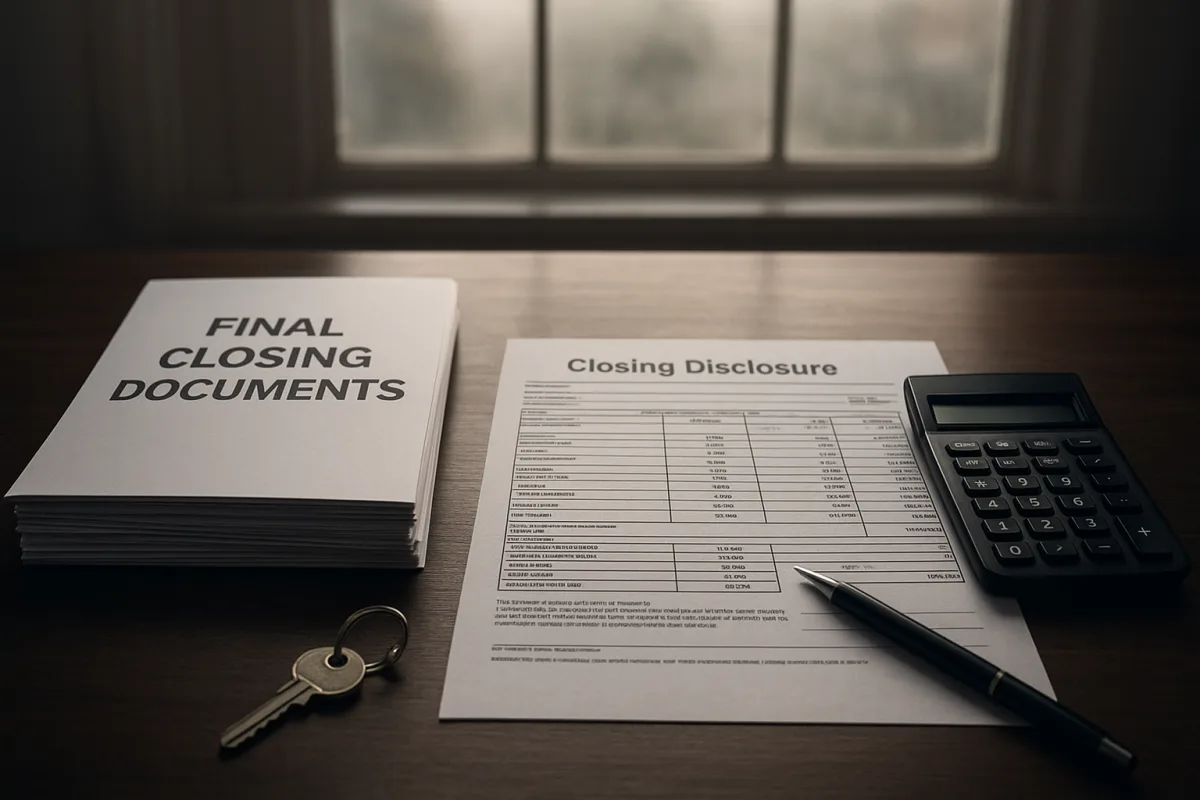
The closing-day number that matters: cash to close
Closing day is often described as a signing appointment. For a buyer, the more useful way to see it is as the final settlement of several separate obligations: purchase price, mortgage proceeds, taxes, insurance, title work, lender charges, and credits.
The number tying those obligations together is usually called cash to close. It is the amount you must deliver to the closing or escrow agent in cleared funds, after the lender, seller, and any credits have each paid their part.
This is not simply your down payment. A buyer putting 10 percent down on a $400,000 home might expect a $40,000 down payment, but the money required at closing can be higher because closing costs and prepaid items are added.
It can also be lower than the down payment plus every listed fee. Your earnest-money deposit is generally credited toward what you owe, and a seller credit, lender credit, or prorated property-tax adjustment can reduce the final amount.
The right figure is the one on your final Closing Disclosure, not an online calculator, a lender’s early worksheet, or the amount you remember discussing when you made the offer. I am not a licensed agent, lender, or financial adviser, but this is the document I would read line by line.
How cash to close is calculated
The basic mechanics are straightforward, even if the paperwork is not. Start with the funds needed to complete the purchase, then subtract the money already credited to you and the money the mortgage lender will provide.
For a financed purchase, the settlement statement effectively combines four buckets: your down payment, your buyer closing costs, prepaid expenses and initial escrow deposits, then credits and deposits that reduce the amount you need to send.
Consider a simplified $400,000 purchase with a 10 percent down payment. The down payment is $40,000. If closing costs and prepaid items total $12,000, the starting amount due from the buyer would be $52,000.
Now assume the buyer already paid a $5,000 earnest-money deposit when the contract was signed. If that full deposit is credited at settlement, the cash-to-close figure falls to $47,000, before any other credits or adjustments.
If the seller agreed to contribute $4,000 toward permitted closing costs, the buyer’s final funds due could fall again, to $43,000. That example is only arithmetic, not a prediction of what any lender will allow or what a seller will agree to.
A lender credit works similarly from the buyer’s perspective, although it often reflects accepting a higher interest rate or choosing a different loan structure. The tradeoff belongs in the Loan Estimate and Closing Disclosure comparison, rather than in a rushed conversation at the signing table.
Why the total is often larger than buyers expect
Nationally, buyer closing costs commonly run from 2 percent to 5 percent of the purchase price, according to Home Buying Brief. On a $400,000 home, that is roughly $8,000 to $20,000, separate from the down payment. [3]
That range contains different types of charges with different purposes. The distinction matters because not every dollar is a fee paid and gone. Some money pays for services, while some funds future bills that will remain associated with the home.
Mortgage-related charges can include origination, processing, underwriting, credit-report, and other lender fees. Third-party charges can include appraisal, title services, title insurance, recording fees, inspections, and, where applicable, attorney services.
Then there are prepaids and escrow reserves. Prepaid interest covers the period from the loan’s funding date to the end of that month. Homeowners insurance may need to be paid in advance, and lenders may collect initial property-tax and insurance reserves.
Those reserves are commonly called an escrow cushion or initial escrow deposit. They are not a purchase-price payment and are not the same thing as the escrow or title company holding the closing funds, even though the same word appears in both contexts.
After closing, the mortgage servicer can use the monthly escrow portion of your payment to pay property taxes and homeowners insurance when due. Whether an escrow account is required depends on the loan and lender requirements.
This is why two buyers with the same price and down payment can bring meaningfully different amounts to closing. Their insurance premium, property-tax calendar, closing date, loan program, negotiated credits, and local charges can all change the calculation.
Location can change the result dramatically
The national 2 percent to 5 percent range is a broad starting point, not a reliable quote for a particular state. Transfer taxes, title practices, attorney requirements, and local recording costs create large geographic differences. [3]
Pulsafi’s 2026 state comparison, for example, puts average closing costs at about $25,500 in New York and about $2,200 in Indiana. Those figures illustrate the scale of variation, not a promise of what an individual buyer will pay. [4]
Transfer taxes are one reason. Sumline notes that Delaware has a 4.0 percent transfer tax, while New York State’s transfer tax is 0.4 percent before any applicable local tax. Who pays a tax can also be negotiated or governed by local custom. [11]
The people running closing also differ by location. Some western and southern transactions commonly use title companies or escrow agents, while buyers in states such as New York, New Jersey, and Connecticut may encounter more attorney involvement. [5]
That variation is a practical reason to ask the settlement agent early: What payment method do you accept, when must it arrive, who must attend, and what identification or local documents do you require? Do not assume another state’s closing routine applies to yours.
The Closing Disclosure is your payment instruction sheet
For most consumer mortgages, buyers must receive the Closing Disclosure at least three business days before closing. Progressive describes it as the document that lays out final loan terms and closing costs before the signing appointment. [9]
Use those three days to compare the disclosure with your Loan Estimate. Focus first on the loan amount, interest rate, monthly principal and interest, cash-to-close figure, and the individual charges that make up the total.
A change is not automatically an error. Prepaid interest changes with the calendar, insurance premiums can change when the policy is bound, and tax reserves can vary based on due dates. But unexplained changes deserve a direct question.
Ask the lender or settlement agent to explain both the dollar difference and the reason. A useful question is: “Which line changed from my Loan Estimate, who receives this money, and is it a fee, a prepaid bill, or a reserve?”
Do this before closing day if possible. The signing table is the wrong place to discover that you are short of funds, that a seller credit was omitted, or that an insurance policy has not been listed correctly.
Nolo recommends bringing proof of homeowners insurance effective on the closing date, with the lender shown as loss payee when required. It also advises bringing government-issued photo identification and, when requested, secondary identification or other transaction-specific documents. [8]
Wiring the money is the highest-risk step
Many buyers pay the final amount by wire transfer, and LegalClarity reports that wires typically arrive the same business day. Cashier’s checks are another common option, but the accepted method and deadline must come from your settlement agent. [5]
Personal checks generally are not accepted for large closing balances. LegalClarity notes that some states or settlement providers may accept small personal checks, often in a range from $500 to $5,000, but that is not something to assume. [5]
Physical cash is generally not accepted for real-estate closing funds. The point is not convenience, it is traceability and compliance. A title company needs verified, documented funds that can be applied to the settlement accurately.
Wire fraud exploits the exact moment when buyers are waiting for instructions. A criminal may send an email that appears to come from a title company, lender, agent, or attorney, replacing the real bank account details with fraudulent ones.
Opendoor’s buyer checklist advises independently verifying wire instructions by phone. [2] Use a phone number from a trusted prior document or the company’s official website, not the number contained in the email that gave you the wire instructions.
Ask the person who answers to read back the bank name, routing number, account number, beneficiary name, and reference information. Confirm the amount separately, since the final cash-to-close figure may differ from a prior estimate.
Do not treat a corrected email, a last-minute request, or a claim that “the account has changed” as routine. Pause and call the known contact. A delayed wire is frustrating, but sending funds to the wrong account can be far worse.
Prepare for the release, not only the signing
A financed signing appointment commonly takes about 60 to 90 minutes, while a cash purchase can take roughly 15 to 30 minutes, according to LegalClarity. [5] The exact duration depends on the documents and local process.
At the appointment, a buyer with a mortgage may sign the promissory note, which is the promise to repay, and a security instrument such as a deed of trust or mortgage. The settlement agent also handles acknowledgments and closing disclosures.
Signing does not always mean you own the home at that exact minute. The settlement agent must confirm the funds, the lender may need to release loan proceeds, and documents may need to be recorded with the relevant government office.
Opendoor says buyers receive keys after funds are confirmed and documents are recorded. [2] Ask in advance whether key delivery will occur at the table, later that day, or after a recording confirmation, particularly if movers are scheduled.
The final walk-through belongs in this preparation sequence because it verifies the condition of the property immediately before settlement. Zillow places it about 24 to 72 hours before closing, and it commonly takes around an hour. [7]
Use it to confirm agreed repairs were completed, included appliances and fixtures remain, and no new damage or unexpected belongings have appeared. If something is wrong, alert the appropriate closing professional before you authorize final documents.
Finally, avoid new debts, large purchases, or new credit accounts before the transaction closes. Changes to debt or credit can affect underwriting, which is why buyers should keep their finances stable until the lender confirms the loan has funded. [13]
Frequently Asked Questions
What does closing day involve for home buyers?
Closing day typically involves a signing appointment where buyers finalize several obligations including the purchase price, mortgage proceeds, taxes, insurance, title work, lender charges, and credits. The appointment usually takes about 60–90 minutes for financed purchases and 15–30 minutes for cash transactions. Buyers also wire their closing funds and review final documents during this time.
How is cash to close calculated on closing day?
Cash to close is the amount a buyer must bring in cleared funds to the closing or escrow agent after accounting for the lender’s mortgage proceeds, seller credits, and any deposits already paid like earnest money. It includes the down payment, buyer closing costs, prepaid expenses, and initial escrow deposits, minus any credits or deposits that reduce the final amount owed.
What documents should I review before closing day?
Buyers should carefully review the Closing Disclosure at least three business days before signing. This document details the final cash to close figure and breaks down all fees, costs, and credits. Comparing the Closing Disclosure with earlier lender estimates helps verify accuracy and avoid surprises at the closing table.
Why can closing costs vary by location?
Closing costs vary widely due to differences in state and local taxes, transfer taxes, title practices, attorney requirements, and recording fees. For example, average closing costs can be about $25,500 in New York but only around $2,200 in Indiana, illustrating how geographic factors dramatically affect the total amount due.
When do I receive the keys during closing?
Buyers receive the keys only after the settlement agent confirms that all funds have cleared and the required recording of documents is complete. This process may not happen immediately after signing, so there can be a short delay before the keys are handed over.
How we researched this
This article was assembled from 16 cited references.
Nothing here is based on hands-on testing. Where a figure or finding appears, it belongs to the source cited beside it, and the writing says so rather than implying otherwise. Every source is listed below so you can check it.
Sources
- It's prime homebuying season - with a caveat
- The Home Buying Checklist: 12 Steps From Financial Prep to Move-In (2026) | Opendoor
- How Much Are Closing Costs for a Buyer? (2026)
- Average Mortgage Closing Costs (2026) | Pulsafi
- How Long Does Signing Closing Papers Take: Buyers vs Sellers - LegalClarity
- What to Expect at Real Estate Closing: Complete Guide 2026
- Final Walk-Through Checklist Before Closing on a Home | Zillow
- Homebuyers: What to Bring to Your Real Estate Closing
- Steps to Closing on a Home | Progressive
- Arizona SB 1479 Effective Sept 12, 2026: Agent Closing Checklist — Inspire Title Team
- Closing Costs by State 2026: Seller & Buyer Fees, All 50
- Closing on a house: Expert advice for homebuyers - Homes.com News
- First-time home buyer mistakes to avoid | Rocket Mortgage
- 10 Common Mistakes People Make When Buying a Home, And How to Avoid Them - Pilmer Real Estate, Inc.
- 10 Costly First-Time Home Buyer Mistakes (and How to Avoid Them in 2026) - The Saward Team
- 3 tips for buyers ahead of a home inspection
Related Articles
Closing Costs: What They Are and How Much to Expect
Learn what closing costs are, typical fees included, and how much you can expect to pay when buying a home.

What Is a Title Search? Understanding the Process
Learn what a title search is, how it works, what it reveals, and why it's essential before buying a home.
Home Warranty: What It Covers, Costs, and How It Works
Learn what a home warranty covers, typical costs, exclusions, and how the claims process works to protect your home systems and appliances.

Prepare for a Home Showing During Winter: Essential Tips
Learn how to prepare for a home showing during winter with tips on snow removal, thermostat settings, and managing wet boots for a safe, inviting visit.