
Home Closing Process: What to Expect During Closing
Learn what to expect during the home closing process, including escrow, inspections, earnest money, and closing costs.
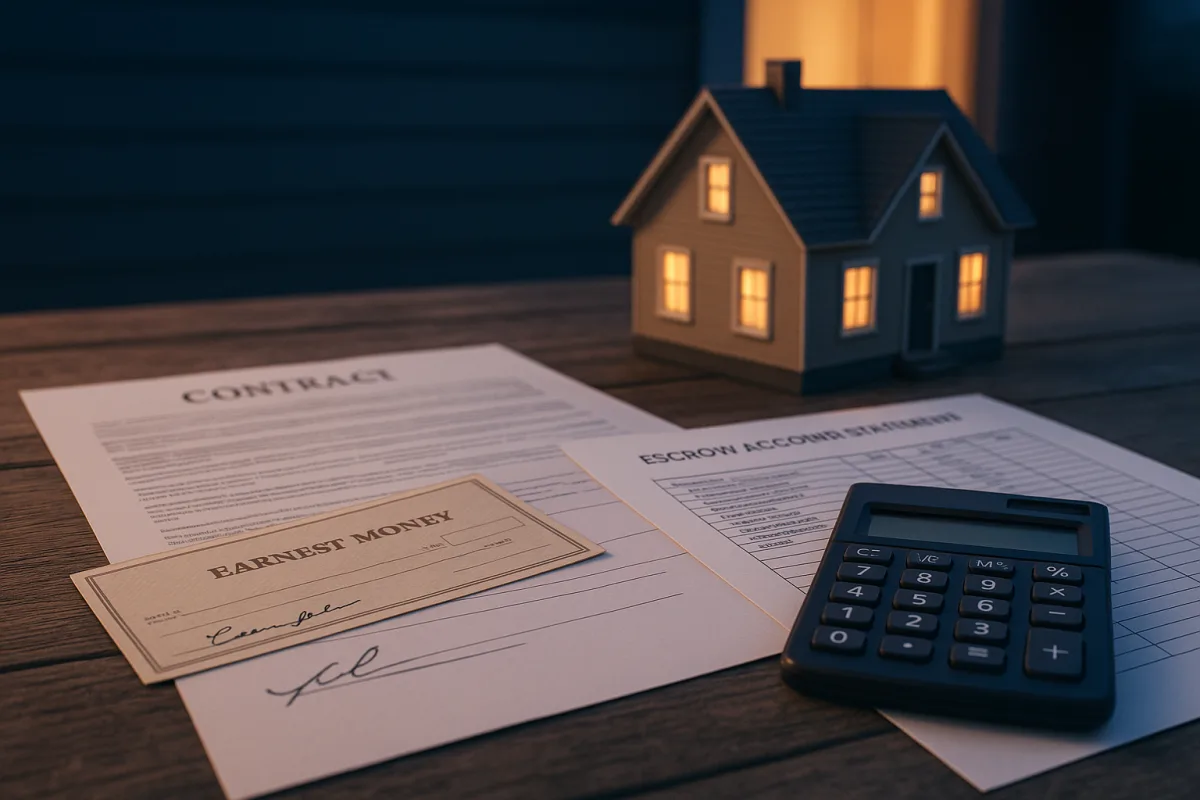
Escrow is the system that turns a signed contract into a completed sale
The central mechanic of a home closing is escrow. It is the controlled handoff of money, documents and legal ownership, with a neutral party holding items until the buyer, seller, lender and title side have met the conditions in the purchase agreement. [3]
That matters because a signed purchase contract does not itself transfer a house. It creates obligations: the buyer must provide funds and obtain financing if applicable, while the seller must deliver clear enough title and meet agreed conditions for transfer. [3][20]
An escrow holder does not decide whether a roof defect is acceptable or whether a buyer got a good price. The holder follows written instructions, releases funds when required conditions are met, and coordinates the document trail that allows recording and disbursement. [3]
Who fills that role depends on location. In many western states, one title company may conduct the title work, hold escrow and coordinate closing. In parts of the East and South, a real-estate attorney may have a larger role in holding funds and conducting closing. [3][15]
That regional variation is more than vocabulary. It affects who sends instructions, who answers title questions, which fees appear on the settlement statement and whether buyers and sellers need their own attorney for a transaction. Connecticut, for example, requires attorney involvement, while California commonly does not. [15]
I am not a licensed agent, lender or financial adviser. The useful preparation is therefore procedural: know what your contract requires, identify the party handling escrow locally, and ask that party or a qualified local professional where each deadline and dollar figure comes from.
The first escrow payment is earnest money, not the whole down payment
After the contract is accepted, the buyer commonly deposits earnest money into an escrow or trust account. LegalClarity describes a typical deposit of 1% to 3% of the purchase price, although the actual amount is negotiated and can vary with the market. [3]
On a $400,000 purchase, that is $4,000 to $12,000. The money is usually credited toward the buyer’s down payment or cash due at closing, rather than becoming an extra charge on top of the purchase price. [3]
The important word is usually. Whether a buyer receives that deposit back if the deal fails depends on the contract, its deadlines and the reason the deal failed, including any inspection, financing or appraisal contingency. [3]
A contingency is an escape clause with rules, not a general right to change your mind. If the agreement permits cancellation after an inspection problem or financing denial and the buyer follows its notice procedure by the deadline, earnest money may be returned. [3]
If a buyer misses a contingency deadline or walks away without a contractual basis, the seller may have a claim to the deposit. The agreement, state law and any dispute procedure control that outcome, so neither side should assume escrow can simply choose a winner. [3]
Sellers should prepare by understanding when the deposit is due and what remedy the contract specifies if it is not delivered. Buyers should retain proof of the wire or other payment and independently confirm wire instructions, rather than treating emailed instructions as self-authenticating.
Escrow waits on evidence, especially inspection, title and appraisal
The deposit starts the process, but escrow cannot close merely because money arrived. A standard financed transaction commonly moves through title work, inspection, appraisal, underwriting, final documents, a walkthrough, signing, recording and disbursement. [3][4]
The home inspection is generally the buyer’s chance to learn about the property’s condition before the contingency expires. A typical inspection costs $300 to $700, according to LegalClarity, and it is separate from an appraisal. [3]
That distinction matters at closing. An inspector evaluates visible condition and potential defects, while an appraisal estimates value for the lender’s collateral decision. An appraisal commonly costs $325 to $1,000. [3]
Buyers may also consider pest, radon or sewer-line inspections where the property or local risk justifies them. These are not one universal national package, and inspector licensing is also state-specific: roughly 35 states require licensing, while California and Colorado do not. [3][16]
For sellers, prompt responses matter because an unresolved inspection request can stall the entire escrow calendar. The choices may include repairing, offering a credit, reducing the price, declining the request or ending the deal if the contract permits it.
An appraisal gap is a separate problem from a repair issue. If a $400,000 contract appraises at $385,000, the lender may base its loan amount on $385,000, leaving a $15,000 difference to address through additional buyer cash, a price change or another negotiated solution.
The actual out-of-pocket cost depends on the loan terms and down payment, not just the raw gap. A buyer already contributing cash may be able to redirect some funds, while another buyer may need new cash, revised financing or a seller concession.
Title work is another escrow condition. A title company generally searches public records for ownership issues, liens or other claims, then helps establish what must be resolved before the deed can be transferred and issues title insurance where purchased or required. [20]
Title insurance is commonly part of the transaction, but it is not universally mandated. The lender often requires a lender’s policy in a financed purchase, while an owner’s policy protects the buyer’s ownership interest and may be recommended even where state law does not require it. [5][15]
The final numbers arrive late, but they should not be a surprise
The Closing Disclosure is the buyer’s near-final accounting of loan terms, monthly payment and cash needed to close. For most covered mortgage loans, it must be received at least three business days before closing, creating a review window before signing. [3]
Compare it line by line with the earlier Loan Estimate and the purchase contract. Look especially at the interest rate, loan amount, points, lender credits, prepaid items, escrow reserves, seller credits, title charges and the final cash-to-close number.
Mortgage points are an upfront lender charge tied to the interest rate, while an escrow reserve is money collected for future property-tax and insurance bills. They can both increase cash due at closing, but they do fundamentally different jobs.
A point is generally expressed as 1% of the loan amount, so one point on a $320,000 loan would equal $3,200. Whether paying it makes sense depends on the rate reduction offered, how long the borrower keeps that loan and available cash, not on the label alone.
Do not confuse the closing escrow account with a mortgage servicer’s ongoing tax-and-insurance escrow account. The first holds transaction funds during the sale; the second, if required by the loan, collects part of each monthly payment for future tax and insurance bills.
Buyer closing costs are commonly estimated at 2% to 5% of the purchase price, though some estimates reach 6%. On the same $400,000 purchase, 2% to 5% is $8,000 to $20,000, before separating out the down payment. [11][12]
Individual line items explain why broad percentages only provide a planning range. Reported ranges include $500 to $2,000 for escrow or closing-agent services, $200 to $400 for a title search, and $50 to $250 for recording fees. [21]
Owner’s title insurance is reported at $500 to $3,500, lender’s title insurance at $300 to $1,000, and transfer or excise taxes from 0.01% to 2%. Which party pays each item is driven by local custom, law and negotiation. [21]
Sellers should likewise treat percentage estimates cautiously. Made For Law puts national seller closing costs at 6% to 10%, while Sellabl.app reports roughly 1.5% in both San Francisco and Cleveland, likely reflecting different treatment of commissions and other categories. [13][23]
That is too large a conflict to smooth over with one national rule. Obtain a local net sheet that states whether commissions, transfer taxes, mortgage payoff costs, repair credits and attorney or title fees are included before using any percentage to plan proceeds.
Prepare for closing day by protecting the timeline
Financing creates the longest stretch of uncertainty because the lender must complete underwriting. Conventional loans average about 41 days, while government-backed loans may take 45 to 60 days; all-cash transactions can close in roughly seven to 14 days. [3][9]
During that period, buyers should avoid financing a car, opening credit, making large card purchases or moving money without records. Those actions can alter debt ratios, cash verification or credit information that the lender needs to approve the loan. [19]
Sellers should keep access available for appraisal, inspections and final walkthroughs, then address agreed repairs or documentation promptly. Delaying a conveyancer or restricting access can compound a small scheduling problem into a missed closing date. [4][24]
A missed date can cost more than inconvenience. Homes.com notes that delays may cause mortgage rate locks, commonly 30 to 60 days, to expire, may trigger seller per-diem charges, and can expose the buyer to a higher available rate. [19]
The current market context may create room for negotiation, but not certainty. The Associated Press reported that sellers were increasingly using price reductions, closing-cost contributions and rate buydowns amid slower conditions, yet the availability of any concession remains local and deal-specific. [1]
Before signing, buyers commonly need photo identification, the Closing Disclosure and mortgage or deed-of-trust documents. The settlement statement and title insurance policy are also among the core records parties should retain after the transaction closes. [14]
The final walkthrough is the buyer’s last practical check that the property is in the agreed condition, included items remain, and required repairs appear completed. It is not a substitute for the earlier inspection, because escrow deadlines may leave little room for a late discovery. [3]
On closing day, parties sign the necessary documents, the buyer supplies verified funds, the deed is recorded where applicable, and escrow disburses money according to the settlement instructions. Keys and possession may follow then or on the separate date stated in the contract. [3][4]
Frequently Asked Questions
What happens during the home closing process?
The home closing process involves fulfilling all conditions in the purchase contract, including providing funds, obtaining financing, and delivering clear title. Escrow coordinates the controlled exchange of money, documents, and ownership once all parties meet these conditions. Buyers and sellers review the Closing Disclosure at least three business days before signing to verify charges and credits.
How does escrow work in a home closing?
Escrow is a neutral system that holds money, documents, and the deed until all contract conditions are met by buyer, seller, lender, and title parties. The escrow holder follows written instructions to release funds and coordinate document recording and disbursement. The specific escrow role varies regionally, with title companies often handling it in western states and attorneys more involved in the East and South.
What are typical closing costs buyers should expect?
Buyers typically pay closing costs ranging from about 2% to 5% of the purchase price, although some estimates go up to 6%. For example, on a $400,000 home, buyer closing costs may range from $8,000 to $20,000 before any seller credits. These costs include fees for title insurance, appraisal, inspections, and lender charges.
When is earnest money paid during closing?
Earnest money is paid shortly after the purchase contract is accepted, usually as a deposit of 1% to 3% of the purchase price. This deposit is held in escrow and credited toward the buyer’s down payment or cash due at closing. Whether the earnest money is refundable depends on contract contingencies and deadlines.
What inspections are required before closing?
While home inspections are a standard part of the closing process, requirements vary by state. About 35 states require home inspector licensing, but some states like California and Colorado do not mandate it. Typical inspections include a home inspection costing between $300 and $700, and an appraisal costing $325 to $1,000, both usually completed before closing.
How we researched this
This article was assembled from 24 cited references.
Nothing here is based on hands-on testing. Where a figure or finding appears, it belongs to the source cited beside it, and the writing says so rather than implying otherwise. Every source is listed below so you can check it.
Sources
- Home sellers are lowering their price and helping buyers to make a deal in a stagnant market
- Portland homebuyers hit the brakes
- Real Estate Escrow: How the Closing Process Works - LegalClarity
- House Closing Process: 15 Essential Steps | Opendoor
- Homeowners: Don't Skip This Protection
- Closing Costs Breakdown: What Buyers Actually Pay (2026) — ProFindr
- Home Buying Process Step by Step (2026) | MortgageCalculatorIQ
- Closing Costs Explained: What Buyers Actually Pay at Closing | MLO Finder
- The Home Buying Process Timeline Explained | Redfin
- What To Expect At A Real Estate Closing | Bankrate
- What are closing costs and how much are they? | Wells Fargo
- Closing Costs Calculator - NerdWallet
- Who Pays Closing Costs Buyer or Seller Cost 2026: Price Ranges & Hidden Fees
- Home Closing Documents Checklist (2026) | Real Estate Ledger
- Closing Costs by State 2026: Transfer Tax and Title Fees
- Home Inspector License Requirements by State
- Closing costs by state: a real 2026 range — RentOrOwn.info
- 10 Costly First-Time Home Buyer Mistakes (and How to Avoid Them in 2026) - The Saward Team
- 7 most common home closing delays (and how to avoid them) - Homes.com News
- What does a title company do? Role, fees, and closing FAQs | Rocket Mortgage
- Escrow Fees Explained: What They Cost, Who Pays, and How They Vary by State (2026) | WhatIsEscrow.com
- Seller Closing Process Workflow: A 2026 Step-by-Step Guide
- Closing Costs Explained: What Buyers and Sellers Pay in 2026 | Made For Law
- It took longer than average to get an offer on my house - these are the 6 selling mistakes I made that I definitely won't be making again
Related Articles
What to Expect During Closing Day: Key Steps Explained
Learn what to expect during closing day, including cash to close, final documents, and key steps to complete your home purchase.

Home Showing Checklist for Sellers: Step-by-Step Preparation
Get a practical home showing checklist for sellers with steps from weeks ahead to showing day to prepare your home effectively.
What Is a Title Search? Understanding the Process
Learn what a title search is, how it works, what it reveals, and why it's essential before buying a home.
Closing Costs: What They Are and How Much to Expect
Learn what closing costs are, typical fees included, and how much you can expect to pay when buying a home.